 When he returned from the Black Hawk War, Lincoln was without any means of employment or income. He briefly considered learning blacksmithing, but he also wanted to further his education, which he acknowledged was sorely lacking. Around this time New Salem resident James Herndon sold his interest in the general store he owned with his brother Rowan to William F. Berry, who had served with Lincoln in the militia. Dissatisfied with Berry, a few weeks later Rowan sold his own share to Lincoln. Berry was the son of a Presbyterian minister from an influential family, so may have paid for his share, but Lincoln’s share was obtained on credit. In 1832, Berry and 22-year-old Lincoln were suddenly partners, store owners, and in debt.
The store came fully stocked with the usual items, just as Offutt’s outfit had been. Mostly they served farmers coming in from the surrounding territory. When another store co-owned by James A. Rutledge failed, Berry and Lincoln quickly scooped up the extra goods. The new products included a barrel of whiskey, which teetotaler Lincoln avoided but Berry proved all too fond of, perhaps explained the store’s lack of profits.
Business was slow, and Lincoln was generally left to operate the store while Berry worked his second job as town constable or was away attending college, which he did at least briefly. The slow pace was perfect for Lincoln, who much preferred entertaining to selling, often sitting by the fire telling humorous stories and jokes to anyone who might wander inside. Everything from the weather to politics was ripe for intense discussion, and Lincoln kept all his visitors enthralled. He freely extended credit to his growing list of friends, which seemed to include everyone who walked into the store.
In early 1833 Berry and Lincoln bought out the inventory of a larger store across the road, as well as the store itself. Here the two men, likely at Berry’s urging, applied for a license to sell whiskey by the glass. Despite the common occurrence of “groceries” (equivalent to what we today call pubs) and widespread alcohol imbibing, Lincoln had to walk a fine line of denial in his debates two decades later with Stephen A. Douglas, who sought to tarnish Lincoln’s reputation.
New Salem had begun to stagnate as a community, in large part because the nearby Sangamon River was not as navigable as hoped. The combination of too much competition, the overstocking of supplies, and inexperienced management by both owners put the business in a bad financial position. In 1834, the store “winked out.” Not long afterward, Berry grew severely ill, most likely from a life of hard drinking, and died. Lincoln was forced to assume the considerable remaining debts of the failed business, which totaled more than $1,000 ($27,000 in today’s valuation). He jokingly referred to this as his “national debt,” and it took him many years to repay.
[Adapted from Lincoln: The Man Who Saved America]
David J. Kent is the author of Lincoln: The Man Who Saved America. His newest Lincoln book is scheduled for release in February 2022. His previous books include Tesla: The Wizard of Electricity and Edison: The Inventor of the Modern World and two specialty e-books: Nikola Tesla: Renewable Energy Ahead of Its Time and Abraham Lincoln and Nikola Tesla: Connected by Fate.
Follow me for updates on my Facebook author page and Goodreads.
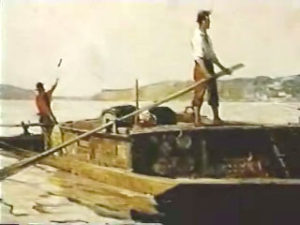 Soon after moving to Illinois, Lincoln made his second flatboat trip to New Orleans. A local entrepreneur and schemer named Denton Offutt approached Lincoln’s relative John Hanks about manning such a journey. Hanks then recruited Lincoln and brother-in-law John Johnston, all of whom now lived in a wooded area west of Decatur near the banks of the Sangamon River. Because of the previous “winter of deep snow,” melting snowpack made the roads impassable by the first of March 1831, forcing the three men to purchase a canoe and paddle down the Sangamon River as far as Springfield, where they expected to find a fully loaded flatboat. Offutt, however, had somehow forgotten to arrange for it.
 The mood in Washington was euphoric. After four long years the war was nearly over. Lincoln had anticipated this ending in his second inaugural address, reminding northerners that they should welcome southerners back into the Union:
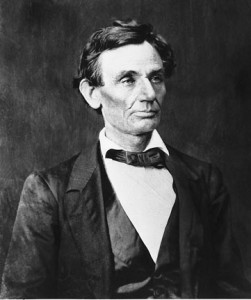 On April 6, 1858, in Bloomington, Illinois, Abraham Lincoln gave his first science lecture on what has become known as “Discoveries and Inventions.” Or maybe he wrote two lectures by that name; the issue is a bit murky.