Abraham Lincoln is everywhere, or so it seems. The Lincoln Sculpture Project Map created by David Wiegers and Scott Schoeder (an LGDC board member) has reached close to 700 sculptures around the world, with new ones being added as soon as they go up. During my recent travels in the Balkans, I went in search of one of the more elusive – and apparently cryptic – statues, in of all places, Skopje, North Macedonia.
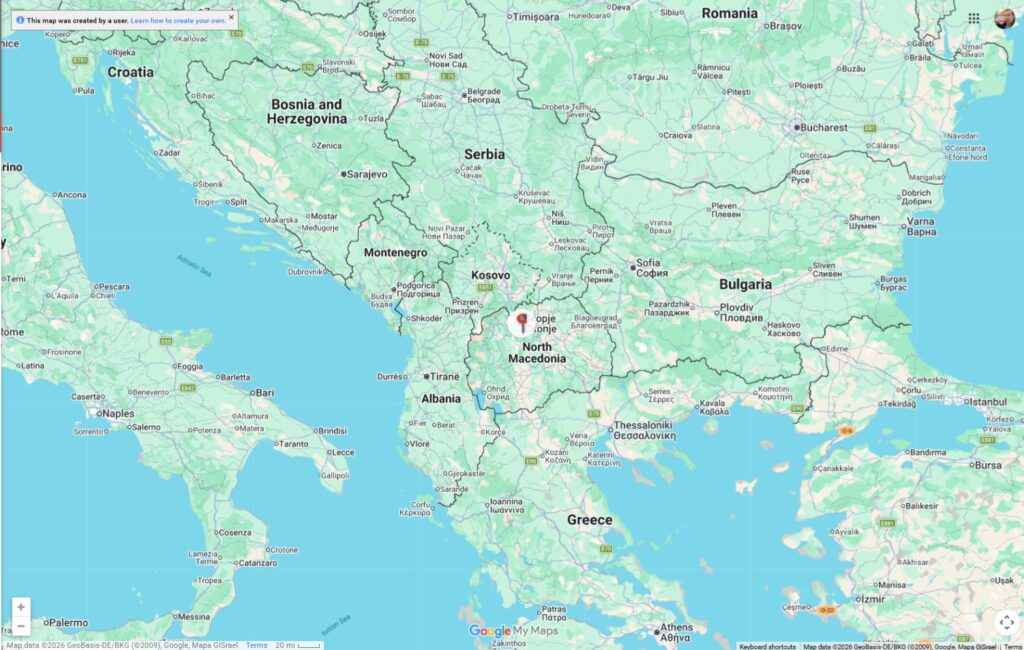
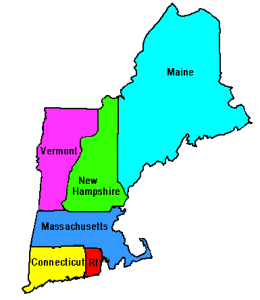
The map above gives you an idea of the area under discussion. That sole red flag designating a Lincoln sculpture is Skopje, the capital of North Macedonia. Like other nations in the region, Macedonia was once part of Yugoslavia following the second World War, then became its own nation during the ensuing split in 1991. A complicated naming dispute with Greece led to the “North” being officially added to the name in 2018. My recent trip took me to Serbia, Bosnia and Herzegovina, Montenegro, Albania, and North Macedonia. It was on the final stop that I eagerly raced through the record heat (highs were generally near or even over 100F the entire time) to find the Ministry of Foreign Affairs and Foreign Trade, a modern building erected during a spurt of growth in 2011-2014.
As part of the design, the government planned to erect dozens of statues on the top and midlevel of this building, as well as the surrounding buildings, the bridges over the river, and the nearby main square. There are statues everywhere. But was there a Lincoln statue?
According to the Sculpture Project Map there is, but they had no photograph, no information on the sculptor, or any other details. My snooping around came up with an article published at the time of the project noting that the statues along the rooftop would include many world leaders, not the least of which were Winston Churchill, George Washington, and Abraham Lincoln. Confirming that became a chore.
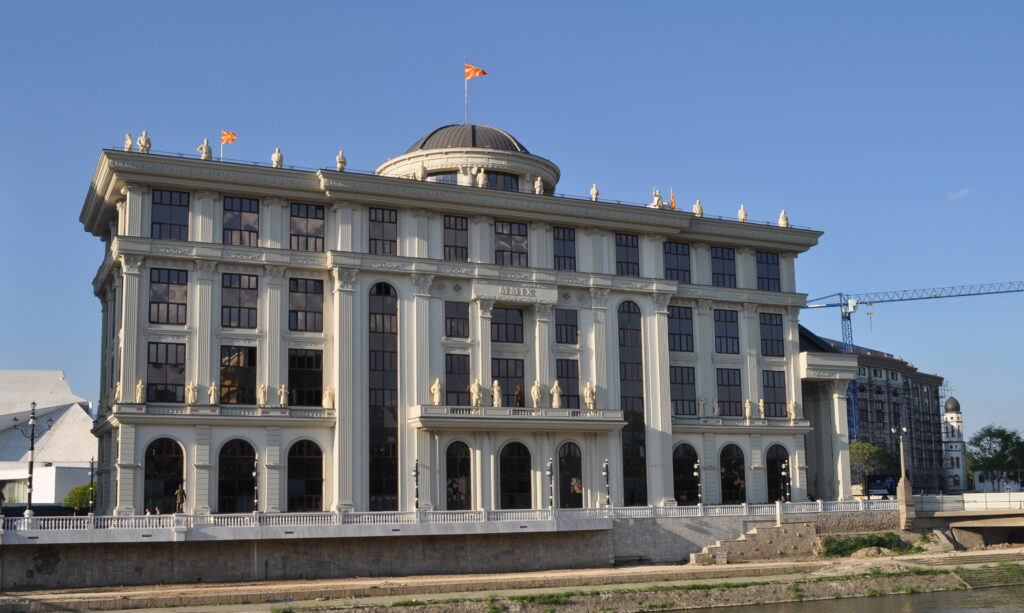
I found the Ministry building easily enough. It was one of several newer buildings dominating the opposite side of the river from the main square, itself dominated by a huge equestrian statue of Alexander the Great (or perhaps not, the story is a bit murky). As you can see, there are many statues at the first level windows, but the Lincoln statue was supposed to be at the roofline where there are even more statues.
Unfortunately, you can’t see any of the roof statues from the lane immediately in front of the building. You have to cross to the other side of the Vardar River to see anything, and only by zooming in from that distance can you make out the roof statues. Making matters worse, the statues are placed around all four sides of the roof, and the back side is particularly difficult to gain access at the proper distance.
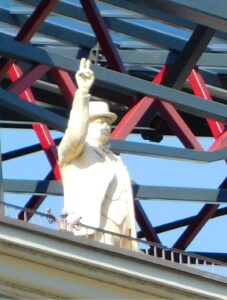 Zooming in further on my photos once I got back home and could enlarge them on my bigger screen, I could easily make out Winston Churchill. I also saw Ghandi. There was one guy who sort of looked like Ulysses S. Grant, but I don’t think it was. And there were plenty of other apparent heads of state over history, some of whom looked familiar but mostly not.
Nowhere did I see George Washington or Abraham Lincoln.
I made some queries on the ground, asking the two gentlemen at the front desk of my hotel. Neither even knew where the building was even though it was only a 10–15-minute walk away. The official tour guide for my group had never heard of any Lincoln statues, and more disconcerting, neither did the city tour guide who took us down to the main square and across the river in the shadow of the building. He did, however, suggest that the project may not have been completed and that its intended effect – sparking a nationalistic fever – didn’t quite work out the way they envisioned (i.e., many thought it a waste of money).
They did seem to finish the “Bridge of Art,” a footbridge crossing the river near the Ministry building. Those thirty-five statues depict distinguished educators, artists, writers, composers, and actors from Macedonia. Skopje is also the hometown of Mother Teresa, and there is a memorial home with its own chapel there for her (she also is featured prominently in other churches in the city). Skopje is a beautiful place to visit, so if anyone else gets there, spend some time looking for Lincoln and let me know if you find him.
Meanwhile, I’ll be in Southeast Asia in the early autumn, and the Lincoln Sculpture Project Map shows there is a Lincoln sculpture in northern Thailand. To paraphrase Sherlock Holmes (and William Shakespeare), “the game is afoot!’
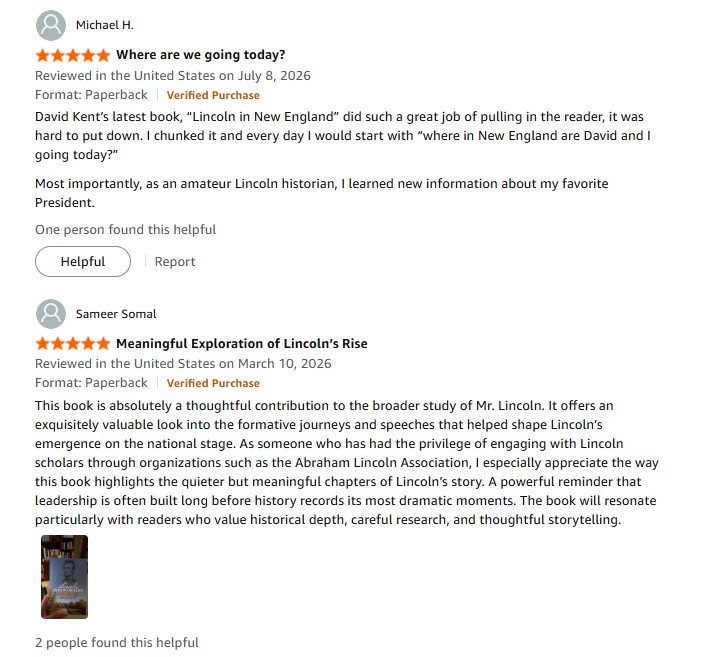
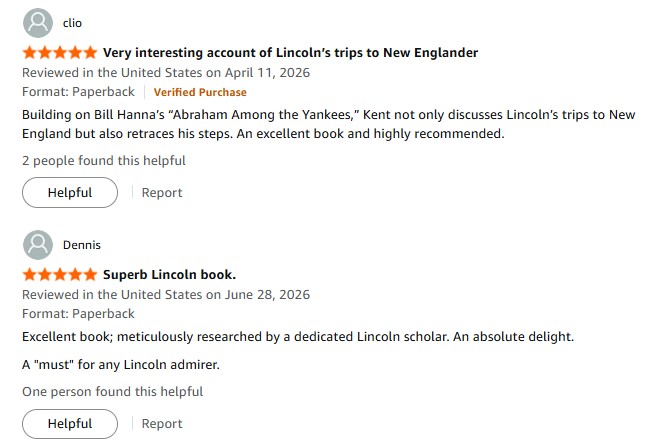
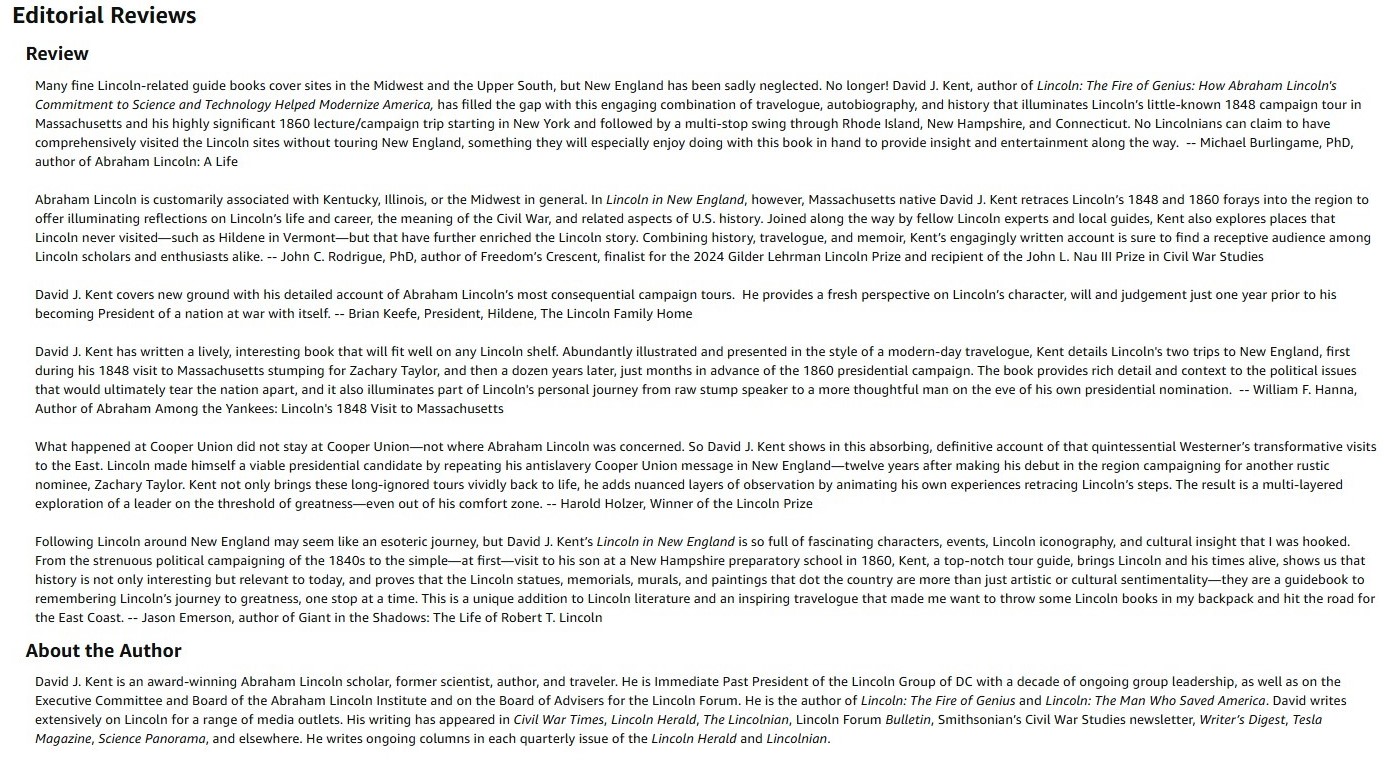
Now Available: Lincoln in New England: In Search of His Forgotten Tours. Or Order directly at:
Amazon Barnes & Noble Books-a-Million Bookshop
Join me on Goodreads, the database where I keep track of my reading. Please leave a review on Goodreads and Amazon if you like the book.
You also follow my author page on Facebook and on Instagram.
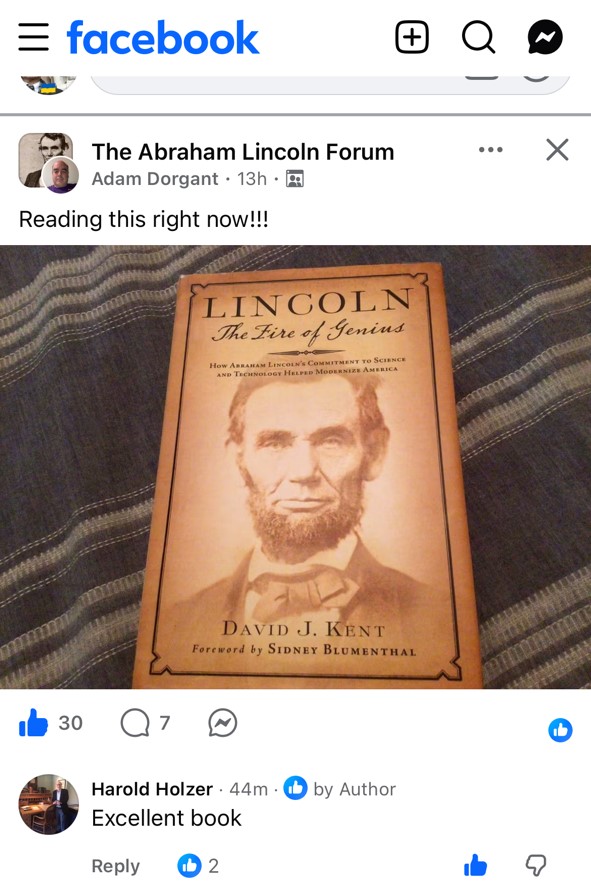
David J. Kent is Immediate Past President of the Lincoln Group of DC and the author of many books on Abraham Lincoln, Nikola Tesla, and Thomas Edison.


 Abraham Lincoln made two separate tours of New England. The first in 1848 helped make him the Lincoln we know as Lincoln. The second in 1860 helped make him president. My most recent book, Lincoln in New England: In Search of His Forgotten Tours, takes the reader on a ride with me as I explore where Lincoln spoke, how the community reacted to him, and how they remember him (if at all). I also delve into the issues that informed Lincoln and the nation.
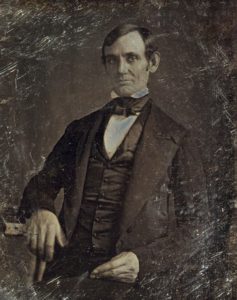 I recently had a new article published in the Winter issue of The Lincoln Herald, a journal published by the Lincoln Memorial University Press. It’s Part 1 of two (the second part will appear in the Spring issue). In September of 1848, Abraham Lincoln was serving his single term in the U.S. House of Representatives. It had been a busy session and by the end of summer he was eager to escape Washington and head back to his day job as a lawyer in Illinois before having to return for the second session of his congressional term in December.
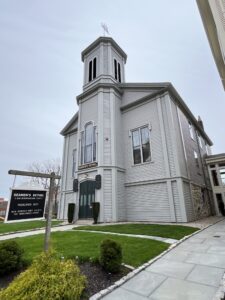 On September 14, 1848, Abraham Lincoln converged on the city of New Bedford, Massachusetts, to campaign for the Whig presidential candidate, Zachary Taylor. On August 14, 2026, Sam Waterston – the eminent actor who often performed Abraham Lincoln’s words in venues across the nation – followed in Lincoln’s footsteps to New Bedford. This time, Waterston was not quoting Lincoln. He was reading an excerpt from Herman Melville’s Moby Dick to commemorate the unveiling of a new statue of Melville on the grounds of the Seamen’s Bethel Chapel in New Bedford.
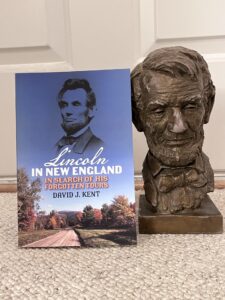 My latest book,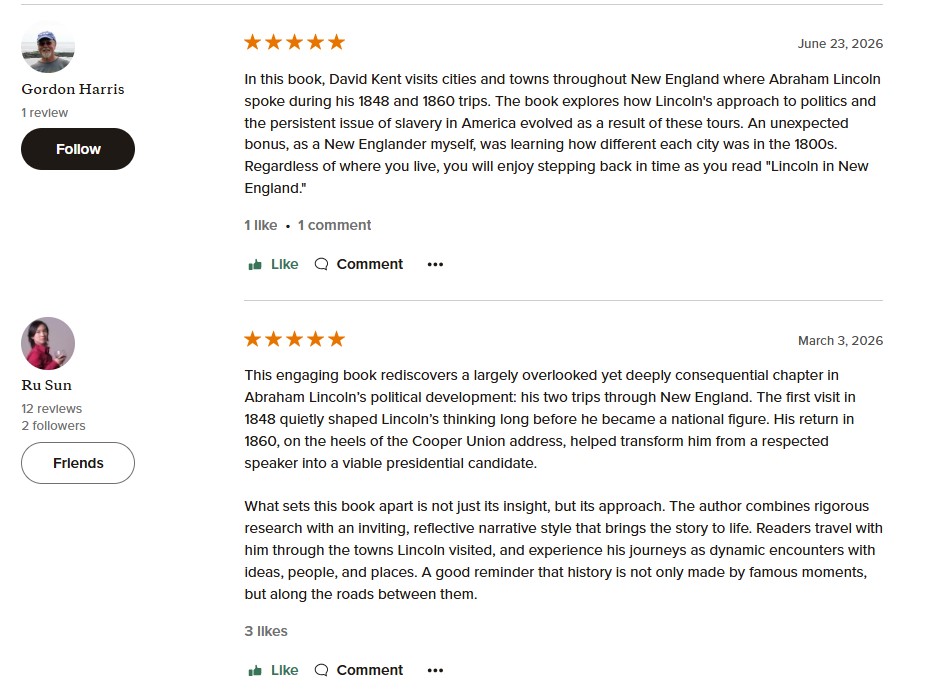
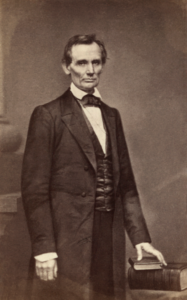 Lincoln’s Whig Party passed on their traditional party leader Henry Clay to nominate General Zachary Taylor as their nominee for the 1848 presidential nomination. Taylor had been the hero of Buena Vista in the recently ended Mexican War, and the public was clamoring for the war hero to be the next commander-in-chief. Lincoln himself spoke out in Taylor’s favor at the Whig convention held in Philadelphia. To balance the ticket featuring the Southern Taylor, the Whigs chose northern Whig Millard Fillmore as the vice-presidential nominee. On July 27, 1848, congressman Lincoln rose in the House of Representative chambers (now Statuary Hall) to address the “presidential question,” i.e., why Taylor would be a good Whig.
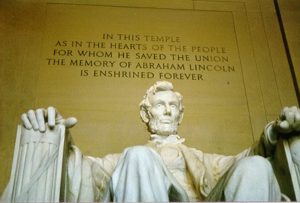 The Lincoln Group of DC (LGDC) is the steward of Lincoln memory in the Washington, DC region and across the country. We recently urged caution on proposed changes to the Lincoln Memorial itself (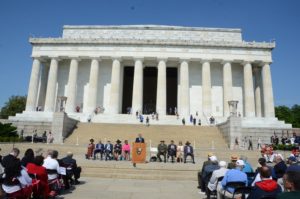
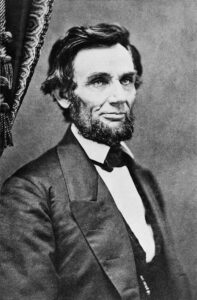 The Republican Party nominating convention was held in Baltimore on June 7 and 8, 1864. Only it wasn’t called the Republican Party that year. It was called the National Union Party.