 It’s been a whirlwind last five weeks as I was traveling through certain parts of Asia, hence the lack of posts for a while. In all, I traversed eight countries (7 and a half if you want to be picky) and saw some amazing places. I’ll write longer on some of the stops soon, either here or in a new “Two Perspectives Travel” site I expect to start up. But here are some highlights.
It seems not long ago I was running around the Balkans, hitting five countries in about ten days. That was followed by a short trip to New England. Then on September 3, I boarded a Turkish Airlines plane that passed through Istanbul on the way to my first destination and country of this version of Asia – Mongolia. I couldn’t even imagine while growing up that I would find my way to the land of Genghis Khan (or Chinggis Khan, as he is better known in his homeland). If I had to take one lesson away from Mongolia, it’s that the country has little infrastructure for handling tourist excursions (although the plane was completely full flying in). There is actually a lot to see, but it’s far between each place bumping along dirt “roads” (really just tire tracks) meandering across the steppe and the Gobi Desert. Ah, but there were camels, and yaks, and huge sand dunes rivaling the better-known ones in Namibia.
After roughly ten days, it was time to leave Mongolia and take an interim week split between Okinawa, Japan and Taipei, Taiwan (plus an overnight stay in the airport hotel in Seoul, Korea, hence the “half”). Okinawa was entirely about seeing the Churaumi Aquarium, one of the few that holds whale sharks (technically, one whale shark). Taipei also held an aquarium stop, number two of the four aquariums I visited on this trip. There was also the Taipei 101 skyscraper and the hike up Elephant Mountain, along with tons of amazing food.
From there it was on to Bangkok, Thailand to start a three-week Southeast Asia tour led by Road Scholar. The first week was split between Bangkok in the south and Chiang Mai in the north. I had been in Bangkok in 2003 and rode an elephant at that time. In Chiang Mai we visited an elephant sanctuary instead, feeding them and even bathing them. And more great food.
The route from Chiang Mai to Luang Prabang, Laos actually took us first back to Bangkok. The high fuel prices caused by the ongoing US war with Iran, combined with the off-season, forced the only Laos airline to go bankrupt, so there were no direct flights. We also flew back through Bangkok from Laos to Cambodia for the same reason. Laos was filled with Buddhist temples (as was Thailand). In contrast, Siem Reap, Cambodia was filled with ancient Hindu temples like Angkor Wat and Angkor Thom, that eventually became dual purpose Hindu/Buddhist sites to keep everyone happy.
Our final week was in Vietnam, split between Ho Chi Minh City (formerly Saigon) and the Mekong Delta in the south and Hanoi and Halong Bay in the north. Both cities provided a bit of historical tension due to the American involvement in what we call the Vietnam War, and they call the American War. Outside Ho Chi Ming City we visited the Cu Chi Tunnels, which were the underground hiding (and it turns out, living) spaces used by the Viet Cong to fight American and allied forces. Up in Hanoi, we visited the Hoa Lo Prison, aka, the “Hanoi Hilton” that held John McCain in captivity for five years, as well as many other American downed airmen. Now a museum, most of the displays focused on its decades of use by the French to hold (and torture) Vietnamese political prisoners. Near the end there were several rooms examining the Americans held there during the Vietnam War. It was both fascinating and more than a little emotional to see the place I had heard so much about from an American perspective. In Hanoi, we also saw the changing of the guard in front of “Uncle Ho’s” mausoleum, which was closed for its annual renovation (as it was when I was there 26 years ago).
One of the highlights of the trip was cruising and spending a night on a boat on Halong Bay, which probably everyone has seen iconic photos of. The Bay and rock outcrops, one of which I hiked to the top of, was much more extensive than I had known. Definitely something that had been on my bucket list and missed during my first visit to Hanoi twenty-six years ago.
We experienced excessive heat the entire trip, mostly in the 90s with heat indexes well into the 100s. We were constantly drenched in our own sweat and struggled to remain hydrated. Even Mongolia had highs around 80, which made the down parka I brought with me particularly useless.
I’ll write more on the trip soon. After catching up on five weeks of backlog, relaxing, and getting my physiology and sleep cycle back into my own time zone, we’ll start planning for 2027 travel.
And be sure to check out the book links below to get your copy of Lincoln in New England:
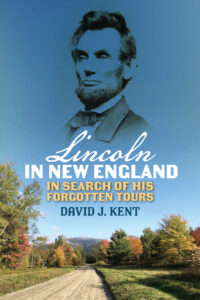
Now Available: Lincoln in New England: In Search of His Forgotten Tours. Or Order directly at:
Amazon Barnes & Noble Books-a-Million Bookshop
Join me on Goodreads, the database where I keep track of my reading. Please leave a review on Goodreads and Amazon if you like the book.
You also follow my author page on Facebook and on Instagram.
David J. Kent is Immediate Past President of the Lincoln Group of DC and the author of many books on Abraham Lincoln, Nikola Tesla, and Thomas Edison.
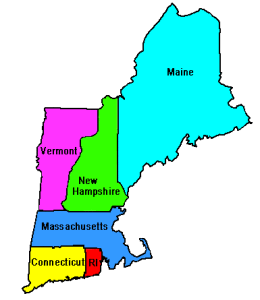 Abraham Lincoln made two separate tours of New England. The first in 1848 helped make him the Lincoln we know as Lincoln. The second in 1860 helped make him president. My most recent book,
 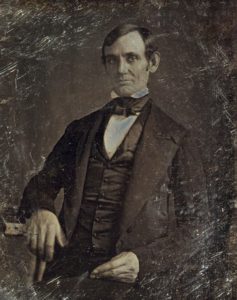 I recently had a new article published in the Winter issue of The Lincoln Herald, a journal published by the Lincoln Memorial University Press. It’s Part 1 of two (the second part will appear in the Spring issue). In September of 1848, Abraham Lincoln was serving his single term in the U.S. House of Representatives. It had been a busy session and by the end of summer he was eager to escape Washington and head back to his day job as a lawyer in Illinois before having to return for the second session of his congressional term in December.
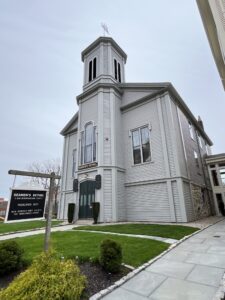 On September 14, 1848, Abraham Lincoln converged on the city of New Bedford, Massachusetts, to campaign for the Whig presidential candidate, Zachary Taylor. On August 14, 2026, Sam Waterston – the eminent actor who often performed Abraham Lincoln’s words in venues across the nation – followed in Lincoln’s footsteps to New Bedford. This time, Waterston was not quoting Lincoln. He was reading an excerpt from Herman Melville’s Moby Dick to commemorate the unveiling of a new statue of Melville on the grounds of the Seamen’s Bethel Chapel in New Bedford.
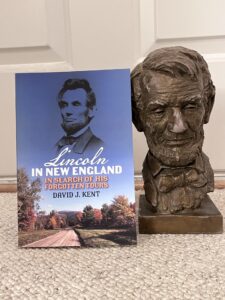 My latest book,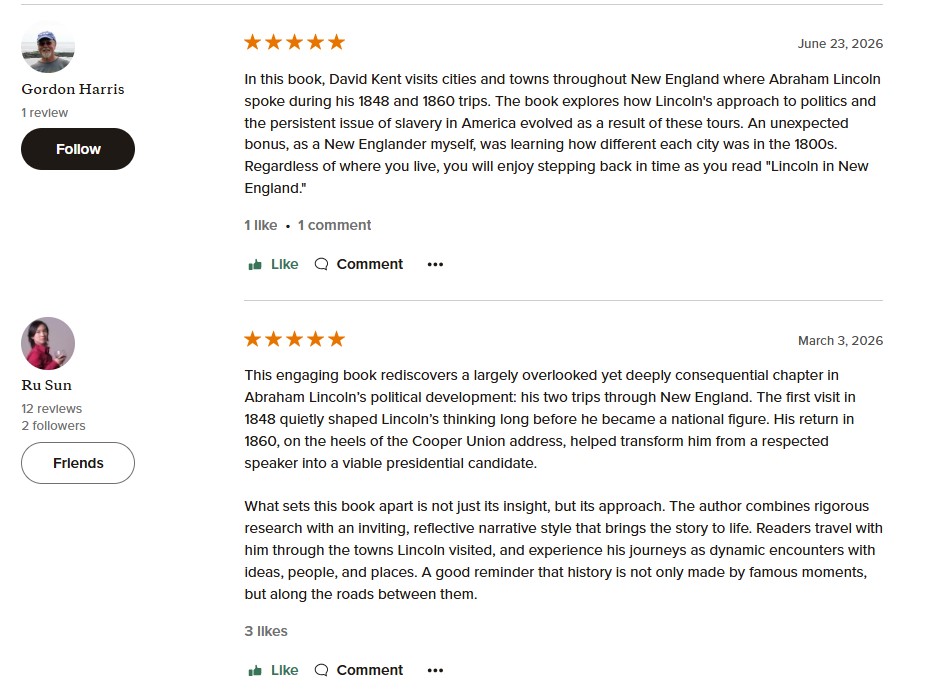
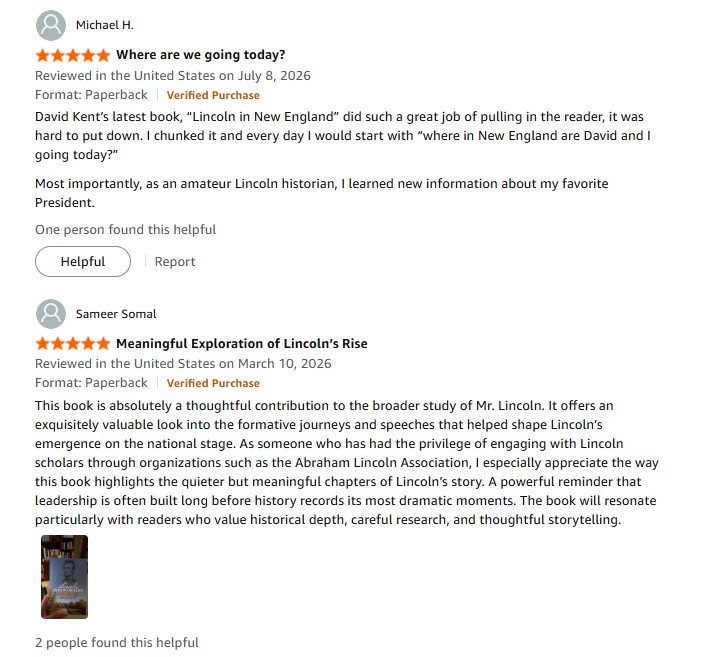
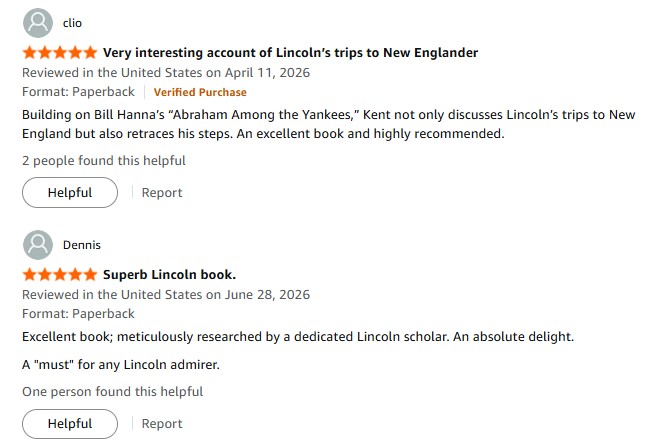
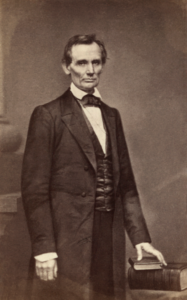 Lincoln’s Whig Party passed on their traditional party leader Henry Clay to nominate General Zachary Taylor as their nominee for the 1848 presidential nomination. Taylor had been the hero of Buena Vista in the recently ended Mexican War, and the public was clamoring for the war hero to be the next commander-in-chief. Lincoln himself spoke out in Taylor’s favor at the Whig convention held in Philadelphia. To balance the ticket featuring the Southern Taylor, the Whigs chose northern Whig Millard Fillmore as the vice-presidential nominee. On July 27, 1848, congressman Lincoln rose in the House of Representative chambers (now Statuary Hall) to address the “presidential question,” i.e., why Taylor would be a good Whig.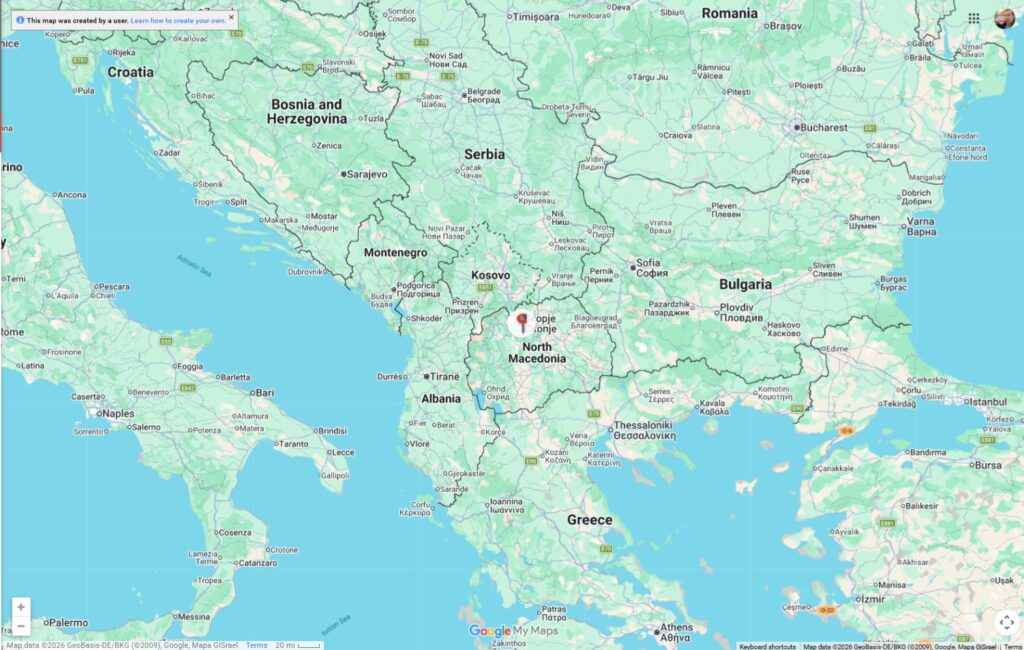
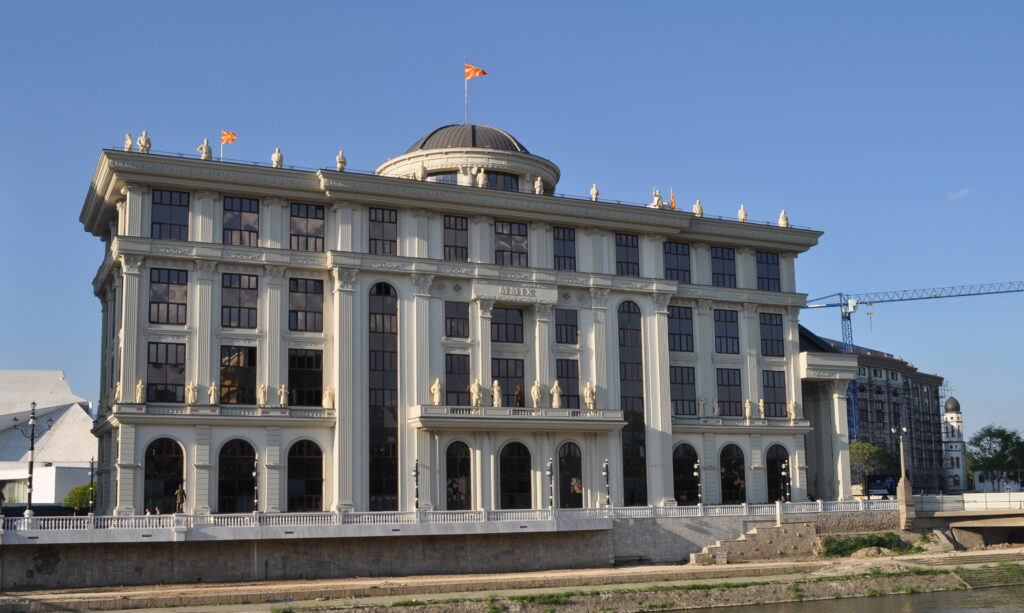
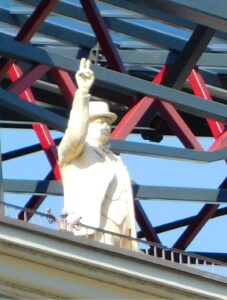 Zooming in further on my photos once I got back home and could enlarge them on my bigger screen, I could easily make out Winston Churchill. I also saw Ghandi. There was one guy who sort of looked like Ulysses S. Grant, but I don’t think it was. And there were plenty of other apparent heads of state over history, some of whom looked familiar but mostly not.
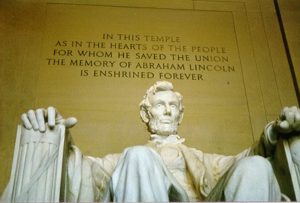 The Lincoln Group of DC (LGDC) is the steward of Lincoln memory in the Washington, DC region and across the country. We recently urged caution on proposed changes to the Lincoln Memorial itself (