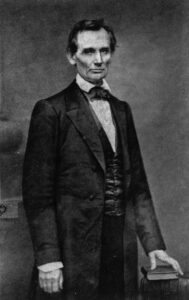
 During his sole congressional term and in his tour of New England in 1848, Abraham Lincoln found out that he has relatives in Massachusetts. After his “spot resolutions” speech, Lincoln was contacted by Massachusetts Whig leader Solomon Lincoln of Hingham. Solomon was about five years older than Lincoln and wrote to Artemas Hale, the Whig congressman for his district. After praising Lincoln’s speech, Solomon added that it was “a source of gratification to those bearing his name to know that the old stock has not degenerated by being transplanted. On the contrary, it exhibits fresh vigor in the fertile soil of the West.” He also asked Lincoln for further information on his family line.
Receiving the message from Hale, an excited Lincoln wrote back with what little information he had on his heritage [misspellings in the original]:
I was born Feb: 12th. 1809 in Hardin county, Kentucky. My father’s name is Thomas; my grandfather’s was Abraham,—the same of [sic] my own. My grandfather went from Rockingham county in Virginia, to Kentucky, about the year 1782; and, two years afterwards, was killed by the indians. We have a vague tradition, that my great-grand father went from Pennsylvania to Virginia; and that he was a quaker. Further back than this, I have never heard any thing. It may do no harm to say that “Abraham” and “Mordecai” are common names in our family; while the name “Levi” so common among the Lincolns of New England, I have not known in any instance among us.
Owing to my father being left an orphan at the age of six years, in poverty, and in a new country, he became a wholly uneducated man; which I suppose is the reason why I know so little of our family history. I believe I can say nothing more that would at all interest you. If you shall be able to trace any connection between yourself and me, or, in fact, whether you shall or not, I should be pleased to have a line from you at any time.
This was Lincoln’s first clue he had relatives that could be traced back to Hingham, Massachusetts. Later researchers would track the family back to Hingham, England, which I will get a chance to visit while drafting this book.
Lincoln continued corresponding with his distant relative. Solomon wrote to Lincoln asking for even more information, which Lincoln responded to on March 24th. He admitted that he had little additional information on his heritage but would “do the best I can.” His grandfather Abraham had, to the best of his knowledge, four brothers: Isaac, Jacob, Thomas, and John. Abraham had three sons, Mordecai, Josiah, and the youngest, Thomas, who was Lincoln’s father. Interestingly, after naming his uncle Mordecai’s three sons and stating that Uncle Josiah had “several daughters,” Lincoln added that his own father, Thomas, “has an only child, myself, of course.” That last bit was true at that moment, but neglects to mention that Lincoln had an older sister, Sarah, who died in childbirth at age 21, and a younger brother, Thomas, who died as an infant just weeks after birth. The omission is especially odd given how close he was to his sister, who stepped in for a time as the mother figure between the time when Lincoln’s mother died and prior to the stepmother’s arrival. Lincoln finished his letter by noting he asked Governor James McDowell of Virginia if he knew any Lincolns there, which set Lincoln on the track of “an old man by the Christian name of David.”
He then traded correspondence over the next few weeks with David Lincoln and determined “there is no longer any doubt that your uncle Abraham, and my grandfather was the same man.” Lincoln happily provided the info about his own family to David as he had done with Solomon, again referring to his own father Thomas and “I am his only child.” Intrigued by what David had told him, Lincoln seemed to have gotten into his head that the family had been Quakers and queried about when he may have emigrated from Berks County, Pennsylvania to Virginia. Like a modern-day genealogist, Lincoln begged for any additional information on his family going farther back in the family lineage. He also promised to call on David if his travels ever brought him close to where he lived. This seems not to have happened.
Lincoln continued to dig into his family tree long after his visit to New England. In 1854 he corresponded with Jesse Lincoln of Tennessee, who was another nephew of Lincoln’s grandfather. He provided what information he knew and queried Jesse for anything additional. Interestingly, Lincoln wrote that Jesse’s “current governor, Andrew Johnson…told me of there being people of the name of Lincoln in Carter County.” Johnson later became Lincoln’s second vice president, then succeed him after the assassination. Even as late as spring of 1860 he was trading letters with Richard V.B. Lincoln, who turned out to be a distant relative in Pennsylvania. In his April 6 letter to Richard, Lincoln said he had previously met Austin Lincoln and Davis Lincoln, two sons of a cousin of his grandfather.
[Adapted from Lincoln in New England: In Search of His Forgotten Tours]
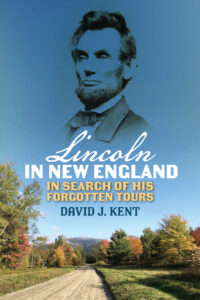
Now Available: Lincoln in New England: In Search of His Forgotten Tours
Join me on Goodreads, the database where I keep track of my reading. Please leave a review on Goodreads and Amazon if you like the book.
You also follow my author page on Facebook and on Instagram.
David J. Kent is Immediate Past President of the Lincoln Group of DC and the author of many books on Abraham Lincoln, Nikola Tesla, and Thomas Edison.
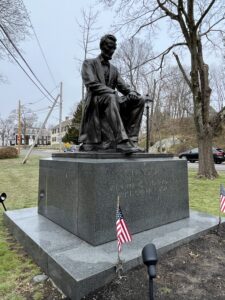 There stands a statue of Abraham Lincoln in Hingham, Massachusetts, New England. It’s immediately across the street from the Samuel Lincoln house. In Hingham, England, United Kingdom there is also a statue of Lincoln. But why? And who was Samuel Lincoln?
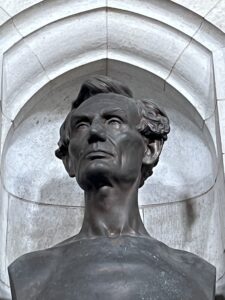 The statue in Hingham, England is actually a bust, not a full statue. It was created based on the life mask of Leonard Volk made in 1860 just after Lincoln’s nomination. It depicts a much younger, beardless (and shirtless) Lincoln. It sits in an alcove on the side of St. Andrew’s Church. The bust was installed in 1919 to commemorate the Lincoln ancestry that had for many generations worshiped at the St. Andrew parish.