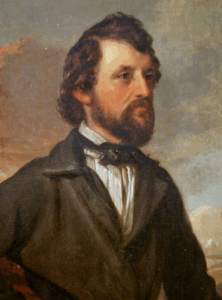
 Abraham Lincoln is best known as the sixteenth President of the United States, long before the POTUS acronym was invented. He was elected in November 1860 and by the time he was inaugurated in March 1861, seven southern states had seceded, with four more joining them just over a month later after the new Confederacy attacked Fort Sumter. But this wasn’t the first time Lincoln had been put forward for executive office. In 1856 he was nominated by his fellow new Republican Party members for Vice President after the party had nominated John C. Fremont for President.
Lincoln didn’t win the final vote at the Republican convention. That went to the William L. Dayton of New Jersey. Lincoln and Dayton were joined by several other prominent figures of the time, such as Charles Sumner, Nathaniel Banks, Henry Wilson (all three from Massachusetts). When the first informal ballot was taken, Dayton led with 253 votes from the delegates to 110 votes for Lincoln. The next closest was Banks with 43. When the first official formal ballots were cast, Dayton had jumped up to 523 and Lincoln was down to 20. That’s not surprising as Dayton was considered the presumptive pick anyway. More surprising is that the one-term congressman who had been out of political office for over seven years was even being considered, no less placing a reasonable second.
Among those surprised to hear the news was Abraham Lincoln himself. When the Chicago newspaper containing the proceedings from the Republican convention held in Philadelphia reached Lincoln on June 20th, Lincoln joked that there must be some mistake. “I reckon that ain’t me; there’s another great man in Massachusetts named Lincoln, and I reckon it’s him.”
Presumably Lincoln was referring to Levi Lincoln, Jr., whom he had met in Worcester, Massachusetts during his visit to campaign for Zachary Taylor in 1848. Levi had been governor of Massachusetts and was Mayor of Worcester when the Whig’s held their state convention that year. Lincoln had gone there not just to promote Taylor, but to convince wayward Whigs who had formed a splinter party called the Free Soilers from accidentally handing the election to the Democrats. How successful he was in that attempt is part of my forthcoming book, Unable to Escape This Toil, but he joined several other prominent men at a dinner party at the Levi Lincoln mansion in the city and subsequently discovered that he and Levi were related through a common ancestor in Hingham.
In any case, Fremont lost that 1856 election so Lincoln wouldn’t have become vice president anyway, which is probably for the best. Four years later he would become the first Republican POTUS.
I’ll have more on Lincoln’s time in New England in future posts. Stay tuned for Lincoln in New England scheduled for release March 3, 2026.
[Photo of John C. Fremont in Public Domain, Wikimedia Commons]
Coming in March 2026: Lincoln in New England: In Search of His Forgotten Tours
Join me on Goodreads, the database where I keep track of my reading. Please leave a review on Goodreads and Amazon if you like the book.
You also follow my author page on Facebook. Also follow me on Instagram.
David J. Kent is Immediate Past President of the Lincoln Group of DC and the author of Lincoln: The Fire of Genius: How Abraham Lincoln’s Commitment to Science and Technology Helped Modernize America and Lincoln: The Man Who Saved America.
His previous books include Tesla: The Wizard of Electricity and Edison: The Inventor of the Modern World and two specialty e-books: Nikola Tesla: Renewable Energy Ahead of Its Time and Abraham Lincoln and Nikola Tesla: Connected by Fate.
 On June 11, 1848, congressman Abraham Lincoln arrived back in Washington, D.C. after having traveled all night from Philadelphia, where he attended the Whig National Convention that nominated Zachary Taylor for president. Upon his return he finds a letter from his wife Mary, who has been visiting her family in Kentucky for several months. These two events begin a campaign and a mystery.