 Abraham Lincoln became nationally famous in large part because of the Lincoln-Douglas Debates, the series of joint political debates between himself and incumbent Senator Stephen A. Douglas in 1858. Lincoln lost that senate race to Douglas, but it positioned him as a potential presidential candidate. The following spring, Lincoln was invited along with other likely presidential contenders to attend an April 1859 dinner in Boston celebrating Thomas Jefferson’s birthday. That may have been a recognition of his minor celebrity status following the debates, but later that year, business magnate and influencer Jesse Fell coaxed Lincoln into providing an autobiographical sketch that was expanded and widely distributed across the country. In addition to enough viability to garner an invitation to give the Cooper Union speech, several of his New England hosts introduced him as presidential or vice-presidential material.
Lincoln’s schedule kept him away from Boston for the 1859 Jefferson birthday event, but he wrote a comprehensive letter to the organizing committee, which was read at the event held in the Parker House in Boston along with similar (but less comprehensive) letters from other prominent Republican politicians unable to attend, including Senator William H. Seward of New York, Governor Salmon P. Chase of Ohio, and Representative Francis P Blair, Jr. of Missouri. Lincoln’s thoughtful letter impressed the attendees.
While Lincoln wasn’t at the Parker House on that occasion, he would have seen it during his 1848 trip to Boston. Campaigning for the Whig presidential nominee of that year, Zachary Taylor, Lincoln stayed at the Tremont House hotel across the street from Parker House, which stands immediately next door to the Tremont Temple Baptist Church where Lincoln and Seward each gave speeches on Lincoln’s last stop of his 1848 campaign swing.
But Abraham wasn’t the only Lincoln to have come across the Parker House. On the morning of November 7, 1861, the first year of Lincoln’s presidency and of the Civil War, Mary Lincoln left New York City where she had been staying and traveled to Boston to visit their son Robert, now at Harvard College. Arriving the same day, Mary took rooms at the Parker House and stayed for several days. Lincoln addressed a telegram to her on November 9 and a band serenaded Mary n November 10, which she acknowledged with a wave of her handkerchief from her balcony room.
The only other time Lincoln himself went to Boston was during his 1860 tour of New England. He didn’t speak in Boston or Massachusetts on that trip but did change trains in Boston on his way from Providence, Rhode Island to Exeter, New Hampshire to see Robert, who at that time was still at Phillips Exeter Academy studying to retake the Harvard entrance exams he had failed the previous year. Needless to say, he passed the second time around, thus his presence in Boston (technically, Cambridge, across the river) to greet his mother in 1861.
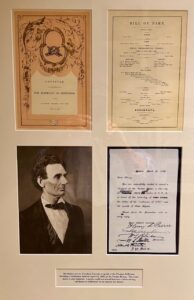
The Parker House remains to this day, now a part of the Omni hotel company. Today there is a display commemorating the Jefferson birthday dinner. It includes the invitation letter sent to Lincoln, a program, the bill of fare for the dinner, and a photo of Lincoln. It’s definitely worth a visit when you’re in Boston. Omni Parker House is conveniently located, a short walk to the Boston Common and the Massachusetts State House.
[Photo compliments of Jeffrey Boutwell]
[Adapted from Lincoln in New England: In Search of His Forgotten Tours]
Coming in March 2026: Lincoln in New England: In Search of His Forgotten Tours
Join me on Goodreads, the database where I keep track of my reading. Please leave a review on Goodreads and Amazon if you like the book.
You also follow my author page on Facebook and on Instagram.
David J. Kent is Immediate Past President of the Lincoln Group of DC and the author of Lincoln: The Fire of Genius: How Abraham Lincoln’s Commitment to Science and Technology Helped Modernize America and Lincoln: The Man Who Saved America.
His previous books include Tesla: The Wizard of Electricity and Edison: The Inventor of the Modern World and two specialty e-books: Nikola Tesla: Renewable Energy Ahead of Its Time and Abraham Lincoln and Nikola Tesla: Connected by Fate.