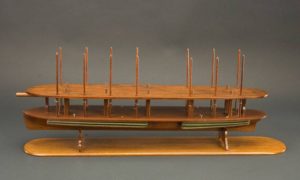
 Abraham Lincoln is the only U.S. president to own a patent. His idea for “an improved method of lifting vessels over shoals” was given Patent No. 6369 on May 22, 1849. The development of the patent stemmed from his personal experience getting his flatboat hung up on the New Salem mill dam and his observation of a steamship run aground in the shallows of the Detroit River passing Fighting Island. He watched as the captain of the steamship Canada ordered his crew to collect “all the loose planks, empty barrels, boxes, and the like which could be had” and force them under her hull to buoy the ship higher in the water. Ever the inquisitive one, Lincoln was enthralled with the ongoing operation. The incident got him thinking seriously about how to solve this particular kind of problem.
Combining his own experiences and some self-study, Lincoln settled on the physics concept of displacement. He probably picked up the basic idea of displacement in his early studies of geometry when preparing to be a surveyor. Displacement in geometric terms is simply the straight-line distance from one position to another. When applied to ships, this translates into the distance a vessel sinks into the water before its weight equalizes with the pressure of the water pushing up. A ship is said to have a certain degree of buoyancy, defined simply as the ability of something to float in a liquid, usually water.
To raise a ship that has run aground, another concept of physics is employed—the Archimedes principle. Archimedes was an ancient Greek mathematician and physicist who lived in the third century BCE. Among his many discoveries, besides deriving an accurate approximation of π (pi), was the principle of buoyancy that bears his name. In his treatise On Floating Bodies, Archimedes states: “Any object, totally or partially immersed in a fluid or liquid, is buoyed up by a force equal to the weight of the fluid displaced by the object.” He supposedly discovered this principle after noticing that the level of water in his tub rose as he got in to take a bath, realizing this effect could be used to determine the volume of any irregularly shaped object. In practice, displacement is the occupation of a submerged body (like the hull of a ship) that would otherwise be occupied by a liquid, or the weight of fluid that would fill the volume displaced by a floating ship. This is measured in tons, which is why a ship’s size is usually referred to in tonnage.
According to Herndon, Lincoln had watched intently how the Canada’s captain used the power of displacement to buoy up the stranded vessel. Empty casks contain air, much lighter than the displacement of water. As additional lighter-than-water materials were placed under the hull, the ship gradually lifted until it was clear of the sandbar. Lincoln recognized intuitively the application of the Archimedes principle, that the objective of underwater vehicle flotation systems was to counteract the weight of the vessel pushing down with some additional buoyancy pushing up. The wooden planks, boxes, barrels, and casks would provide that buoyancy. As Lincoln continued on his way, he undoubtedly pondered deeply the problem of getting stranded vessels afloat. There had to be a better way. Obsessed with the idea, Lincoln decided to invent that better way.
For his design to lift stranded vessels, Lincoln decided on “expansible buoyant chambers placed at the sides of a vessel . . . in such a manner that . . . the buoyant chambers will be forced downwards into the water and at the same time expanded and filled with air for buoying up the vessel by the displacement of water.” Fleshing out his idea to get the design in line with the physics, Lincoln worked with a Springfield mechanic named Walter Davis to build a working model of the device. How much of the model Lincoln himself manufactured is uncertain, but at the very least he fashioned the central pillars. When it was finished, Lincoln showed off the model in “the big water trough at the corner opposite” his office in downtown Springfield. One witness noted that the four-foot model was set afloat in the trough, then forced downward with bricks to simulate a grounding. Lincoln “then applied the air pumps modeled like the old fire bellows, four in number, two on each side that were beneath the lower or first deck and in a few moments, it slowly rose above the water about six inches.” The gathered crowd, although much impressed, was not entirely convinced the device would help open up the Sangamon River for navigation, but they gave him three cheers for the entertainment value.
When Lincoln returned to Washington for another session of Congress, he sought out Zenas C. Robbins, an experienced patent agent, to help navigate the cumbersome patent process. “He walked into my office one morning with a model of a western steamboat under his arm,” reported Robbins. “After a friendly greeting he placed his model on my office-table and proceeded to explain the principles embodied therein and what he believed was his own invention, and which, if new, he desired to secure by letters patent.” Robbins helped Lincoln create the necessary drawings and paperwork, and the patent application was submitted on March 10, 1849.
While the theoretical concept of the invention was simple, the actual mechanism to achieve buoyancy was somewhat unwieldy, as was the ninety-six-word opening sentence of his application:
Be it known that I, Abraham Lincoln, of Springfield, in the county of Sangamon, in the state of Illinois, have invented a new and improved manner of combining adjustable buoyant air chambers with a steam boat or other vessel for the purpose of enabling their draught of water to be readily lessened to enable them to pass over bars, or through shallow water, without discharging their cargoes; and I do hereby declare the following to be a full, clear, and exact description thereof, reference being made to the accompanying drawings making a part of this specification.
His astounding grasp of both the necessary physics and the intricacy of the design is demonstrated in three accompanying figures—a side elevation, a transverse section, and a longitudinal vertical section—that show the placement of the buoyant chambers on the sides of the vessel.
“Each buoyant chamber,” he explains, “is composed of plank or metal, of suitable strength and stiffness, and the flexible sides and ends of the chambers, are composed of India-rubber cloth, or other suitable waterproof fabric, securely united to the edges and ends of the top and bottom of the chambers.” These are in effect inflatable rubber bellows held in place within a strong collapsible frame that can be raised or lowered as needed. “A suitable number of vertical shafts or spars” would be secured to the bottom part of the bellows and to a main shaft passing horizontally through the center of the vessel. Ropes wound around the main shaft would, upon turning, raise or lower the vertical spars, thus inflating or deflating the chambers.
And on he went, describing in great detail every aspect of the system: how the bellows were to be operated, how the devices were attached to the vessel, how the system of ropes and pulleys was used to manipulate the positioning of the spars. Lincoln even considered the scalability of the design such that it could be operated by manpower on smaller vessels or by steam power on larger steamships. He incorporated enough flexibility in the design to cover a range of mechanical arrangements, thus providing broader protection for his patent. What he claimed as his patent was not to be limited by the specific design shown in the drawings, but the “combination of expansible buoyant chambers placed at the sides of the vessel” and a system to deploy them as needed. When finished, “the buoyant chambers will be contracted into a small space and secured against injury.”
Lincoln had used his still growing knowledge of hydraulics, hydrology, mechanics, and construction to successfully develop an application for “an improved method of lifting vessels over shoals.” After submitting the application, Lincoln put his focus back on his responsibilities as U.S. congressman, which included drafting a bill that would have emancipated enslaved people in the District of Columbia if it had passed. A year earlier Congress had passed a new patent law that gave sole power of issuing patents to the commissioner of patents and increased the salaries of examiners to $2,500 per year, thus increasing the professionalism of the office. A law passed the following year moved the patent office from the State Department to the newly created Department of Interior (originally called the Home Department).
On April 13, Robbins wrote excitedly to Lincoln: “It affords me great pleasure to inform you that I have obtained a favorable decision on your application. . . . The patent will be issued in about a month.” On May 22, Abraham Lincoln received Patent Number 6469 from the U.S. Patent Office, the only president ever to receive a patent. A few weeks later, Lincoln recommended his model creator, Walter Davis, be appointed receiver of the Land Office in Springfield. While he had regaled Herndon with his belief of “the revolution it was destined to work in steamboat navigation,” Lincoln made no attempt to commercialize the invention. In truth, the apparatus was probably heavy enough in itself to weigh down the vessel, plus presented a potentially insurmountable array of ropes and pulleys on the deck that might limit room for cargo or crew movement. Still, the overall concept of inflatable chambers or pontoons has been employed in more recent times to raise sunken ships, so there is some merit to Lincoln’s design even if he never promoted it.
The original patent drawings, lost at some point, were rediscovered in 1997 in the patent office director’s office. The original model is stored in the Smithsonian Institution’s vault. A second model, and possibly a third, may also exist. Clark Moulton Smith, who was married to Mary Lincoln’s sister Ann, found the second model in the attic of Lincoln’s Springfield home shortly after his assassination. The model was given to Shurtleff College in Alton but disappeared after the college closed in 1957. In 1864, Adam S. Cameron requested Lincoln’s consent to reproduce the model for the benefit of the Sanitary Commission. Given Lincoln’s prominence, the model was sure to fetch considerably donations that the commission would use to support sick and wounded Union soldiers, according to Cameron. There is no evidence this third model was ever created.
[Adapted from Lincoln: The Fire of Genius]




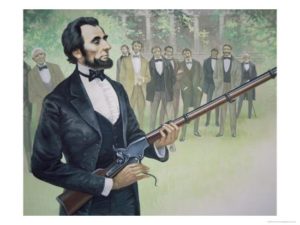 Lincoln’s enthusiasm for mathematics, science, and technology made him a national sounding board for innovations, but he simply could not handle all the inventors pouring letters into his mailbox or showing up at the White House expecting a stamp of approval for their miraculous “war-ending invention.” Unlike today, there was no military-industrial complex developing new weapons during the Civil War. When it came to innovation, the government relied on “the chance, unreliable labors of inventors and amateurs of science” who “literally besieged official Washington after the outbreak of the war.”
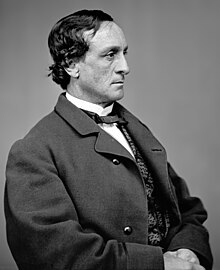 We all know John Wilkes Booth, the assassin of President Abraham Lincoln. And then there was Edwin Booth, the great Shakespearean actor known for his performances of Hamlet. But there was another Booth brother in the acting business, and you won’t believe where he showed up in this edition of Unexpected Lincoln.


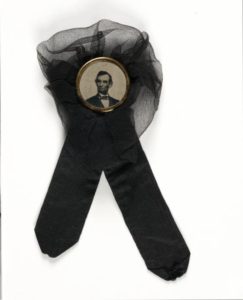 April 14, 1865, had been a busy day for Abraham Lincoln. The previous week he had walked through Richmond, arriving back in Washington to a telegram saying the South’s main army would fight no more. On this Good Friday, Lincoln felt rejuvenated, relieved that the war would soon end and he could focus his second term on reconstructing the Union. The day started with a welcome visit. Captain Robert Lincoln, the president’s son, returned to the city in time to join Lincoln for breakfast. Robert brought firsthand witness to the recent surrender of Confederate General Robert E. Lee to Union General Ulysses S. Grant at Appomattox Courthouse. Many formal interviews later (including with former New Hampshire senator John P. Hale, whose daughter Lucy was later discovered to be secretly engaged to John Wilkes Booth), Lincoln held a cabinet meeting in which he related a recurring dream of a ship “moving with great rapidity toward a dark and indefinite shore.”
 Abraham Lincoln had a busy day, this April 11, 1865. There were meetings, then more meetings, and proclamations (and more proclamations), a pass for his friend, and a request to General Grant. That evening he would give
 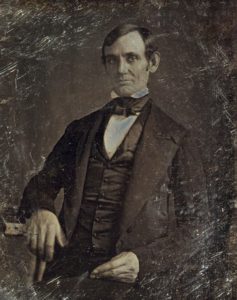 On April 4, 1860, a mere six weeks before he would be nominated as the Republican candidate for president, Abraham Lincoln wins a case formally known as
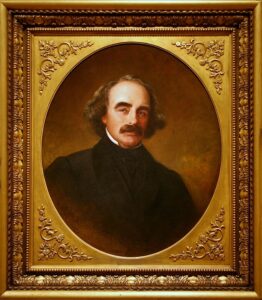 On March 13, 1862, Nathaniel Hawthorne, the great novelist, met Abraham Lincoln in the White House. He was not impressed.