 I’m currently working on a travel memoir of a recent trip to Patagonia. Our first stop was Buenos Aires, where we toured the opera house, visited the cemetery (trust me, it’s the thing to do), and dreamed about Darwin and the giant ground sloths.
Giant ground sloths, you say?
As a scientist and historian I couldn’t help but think of Darwin as we wandered around the capital city of Argentina. I had hoped to get further south to the Mar del Plata Aquarium but weather and circumstances conspired to disappoint me. I took consolation in the knowledge that Charles Darwin, of Origin of Species fame, spent many months in the coastal areas south of Buenos Aires during his five-year voyage on the HMS Beagle. After general wanderings around Rio de la Plata, the estuary of which separates Buenos Aires and Argentina to the south and Montevideo and Uruguay to the north, Darwin headed to Bahia Blanca and Punta Alta. It was in Punta Alta that Darwin really became enamored of his adventurous investigations, which up until now had been mostly at sea during the long Atlantic crossing, and a few forays into the interior of Brazil near Rio de Janeiro and across into Montevideo.
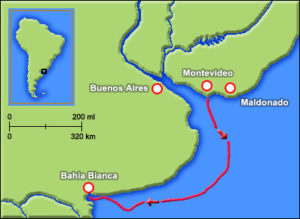 It was also in Punta Alta that Darwin made one of his biggest scientific discoveries. Ranging about the landscape on horseback, sleeping in the open with guachos or staying in haciendas with local ranchers, Darwin stumbled upon the fossilized bones of, well, something. One specimen was “the head of some large animal, embedded in soft rock.” He thought it might be similar to a rhinoceros. It took a second visit several months later – FitzRoy and his crews were busy mapping up and down the coastline – to realize he had discovered a large number of large mammal fossils not previously known from previous scientific expeditions to Europe, Asia, or Africa. In all he found nine different types of “great quadrupeds.”
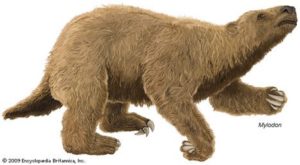
Dutifully shipping the fossils with the thousands of other samples collected to various collaborating scientists in Europe, these large mammal fossils ended up via a circuitous route in the hands of French scientist Georges Cuvier. Cuvier determined that these were the bones of what became known as giant ground sloths, some as big as elephants, which roamed widely in the ancient North and South American plains. Cuvier named the huge beast Megatherium, which is, appropriately enough, derived from the Latin for “huge beast.”
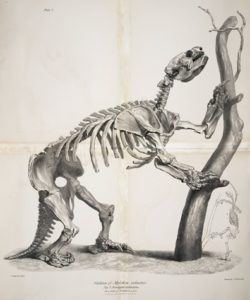 Here is where the plot thickens. While Cuvier was working up his paper describing and naming Megatherium, workers in what is now West Virginia dug up some old bones and sent them to Virginia’s biggest paleontological expert, who just happened to be Vice President of the United States, Thomas Jefferson. Jefferson named these new bones Megalonyx jeffersonii, meaning “giant claw” (the jeffersonii species name is an affectation that many discoverers take when naming their new species). These too turned out to be giant ground sloths. Meanwhile, Darwin was digging up even more sloth species. Many of these ended up in the Museo Municipal de Ciencias Naturales “Carlos Darwin,” set up in Punta Alta by modern day Argentinian geologist Teresa Manera.
Why is the museum called Carlos Darwin instead of Charles Darwin, you might ask? The museum was established in the late 1990s, not long after the Falklands War. The Falkland Islands, known in Argentina as the Malvinas Islands, were a disputed territory off the coast of Argentina. The British had claimed them many years before and engaged in a war to protect their claim when Argentina tried to get them back. Not surprisingly, the museum wasn’t too keen on recognizing the English at the time so they used the Spanish form of Charles – Carlos – instead. Teresa Manera and her husband, by the way, also discovered giant ground sloth footprints on a beach near there and has been trying for decades to get it made a UNESCO World Heritage Site.
Darwin wasn’t finished in South America, of course; the Beagle gave him plenty of time to explore Patagonia, both in Argentina and Chile. My own travels in Patagonia included climbing up to the base of Cerro FitzRoy, the mountain in the lower Andes named after the Beagle‘s captain, with whom Charles Darwin spent five years living in a cabin not much bigger than a closet.
Meanwhile, our time in Buenos Aires was quickly coming to an end and we were headed out to Bariloche to start our big adventure. Darwin would make more appearances along the route.
For previous articles about Buenos Aires and Patagonia, this post is a good place to start.
David J. Kent is an avid science traveler and the author of Lincoln: The Man Who Saved America, now available. His previous books include Tesla: The Wizard of Electricity and Edison: The Inventor of the Modern World (both Fall River Press). He has also written two e-books: Nikola Tesla: Renewable Energy Ahead of Its Time and Abraham Lincoln and Nikola Tesla: Connected by Fate.
Check out my Goodreads author page. While you’re at it, “Like” my Facebook author page for more updates!
Follow me by subscribing by email on the home page. Share with your friends using the buttons below.
 This is Science Traveler, right. So let’s begin with some recent travel posts. I recently returned from a tour of “Lincoln’s Illinois” where I visited Lincoln’s home in Springfield, his earlier village of New Salem, and several other Lincoln related venues. I even got to hear songs Lincoln listened to on the very piano on which he heard them played. Here are
 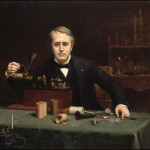 Another major event this year was the release of my new book, Edison: The Inventor of the Modern World. This set up a competition, of sorts, between
 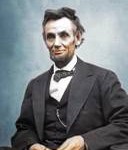 In addition to the travel out to Illinois, I’m currently working on a new book for the same publisher as Edison and Tesla on, you guessed it, Abraham Lincoln. That book will be released some time in the summer of 2017. Recently I wrote about the progression from
 Hot White Snow
 The Dake Page
 Of course, here on
  But wait, there’s more. I also received my first advance copy of
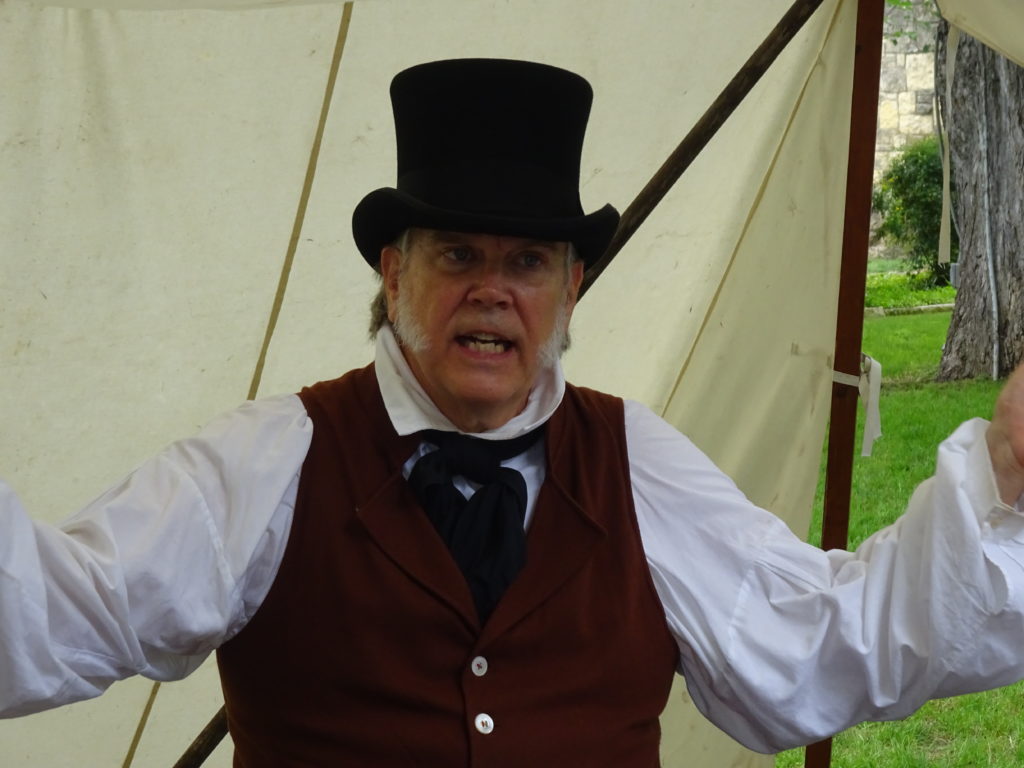
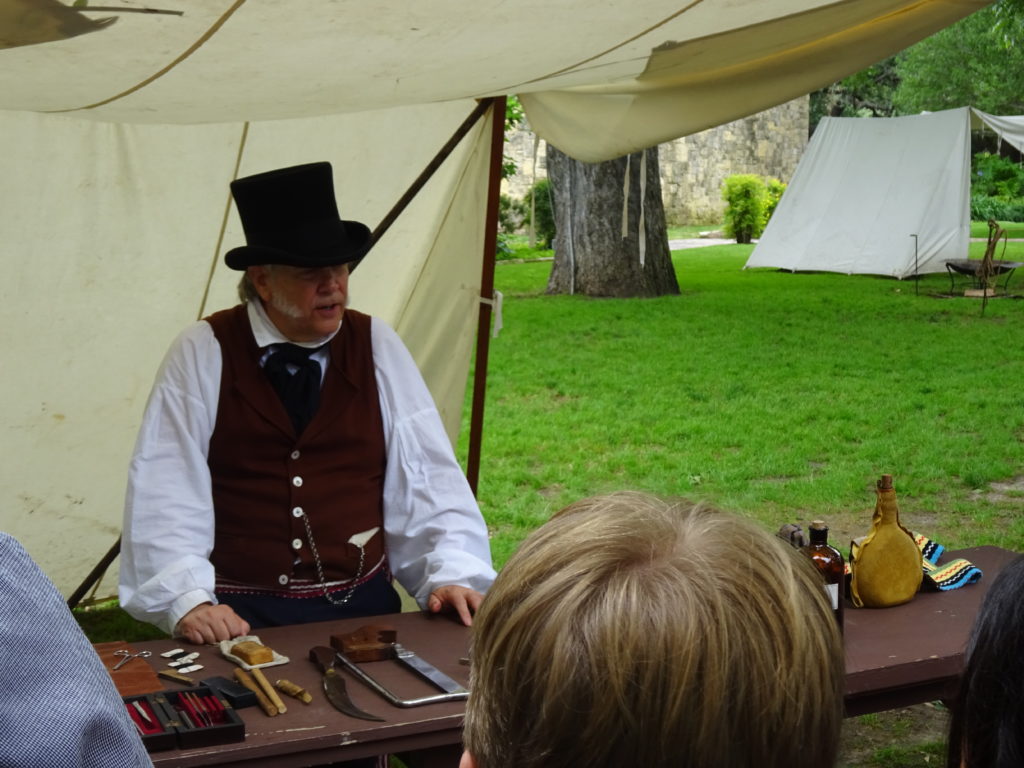 The good doctor regaled us with stories of the medical practices of the day. You can see the hacksaw on the table used for amputations. There are also leeches for bloodletting, stiff brandy for medicinal painkilling, and a variety of other instruments that range from precursors of today’s instruments to objects that seemed more appropriate for the Marquis de Sade.
 Hot White Snow
 The Dake Page
 Science Travele
 Renowned author Simon Winchester has written a wonderful book about a scientist most people have not heard about, but should have. Joseph Needham was a biochemist, nudist, socialist-leaning British scientist at prestigious Cambridge University. He was devoted both to his wife and his mistress, the latter of whom was a visiting Chinese scientist who introduced him to the culture he would obsessively love and study the rest of his life.

 The Dake Page
 Here on
  On
On  There was a lot more, so click on the blog names above and scroll down to see other articles of interest.