The Year in a Traveler’s Life – 2025

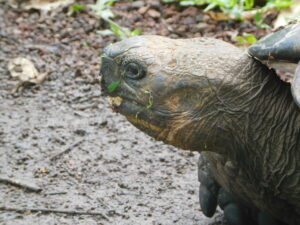
Galapagos Giant TortoiseIt’s time for my annual Year in a Traveler’s Life even though I’m not quite done traveling for the year. You can read about 2024 year here and follow the links to previous years.

I repeated my pattern of the last few years by starting off slowly. The first quarter of the year is usually kept close to home to meet Abraham Lincoln-related obligations, including the Lincoln Memorial birthday wreath laying and various Lincoln Group of DC events. March is always tight because of the Abraham Lincoln Institute Symposium held at Ford’s Theatre, which I always attend and often have introduction duties (and in 2023 was a speaker). I also was locked in front of my computer most of the spring writing Lincoln in New England: In Search of His Forgotten Tours, which is scheduled for release March 3, 2026.

April got things rolling with a road trip. The previous two years I had road tripped around New England doing research for the book. This year took me through upstate New York on my way to Vermont to attend the very first Lincoln Forum Spring Conference at Hildene, the Robert Lincoln family home in Manchester. I drove from DC up to Westfield, NY to see the statues of Lincoln and Grace Bedell, the 11-year-old girl who had written Lincoln to encourage him to grow “whiskers.” From there it was on to Buffalo for two Lincoln statues, with a quick trip over the border to Canadian Niagara Falls for the Tesla power plant (which caused some consternation with the border agent who couldn’t understand why I had driven from Virigina to spend only three hours in Canada). Next was over to Rochester for Lincoln-Frederick Douglass, around two finger lakes an on to Seneca Falls for the women’s voting rights exhibits, to Auburn for the William Seward house, to Syracuse for two Lincoln statues, and finally on to Hildene.

The rest of the spring I was writing, with a day trip to tour Rock Creek Cemetery in Washington, DC with the Lincoln Group’s ace tour guide, Craig Howell. I also joined Craig for a tour of Congressional Cemetery in October, where I got my own 15 minutes of fame touting the history of Alexander Dallas Bache. On May 30, I submitted my manuscript to the publisher!

July began a whirlwind of overseas travel. An invitation to a wedding at Oxford University provided a great excuse for the UK road trip we had been talking about for a long time. A flight to Edinburgh gave a few days in Scotland before renting a car (manual shift, left side of the road) to wiggle down through England and Wales over several days before the wedding. Mostly the trip was guided by locations of Lincoln statues, necessitating stops at an old novitiate, Manchester (I’ve been in Manchester cities in multiple states and countries now), Newport (Wales), and Bath. One of the greatest thrills was a stop along the English/Welsh border to visit the home of a famous sculptor whose double-faced Lincoln bust is one of the most unique in the world. I then had to convince the people at the American Museum and Gardens in Bath that they also had a copy, which I eventually talked the one person who knew about it into showing me in the private spaces not open to the public.

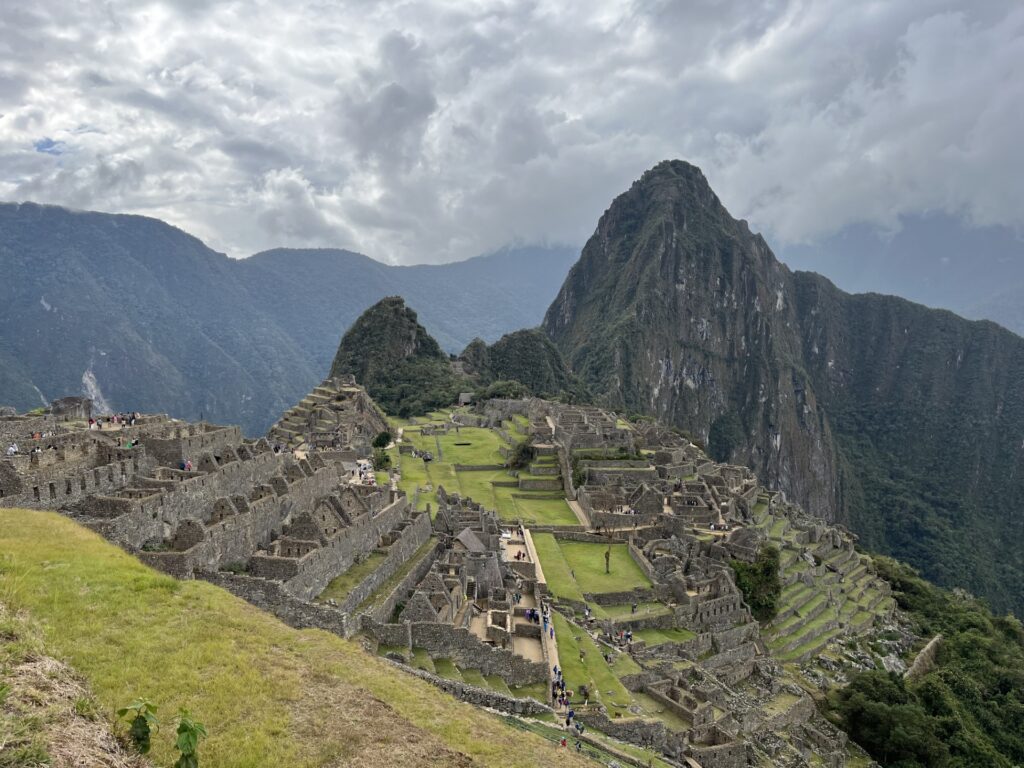
The following month really got things going. In mid-August we flew to Lima, Peru to start a Road Scholar tour. From Lima it was on to Cusco, the Sacred Valley, and Machu Picchu, where we climbed up to the terraces to get the ubiquitous photograph before hiking through the city itself. Luckily the altitude (up to 12,000 feet in Cusco) didn’t cause too much of a problem. Then it was on to Quito, Ecuador before flying out to the Galapagos Islands for a week on a boat hopping around between eight islands. Every perfect day involved a hiking trip to see birds, iguanas, sea lions, and more, plus also a snorkeling and/or kayaking trip to see them all underwater. Snorkeling with huge green sea turtles and kayaking with playful sea lions has been on my bucket list since my early marine biologist days.

The fall was busy but domestic. I attended a Lincoln statue dedication at the African American Civil War Museum in DC in September, then in November make my annual trek up to Gettysburg for the Lincoln Forum Conference, followed a week later by a longer road trip up to Massachusetts for Thanksgiving with family.

But the travel isn’t over for year. I have one short jaunt out of the country relaxing in the Bahamas over Christmas.

Which gets me to 2026.

Spring 2025 was writing Lincoln in New England, so Spring 2026 is promoting it. I have several speaking gigs already arranged and more in process, both in New England and in the DC area, that will keep me busy for several months after the March 3 release. I may go out to Springfield, Illinois for the Abraham Lincoln Association birthday symposium in February, but almost certainly will be in Illinois in June. I will definitely be in Vermont the first weekend of May as I will be on the program of the 2nd Lincoln Forum Spring Conference at Hildene. More info on that here soon.

Beyond that, I am booked on a long overseas trip that will take me first to Mongolia in September, led by a friend of mine who arranges cool trips every year. Four days after that ends I’ll start a Road Scholar tour of Southeast Asia covering Thailand, Laos, Cambodia, and Vietnam. I’m obviously not coming back to the states in between, so will be adding in a short trip, probably to Taiwan.

November will take me back to Gettysburg for the Forum. I’m sure I’ll squeeze in other shorter, domestic trips during the year, with spots like Philadelphia, New York City, Pittsburgh, and West Virginia high on my “go to” list next year. We’ll see if I hit the 5 new countries goal. I might not, since I’ve already been to Thailand and Vietnam. Still a lot of places I want to go.

I’ll have my annual Year in the Writer’s Life post up shortly before New Year’s.

[Photo of Giant Galapagos Tortoise, David J. Kent, 2025]
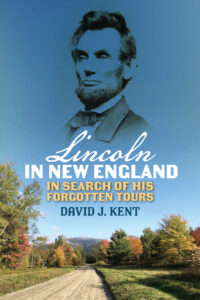
 

Lincoln in New England book cover

Coming in March 2026: Lincoln in New England: In Search of His Forgotten Tours

Also see – Lincoln: The Fire of Genius: How Abraham Lincoln’s Commitment to Science and Technology Helped Modernize America.

Join me on Goodreads, the database where I keep track of my reading. Please leave a review on Goodreads and Amazon if you like the book.

You also follow my author page on Facebook and on Instagram.

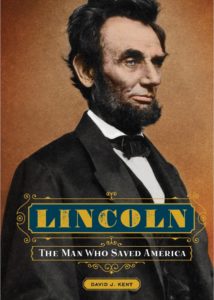
David J. Kent is Immediate Past President of the Lincoln Group of DC and the author of Lincoln: The Fire of Genius: How Abraham Lincoln’s Commitment to Science and Technology Helped Modernize America and Lincoln: The Man Who Saved America.

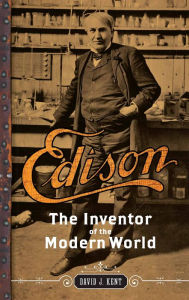
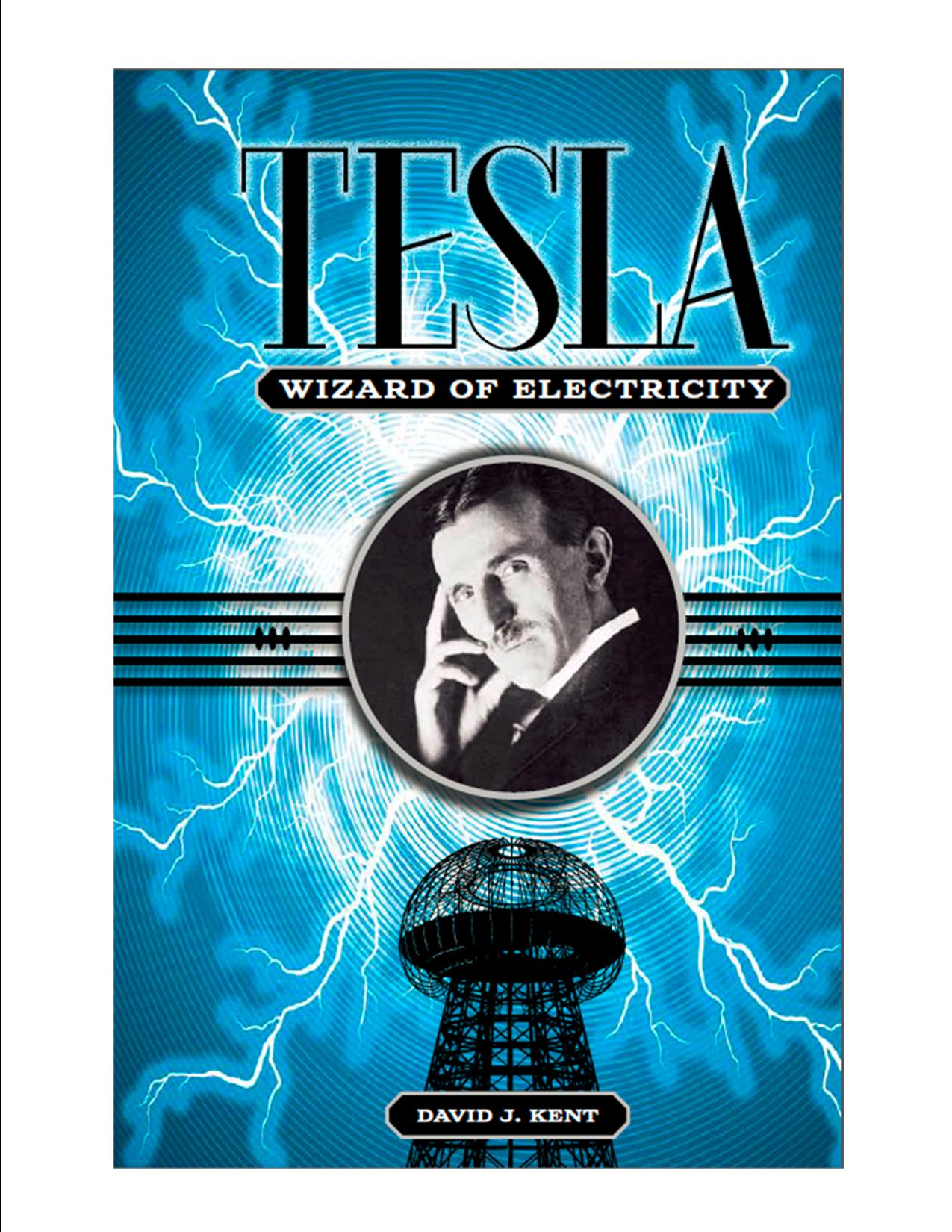
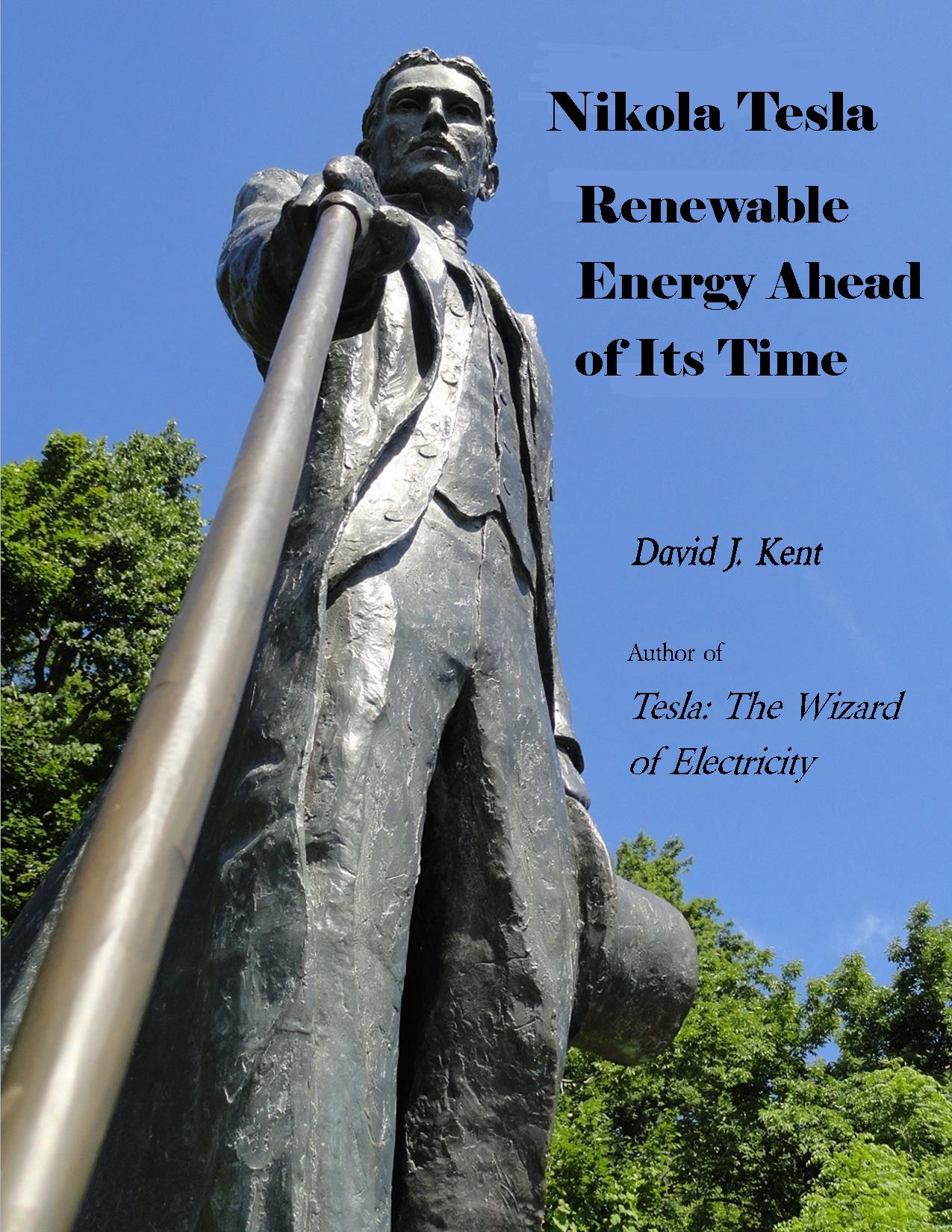
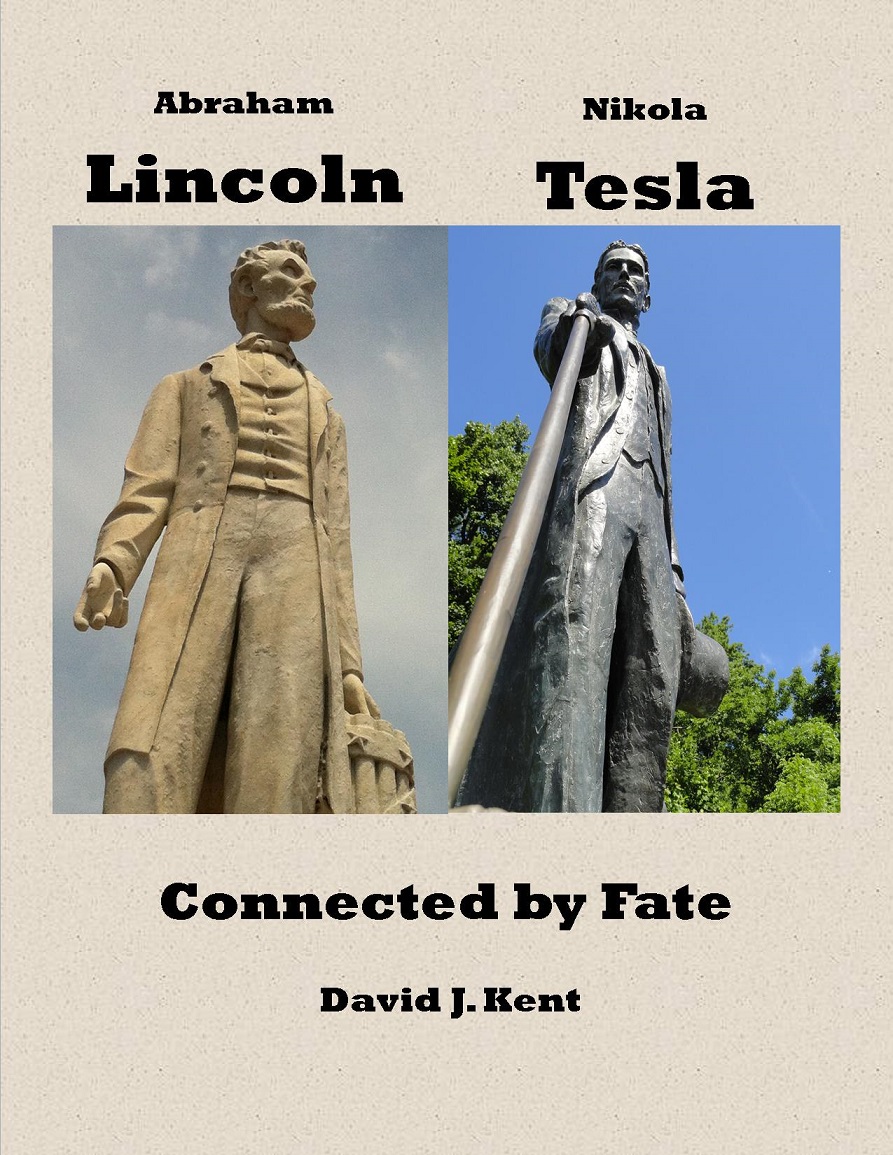
His previous books include Tesla: The Wizard of Electricity and Edison: The Inventor of the Modern World and two specialty e-books: Nikola Tesla: Renewable Energy Ahead of Its Time and Abraham Lincoln and Nikola Tesla: Connected by Fate.
Turn Right at Machu Picchu, Plus Galapagos

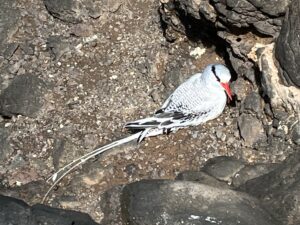
Red-billed tropicbirdI finally made it to Machu Picchu!

I had planned to go back in 2016, but that trip got punted in favor of a trip to Serbia instead (which I documented here). No problem, I thought. I’ll schedule it for the next year. That didn’t happen (I went to South Korea, China, Australia, and New Zealand instead). Another 40+ countries and nine years later I finally did the Machu Picchu trip. And threw in the Galapagos Islands as a bonus.

We booked a tour with Road Scholar, a 50-year-old company specializing in educational learning, which was important to us. I’ll have more details later, but here are some highlights of the trip. Joining fourteen others from around the United States, we flew first to Lima, Peru. Touring the city one day, we then flew on to Cusco, only to head out to the Sacred Valley to climb the Ollantaytambo ruins and visit an alpaca/llama/vicuna farm. After a day or so there we headed back to Ollantaytambo to take the famous rail line to Aguas Calientes (aka, Machu Picchu Village), where we spent the night. Taking the treacherous bus ride up to the Machu Picchu gate was worth it. Finally being able to stand in the iconic viewing spot to get a photo of the ancient Incan village was a dream come true. We also got to hike around the village itself and learn from a guide with traditional ancestry.

Machu Picchu

Eventually we headed back to Cusco for a couple of days, touring the city and going out to the Sacsayhuamen ruins just outside of town. In both Machu Picchu and Sacsayhuamen we got to see the amazing Incan craftmanship, with many-ton blocks of rock placed together so tightly you can’t slip a piece of paper between them. We also got to experience local Peruvian music and hear lectures on Peruvian agriculture (including 4000 varieties of potatoes and corn), Inca and pre-Inca history, and musical instruments. We even had a lesson in making ceviche.

Then it was off to Ecuador with a quick flight from Cusco to Lima and then on to Quito. After touring Quito for a day or so, we hopped on another plane, stopping in Guayaquil to refuel and trade passengers, then out to the Galapagos for the second half of the adventure. This really was two trips in one. The Peru part was all about ancient culture and civilizations. The Galapagos part was all about communing with nature.

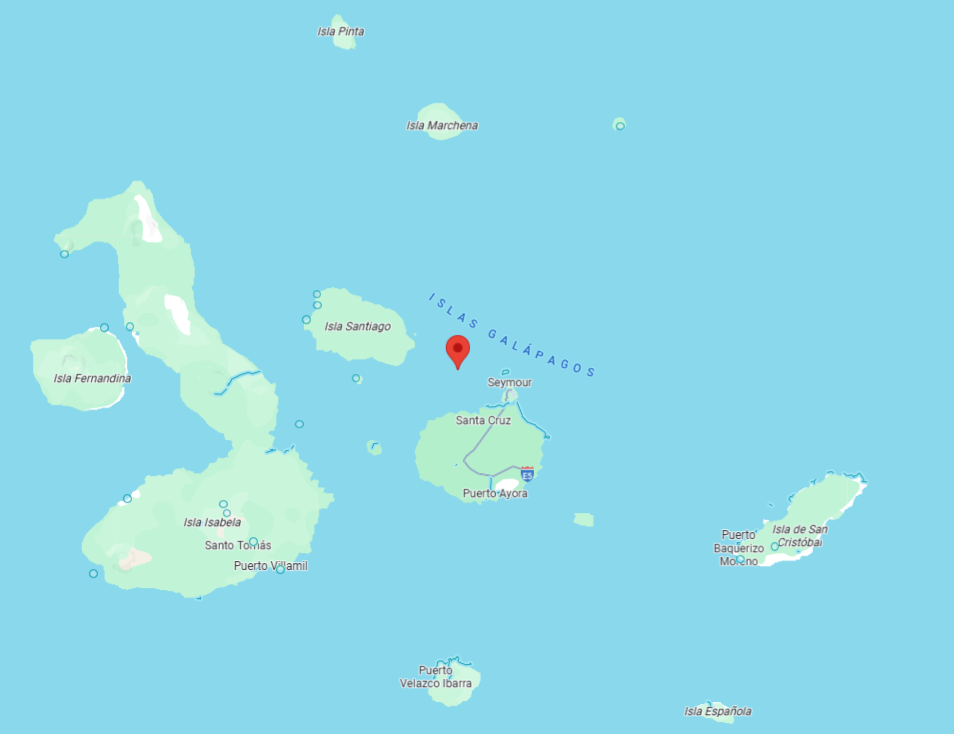
Galapagos map

In all, we visited eight Galapagos Islands in the middle and eastern part of the archipelago (there is a separate tour for the western islands). We arrived in Baltra, which is mostly airport, then spent time on Santa Cruz, the amazing bird island of Genovesa, Plaza Sur (South Island), Santa Fe, Floreana, Espanola, and San Cristobal. Mostly we were by ourselves on the islands, sometimes overlapping with another tour boat. All tours are limited to no more than 16 passengers to help protect the native flora and fauna. During the week in the Galapagos, we had plenty of opportunity to snorkel with green turtles and sea lions, kayak around the rocky inlets (often with young sea lions frolicking around us), and hiking in the bird-filled environments. There were plenty of blue-footed, red-footed, and Nazca boobies, albatross, and tons of other birds and their babies, not to mention land and marine iguanas, and unique species like lava lizards and lava herons.

It was hard to come home after 17 days on the road (and in the air and on the water), and it didn’t help that I got a bad cold upon my return. But the time spent in both Peru and Ecuador is something I’ll treasure forever.

More stories and photos coming soon.

[All photos by David J. Kent; map adapted from Google maps]

Lincoln in New England cover coming soon

Coming in March 2026: Lincoln in New England: In Search of His Forgotten Tours

Also see – Lincoln: The Fire of Genius: How Abraham Lincoln’s Commitment to Science and Technology Helped Modernize America.

Join me on Goodreads, the database where I keep track of my reading. Please leave a review on Goodreads and Amazon if you like the book.

You also follow my author page on Facebook. Also follow me on Instagram.

David J. Kent is Immediate Past President of the Lincoln Group of DC and the author of Lincoln: The Fire of Genius: How Abraham Lincoln’s Commitment to Science and Technology Helped Modernize America and Lincoln: The Man Who Saved America.

His previous books include Tesla: The Wizard of Electricity and Edison: The Inventor of the Modern World and two specialty e-books: Nikola Tesla: Renewable Energy Ahead of Its Time and Abraham Lincoln and Nikola Tesla: Connected by Fate.

Lincoln in Hingham, New England (and Hingham, old England)

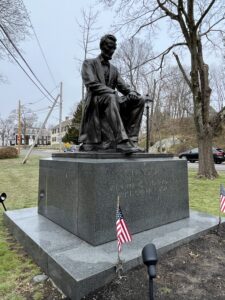
Lincoln in Hingham, Massachusetts, New EnglandThere stands a statue of Abraham Lincoln in Hingham, Massachusetts, New England. It’s immediately across the street from the Samuel Lincoln house. In Hingham, England, United Kingdom there is also a statue of Lincoln. But why? And who was Samuel Lincoln?
The original Samuel was an Englishman who left his home near Hingham, England (100+ miles northeast of London) and moved to the Massachusetts Bay Colony in 1637. He settled in, where else, the new town of Hingham, Massachusetts. The New England Hingham is a coastal town southeast of Boston. Think of it this way – if you look out the window of the tallest building in Boston (the John Hancock Tower) and look southeast toward Provincetown on the very tip of Cape Cod, you’re probably looking over Hingham. In any case, Samuel made his way to the New England Hingham from the old England Hingham as a teenager and started a long line of Lincoln descendants, including the one that begat the Abraham Lincoln lineage.

Abraham Lincoln never visited Hingham, Massachusetts (and obviously, not Hingham, England). He did come close once. In 1848, while a sitting congressman, Lincoln did a tour of Massachusetts campaigning for the Whig nominee for president, Zachary Taylor. The Mexican War hero (which the Whigs “very generally opposed” as unnecessary and unconstitutional) and southern slaveholder didn’t sit well with New England’s Conscience Whigs, who spun off into a Free Soil Party. Lincoln was there to try to keep them in the Whig fold. Taylor won the election, but it was closer than it should have been. He then inconveniently died sixteen months into his presidency, thus opening the door for the Compromise of 1850 and the nightmare that turned into. But that’s for another post.

The statue in Hingham, Massachusetts is a full size President Lincoln sculpted by Charles Keck. He is depicted sitting on a large stone staring downward in deep contemplation. The statue sits on a large pedestal. Standing in front of it, he seems to be staring at the viewer (or at his own feet, depending on your perspective).

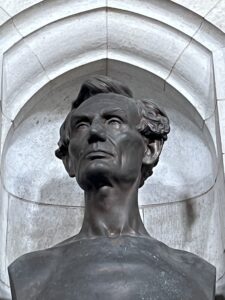
Lincoln in Hingham, England, old EnglandThe statue in Hingham, England is actually a bust, not a full statue. It was created based on the life mask of Leonard Volk made in 1860 just after Lincoln’s nomination. It depicts a much younger, beardless (and shirtless) Lincoln. It sits in an alcove on the side of St. Andrew’s Church. The bust was installed in 1919 to commemorate the Lincoln ancestry that had for many generations worshiped at the St. Andrew parish.
I’ve had the privilege of seeing both of these Lincoln memorials recently. I visited the statue in Hingham, Massachusetts during my tours of New England tracing Lincoln’s own two tours, one in 1848 and the other in 1860. I visited the bust in St. Andrew’s Church just a few weeks ago as I toured the UK seeing Lincoln statues from Edinburgh to Durham to Manchester to (near) Wales to Bath to Hingham. All of these visits gave me more insights into the Lincoln family tree, which I discuss in my new book, Lincoln in New England: In Search of His Forgotten Tours, which comes out March 3, 2026.


[Photos by David J. Kent, 2023, 2025]

Fire of Genius

Coming in March 2026: Lincoln in New England: In Search of His Forgotten Tours

Also see – Lincoln: The Fire of Genius: How Abraham Lincoln’s Commitment to Science and Technology Helped Modernize America.

Join me on Goodreads, the database where I keep track of my reading. Please leave a review on Goodreads and Amazon if you like the book.

You also follow my author page on Facebook. Also follow me on Instagram.

David J. Kent is Immediate Past President of the Lincoln Group of DC and the author of Lincoln: The Fire of Genius: How Abraham Lincoln’s Commitment to Science and Technology Helped Modernize America and Lincoln: The Man Who Saved America.

His previous books include Tesla: The Wizard of Electricity and Edison: The Inventor of the Modern World and two specialty e-books: Nikola Tesla: Renewable Energy Ahead of Its Time and Abraham Lincoln and Nikola Tesla: Connected by Fate.

Abraham Lincoln’s Connections to Edinburgh, Scotland

Abraham Lincoln never traveled outside the United States other than a few hours on the Canadian side of Niagara Falls. While he had planned to after his presidency, he never traveled overseas. He definitely never went to Edinburgh or anywhere else in Scotland. And yet, Edinburgh has not only a statue of Lincoln but also other connections to our sixteenth president. I became aware of these connections during my recent Lincoln-themed road trip around the United Kingdom.

Lincoln statue, Edinburgh, Scotland

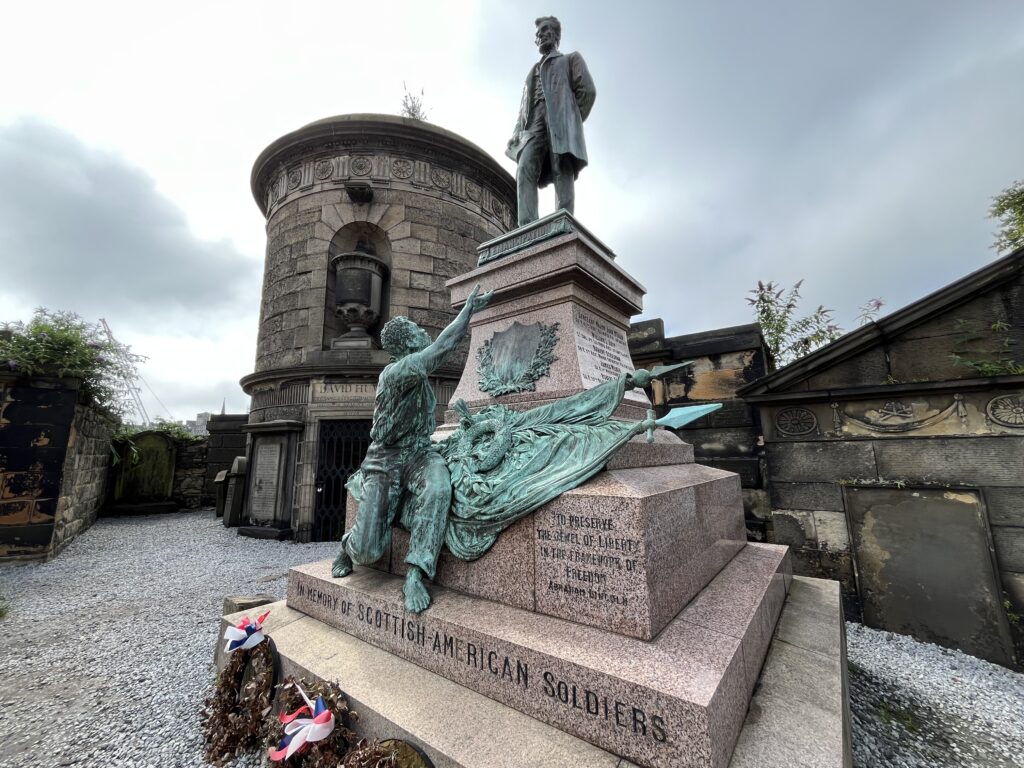
The most obvious is a grand full-length statue of Lincoln that tops the Emancipation Monument in Edinburgh’s Old Calton Burial Ground. Created by the well-known American sculptor George E. Bissell (whose bust of Lincoln sits two feet from me as I type these words), the monument also includes a second figure, a crouching, freed formerly enslaved man extending his arms in gratitude to the imposing Lincoln above him. In a sense, the juxtaposition is reminiscent of the more controversial Thomas Ball Emancipation (Freedman’s) Memorial in Washington, DC. Unlike the Ball statue, however, this figure is fully clothed and resting on furled flags, symbols of victory. This remains the only American Civil War Memorial outside the United States and is a tribute not just to Lincoln but to the memory of Scottish American soldiers who fought in the war. Unveiled in 1893, the Lincoln statue was the first life-sized statue of an American President unveiled in Europe. Philosopher David Hume’s stone tower serves as an impressive backdrop to the Lincoln monument.

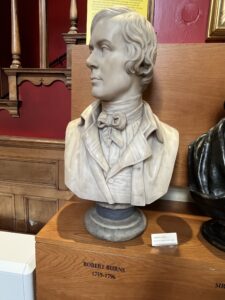
Robert Burns, Writers' Museum, Edinburgh, ScotlandAnother connection is to Robert Burns, the Scottish poet whom Lincoln had a particular fascination. Lincoln had supposedly discovered Burns from Jack Kelso, an enigmatic friend from Lincoln’s New Salem days. Kelso had emigrated to the United States from Scotland, where he had previously been a Glasgow schoolteacher. He apparently owned many volumes of Burns that Lincoln read over and over (ditto for Shakespeare). Lincoln was hooked and recited Burns from memory on many occasions through his life. Robert Burns is eminently present in Edinburgh, including a large monument at the foot of Calton Hill (not far from the aforementioned Lincoln statue). Burns is also one of the three Scottish writers featured in the Writers’ Museum tucked into Lady Stair’s Close a few steps off the Royal Mile that leads to the Edinburgh Castle. He is joined there by Robert Louis Stevenson and Sir Walter Scott.
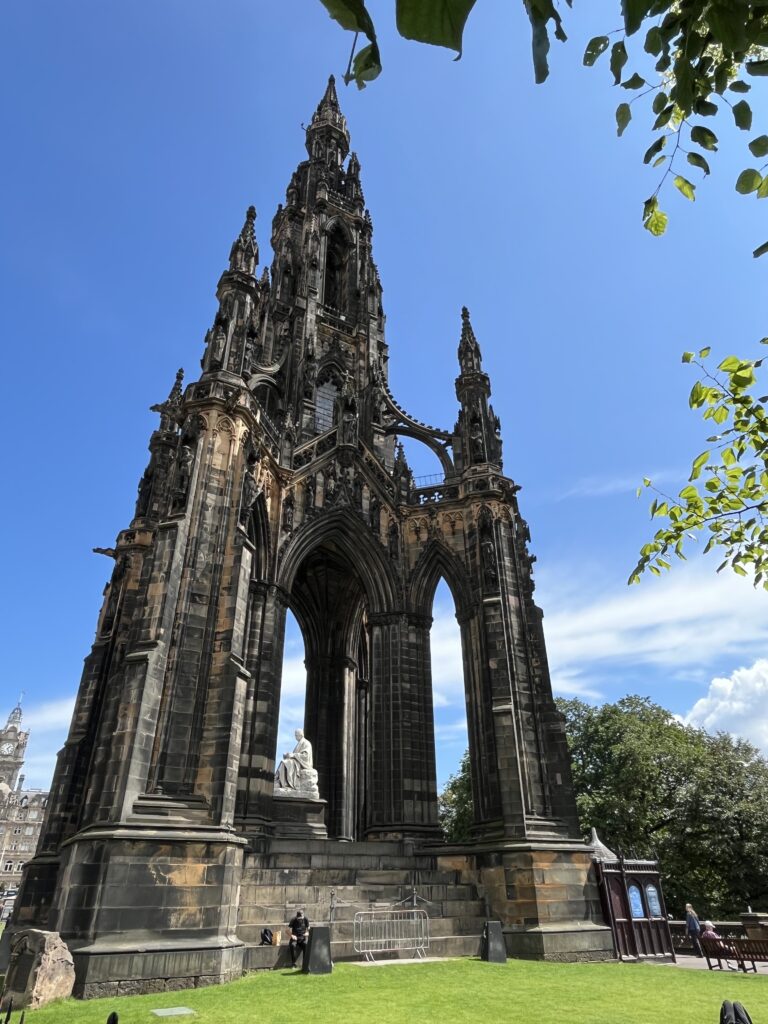
Sir Walter Scott provides yet another, albeit somewhat indirect, connection to Lincoln. The Scott Monument is a Victorian Gothic multi-towered structure that is the second-largest monument in the world to a writer. It dominates the skyline from most of Edinburgh along Princes Street near the Waverly Railway Station (named after Scott’s Waverly novels). Here’s where the Lincoln connection comes in. Way back in 1838 a man named Frederick Bailey escaped from slavery, moved briefly to New York and married Anna Murray, changing their last name to Johnson. They quickly moved on to New Bedford, Massachusetts, where they stayed with Nathan and Mary Johnson. It turns out Johnson was a common name and seeking something more distinctive, Frederick asked Nathan to help pick a new last name. Nathan was a fan of, you guessed it, Sir Walter Scott, and suggested Frederick take on the name Douglas, the name of two principal characters in Scott’s poem “The Lady of the Lake.” Frederick decided to give it a little flair and added the extra “s,” giving us the man we all know today as Frederick Douglass.

Sir Walter Scott Monument, Edinburgh, Scotland

There is another, more obscure, connection to Lincoln in Scotland. During my travels I also stayed one night in an old mansion overlooking the cliffs in Dunbar on the far eastern Scottish coast. Dunbar is the birthplace of John Muir, who as I discussed in a previous post, was instrumental in making Yosemite a National Park. Lincoln, of course, had designated Yosemite as the first federal land to be set aside for protection.

I’ll have more on my Lincoln road trip through the UK in future posts, so stay tuned.

[Photos by David J. Kent, 2025]

Fire of Genius

Coming in March 2026: Lincoln in New England: In Search of His Forgotten Tours

Also see – Lincoln: The Fire of Genius: How Abraham Lincoln’s Commitment to Science and Technology Helped Modernize America.

Join me on Goodreads, the database where I keep track of my reading. Please leave a review on Goodreads and Amazon if you like the book.

You also follow my author page on Facebook. Also follow me on Instagram.

David J. Kent is Immediate Past President of the Lincoln Group of DC and the author of Lincoln: The Fire of Genius: How Abraham Lincoln’s Commitment to Science and Technology Helped Modernize America and Lincoln: The Man Who Saved America.

His previous books include Tesla: The Wizard of Electricity and Edison: The Inventor of the Modern World and two specialty e-books: Nikola Tesla: Renewable Energy Ahead of Its Time and Abraham Lincoln and Nikola Tesla: Connected by Fate.

Update – Lincoln in New England Book Gets a New Title

Lincoln in New England cover coming soonBack in May I announced that I submitted the final manuscript for my new book about Lincoln’s two tours of New England. As the production process proceeds, I’ve been working with the editors to fine-tune the book. Most of that sausage-making is behind the scenes and won’t be noticeable to the public, but one change is rather obvious. I have a new title!

The title of the book in print will be…(imagine a drum roll here)…Lincoln in New England: In Search of His Forgotten Tours.

My original working title, Unable to Escape This Toil, came from a letter Abraham Lincoln had written to his wife Mary. He was in Exeter, New Hampshire at the time visiting his son Robert, who was at Phillips Exeter Academy studying to retake the Harvard entrance exams he had failed the previous summer. Lincoln had given a big (really big) speech at Cooper Union in New York, then planned a relaxing few days visiting his son. By the time he got there he had already given one additional speech and committed to at least five more. Another four were waiting for him when he arrived at the Exeter train station. In his letter home, Lincoln wrote: “I am unable to escape this toil,” he said, adding “If I had foreseen it, I think I would not have come East at all.” He was being a bit whiny and disingenuous, which I discuss in a paper that I just submitted to the Lincoln Forum Bulletin for publication this fall. In any case, the title seemed a big opaque to the general public, so we changed it to a much more descriptive Lincoln in New England. The subtitle is tweaked slightly to go with the new title.

As of this writing, Lincoln in New England: In Search of His Forgotten Tours is scheduled for release on Tuesday, March 3, 2026. You can even pre-order the book via the publisher website and other booksellers:

Globe Pequot (with links to Amazon, Barnes and Noble, Books-a-Million, and Bookshop)

Amazon

[The other links weren’t updated yet, so I’ll add them when they work]

Meanwhile, formatting of the book continues. It will include fifty black-and-white photos from my travels and of historical places, plus two maps to show Lincoln’s speaking tour routes.

Stay tuned for the cover reveal to come soon!

[Photos by David J. Kent, 2025]

Fire of Genius

Coming in March 2026: Lincoln in New England: In Search of His Forgotten Tours

Also see – Lincoln: The Fire of Genius: How Abraham Lincoln’s Commitment to Science and Technology Helped Modernize America.

Join me on Goodreads, the database where I keep track of my reading. Please leave a review on Goodreads and Amazon if you like the book.

You also follow my author page on Facebook. Also follow me on Instagram.

David J. Kent is Immediate Past President of the Lincoln Group of DC and the author of Lincoln: The Fire of Genius: How Abraham Lincoln’s Commitment to Science and Technology Helped Modernize America and Lincoln: The Man Who Saved America.

His previous books include Tesla: The Wizard of Electricity and Edison: The Inventor of the Modern World and two specialty e-books: Nikola Tesla: Renewable Energy Ahead of Its Time and Abraham Lincoln and Nikola Tesla: Connected by Fate.

In Search of Lincoln and Tad in Richmond (and Jeff Davis too)

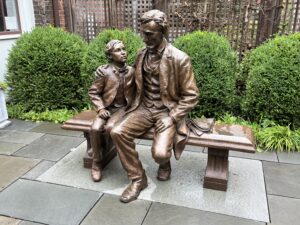
Lincoln and Tad, Richmond VAThe American Civil War Museum in Richmond, Virginia once had a statue depicting Abraham Lincoln and his son Tad sitting on a park bench. As of this writing it is no longer there, and hasn’t been since 2023. So, where is it?
I discussed Lincoln’s trip into Richmond in a previous post, which you can read here. In a nutshell, Lincoln had been visiting Ulysses S. Grant and the troops at City Point, a bluff overlooking the confluence of the Appomattox and James Rivers. When Richmond fell and Jefferson Davis’s government fled south, Lincoln decided to take Tad and visit the city. There he walked from the river to what had been the White House of the Confederacy. Shortly after his visit, Lincoln made his way back to Washington, and Lee surrendered to Grant by the time he got there.

The White House of the Confederacy, along with Tredegar Iron Works and the Appomattox Courthouse building where Lee surrendered, is now the American Civil War Museum (next door to the main location is the Tredegar Pattern Building, still run by the National Park Service as part of its Richmond National Battlefield). The statue of Lincoln and Tad commemorating Lincoln’s visit was installed at the Tredegar site in 2003. Not everyone was happy. In a post on the Lincoln Group of DC’s website, Lincolnian.org, Wendy Swanson noted that:

However, despite this peaceful theme the atmosphere at the statue’s actual dedication, almost twenty years ago on April 5, 2003, was anything but serene. Protestors with pro-Confederate leanings did their best to disrupt the dedication ceremony. Garbed in clothing from the era as well as modern t-shirts containing themes derogatory to the Sixteenth President, the protestors’ presence at the dedication was quite evident. They greeted ceremony attendees with chants and anti-Lincoln signs and slogans. During the ceremony a small plane flew over the crowd, displaying a banner containing words made infamous by John Wilkes Booth at Ford’s Theatre on April 14, 1865, “Sic semper tyrannis.” There also was a second event held that day to counter the tribute to Lincoln. At Hollywood Cemetery there was a protest vigil at the grave of Jefferson Davis.

While many people were in Gettysburg this week commemorating the Battle of Gettysburg, which occurred July 1-3, 1863, I was in Richmond visiting Tredegar and the Confederate White House. Two and a half years ago the statue of Lincoln and Tad was moved “temporarily” to The Valentine, a Richmond-themed Museum two blocks away. At Tredegar the statue had its own stone exedra bearing the words from Lincoln’s second inaugural address: To Bind Up the Nation’s Wounds. At the Valentine, the statue sits in a small corner outside the building, where it is expected to sit for several years while the National Park Service builds an amphitheater at the Tredegar site. The amphitheater is apparently still under construction, although it looked largely finished and quite impressive during my visit this week.

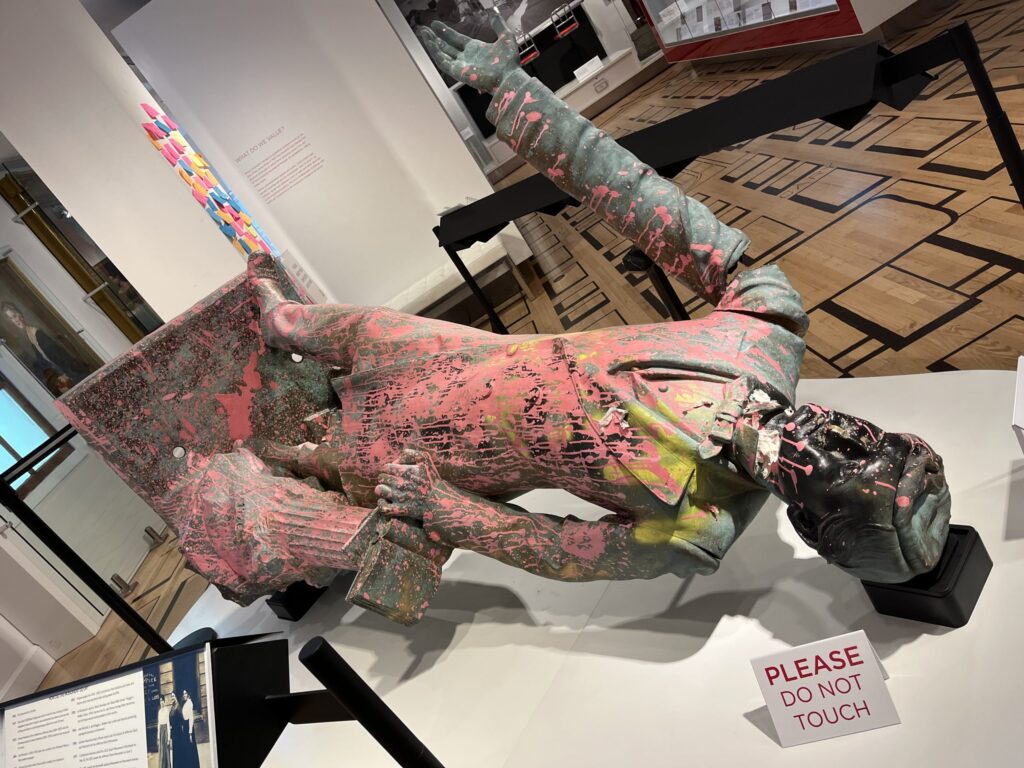
Jefferson Davis at the Valentine, Richmond VAWhile at the Valentine I also got to see another “Civil War President.” A statue of Jefferson Davis had stood for many decades along Monument Avenue in Richmond. During the 2020 protests over the murder of George Floyd in Minnesota, the Davis statue was vandalized with paint, then pulled down. That statue now sits – or more accurately, lays – in the Valentine’s main gallery. Pink and yellow paint splatters the bronze, Davis’s head is bashed in from the fall off his pedestal, and his right arm is nearly severed. The display symbolizes the city’s change in attitude over its prior adulation of Confederate figures. All of its many dozens of Confederate statues have now been removed, with the exception of a few remaining on the grounds of the Viriginia State Capitol (you walk past them as you proceed from the equestrian statue of George Washington to the Governor’s Mansion). They are now joined by two large group statues, one featuring the many women who fought for voting rights and the other of Barbara Johns and others who fought the battle that would become Brown v. Board of Education. Johns is scheduled to replace Robert E. Lee in the U.S. Capitol’s Statuary Hall. Interestingly, it was Edward Virginius Valentine who had sculpted both the Lee statue (now removed from the hall and currently at Richmond’s Museum of History and Culture) and the one of Davis now at the Valentine Museum. Hopefully, Johns will make it into Statuary Hall soon, perhaps after the new governor takes off after this fall’s election.
There was much more to my trip to Richmond, so expect future posts on the area.

[Photos by David J. Kent, 2025]

Fire of Genius

Coming in February 2026: Lincoln in New England: In Search of His Forgotten Tours

Also see – Lincoln: The Fire of Genius: How Abraham Lincoln’s Commitment to Science and Technology Helped Modernize America.

Join me on Goodreads, the database where I keep track of my reading. Please leave a review on Goodreads and Amazon if you like the book.

You also follow my author page on Facebook. Also follow me on Instagram.

David J. Kent is Immediate Past President of the Lincoln Group of DC and the author of Lincoln: The Fire of Genius: How Abraham Lincoln’s Commitment to Science and Technology Helped Modernize America and Lincoln: The Man Who Saved America.

His previous books include Tesla: The Wizard of Electricity and Edison: The Inventor of the Modern World and two specialty e-books: Nikola Tesla: Renewable Energy Ahead of Its Time and Abraham Lincoln and Nikola Tesla: Connected by Fate.

The Year in a Traveler’s Life – 2024

Elephants Moremi Game Reserve, BotswanaTraveling seems to be done for the year. At least mostly (there might be one short overnight trip squeezed in before New Years). Enough to look back on the year in a traveler’s life. You can see the 2023 recap and 2022 recap by clicking on the links in this sentence. For the last several years I’ve included on my list of goals to visit at least 5 new countries and territories during the year. “Country” is the official United Nations designation, while “territory” encompasses those countries that are betrothed one way or another to some archaic monarchical system (e.g., Aruba is an “island country” but also a “constituent country in the Kingdom of the Netherlands). In any case, I use an app called “Been” to decide which is which. Personally, I respect their sovereignty.
The year started off slowly, as usual, mainly because I have a lot of Abraham Lincoln-related obligations in February, March, and April. For example, on February 12, I was the keynote speaker at the official National Park Service Lincoln birthday ceremony, where after providing some context, I performed the Gettysburg Address. I also attended events at Ford’s Theatre (where Lincoln was shot) and hosted renowned Lincoln historian Harold Holzer at the annual Lincoln Group of DC/Civil War Roundtable of DC joint birthday banquet. Spaced throughout the year were other Washington, DC and/or Lincoln centric events.

My first real traveling of the year was in March, when I took two weeks for a Windstar small ship sailing cruise, roughly 130 people on a four-masted sailing yacht in the Caribbean. Starting in Panama, there were stops in Colombia, Aruba, Curacao, Bonaire (these last three commonly called the “ABC Islands”), then on to Grenada, Mayreau (part of a country called St. Vincent and Grenadines), and ending in Barbados. In addition to the relaxing onboard gourmet meals and camaraderie, there were plenty of excursions to local history and culture sites, as well as tons of fantastic snorkeling. In Grenada, I got to snorkel over an underwater sculpture garden, with statues representing everything from the bizarre to the seriousness of slavery.

April took me back on the road. Like last year, I did a road trip into New England as research for a work in progress (WIP, which I’ll mention in my annual “writer’s life” post in a week or so). That gave me a chance to visit one of my old universities, to see historic sites in New Bedford and a dozen other locations, and to chat with interesting historians and laypeople. Again, more on that in my writer’s post.

The biggest trip of the year was to Africa. I first made it to Africa in 2022 with a trip to Tanzania. In 2023, I went to Morocco. In 2024, Ru and I joined my brother and his wife on a safari centered in Botswana. Arriving first in Cape Town, South Africa, we spent a few days exploring Table Mountain and the Cape of Good Hope. We even saw penguins. Then we flew up to Maun, Botswana to start the tour, which first took us into the Okavango Delta, an amazing experience full of hundreds of new species of birds, hippos, elephants, antelope, and more. Then it was on to the Moremi Game Reserve and Chobe National Park where we saw thousands of elephants, or at least it seemed like thousands. From there we crossed the border into Zimbabwe to see the spectacular Victoria Falls. We even crossed the bridge into Zambia, which was an experience in itself. You can read more about the Botswana Experience in this post.

The fall travel was more domestic. September saw us in Vermont, New Hampshire, Maine, Massachusetts, and Connecticut (somehow, I missed Rhode Island) for more WIP research and a family wedding. November was to the annual three-day Lincoln Forum conference in Gettysburg, PA, then back up to Massachusetts for a family Thanksgiving. Interspersed were tons of meetings, calls, presentations, and daytrips.

And the year ended (well, almost; I might still do a short trip to Richmond).

And what of 2025?

As I look forward, I’m not sure I’ll make my goal of 5 new countries and territories. I should be in that many countries but not all new. The new ones, however, should be spectacular.

The beginning of the year will remain closer to home as the usual Lincoln-related obligations will always be there, plus my new project. I may get up to New York City in January for research. April will take me back to Vermont for a new Lincoln conference at Hildene, the “summer home” of Lincoln’s son Robert and his family, now a historical non-profit. The tentative plan is to tack on a road trip to upstate New York on the way there. July is tentatively a road trip around the United Kingdom as a preamble to attending a wedding at Oxford University. The hope is to start in Edinburgh, Scotland (where I had lived for three months one summer for work), then down through England with enough wiggling to drop in on Wales and my hometown’s namesake village. November will take me back to Gettysburg for the Forum.

The biggie is a trip to Ecuador and Peru in late summer. This has been on my bucket list since the phrase bucket list was invented. There will be time in Lima, Cusco, the Sacred Valley, Machu Picchu in Peru, then seven days on a small boat (16 passengers) roaming around the Galapagos Islands and snorkeling with marine iguana, something sure to stir my old marine biologist bones. Then there is time in Quito and maybe other parts of Ecuador. The trip is through Road Scholar, which is the company that we used to see much of Cuba in 2019.

There may be more. While my “must see” list is getting shorter, it is by no means short.

I’ll have my annual Year in the Writer’s Life post up shortly before New Year’s.

Photo: David J. Kent, Elephants, Moremi Game Reserve, Botswana

Fire of Genius


Lincoln: The Fire of Genius: How Abraham Lincoln’s Commitment to Science and Technology Helped Modernize America is available at booksellers nationwide.

Limited signed copies are available via this website. The book also listed on Goodreads, the database where I keep track of my reading. Click on the “Want to Read” button to put it on your reading list. Please leave a review on Goodreads and Amazon if you like the book.

You also follow my author page on Facebook.

David J. Kent is President of the Lincoln Group of DC and the author of Lincoln: The Fire of Genius: How Abraham Lincoln’s Commitment to Science and Technology Helped Modernize America and Lincoln: The Man Who Saved America.

His previous books include Tesla: The Wizard of Electricity and Edison: The Inventor of the Modern World and two specialty e-books: Nikola Tesla: Renewable Energy Ahead of Its Time and Abraham Lincoln and Nikola Tesla: Connected by Fate.

Abraham Lincoln’s New England Sculptor – Augustus Saint-Gaudens

Technically, Augustus Saint-Gaudens was born in Dublin, Ireland and from the age of six months was reared in New York City. But by his late 30s he began spending his summers in Cornish, New Hampshire, moving there year-round from 1900 to his death from cancer in 1907. I had the opportunity to visit the Saint-Gaudens home and studio in Cornish a few weeks ago, now the Saint-Gaudens National Historical Park, where I saw several of his greatest sculptures.

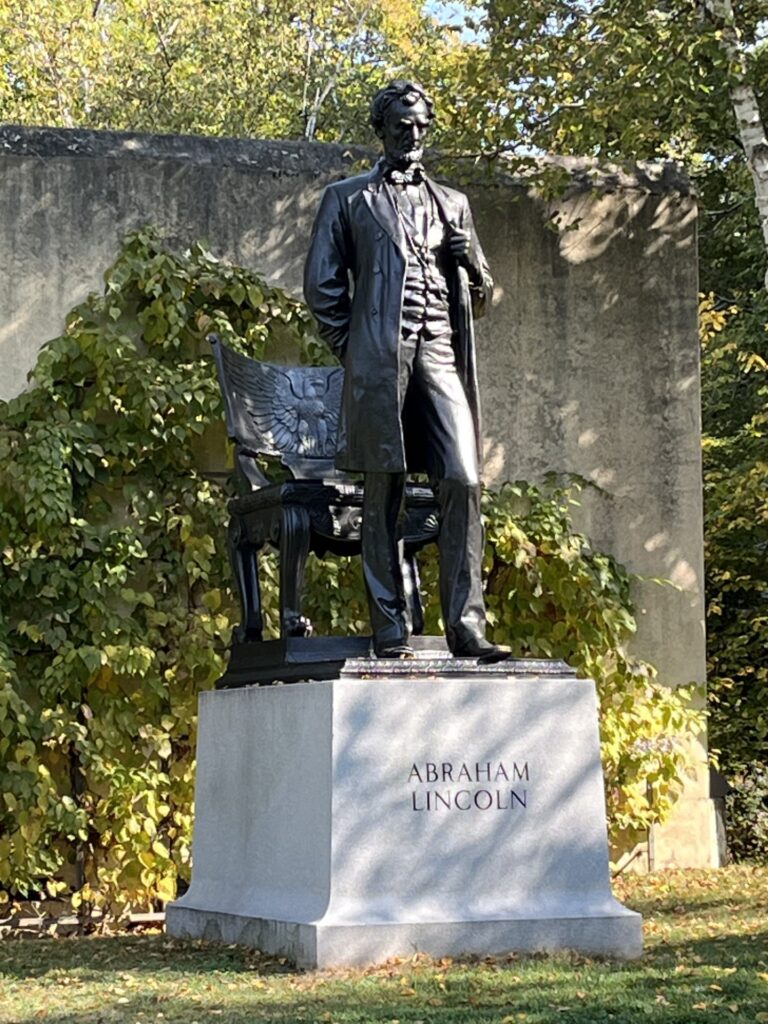
The most recognizable is his Abraham Lincoln: The Man, better known as the Standing Lincoln, which graces Lincoln Park in Chicago. Full-size recastings can be found in London’s Parliament Square, Mexico City’s Parque Lincoln, and, of course, at the Saint-Gaudens site in New Hampshire. There are numerous reduced size replicas throughout the United States, including inside the Lincoln Tomb in Springfield, Illinois. Saint-Gaudens also created a seated Lincoln called Abraham Lincoln: The Head of State, also in Chicago, for the 1909 centennial of Lincoln’s birth.

Abraham Lincoln, The Man at Saint-Gaudens Historical Park

My visit started the night before when I stayed at the Windsor Mansion Inn across the river in Vermont. Saint-Gaudens designed the stately home for his family friend, Maxwell Evarts, a Vermont lawyer and state politician. We’ll come back to the Evarts family in a minute. I stayed in the Auguste Rodin room, named for the French sculptor famous for The Thinker and The Kiss. Rodin never visited, but the story goes that he saw a plaster cast of Saint-Gaudens’s Robert Gould Shaw Memorial at an exhibition and, recognizing its brilliance, was noted to have bowed and tipped his hat to it. Another plaster cast is currently on display at the National Gallery of Art in Washington, DC.

After spending the night in the historic mansion, I crossed over the Connecticut River via the Cornish-Windsor Bridge, the longest wooden bridge in the United States and the longest two-span covered bridge in the world. I found the Saint-Gaudens site along a long early-fall foliage-lined lane, arriving just in time for a guided tour. Not surprisingly, the Standing Lincoln statue features prominently as you approach the main visitor’s center. With essentially a private tour for the two of us, the park ranger explained the background behind Saint-Gaudens’s life and the Lincoln statue. She expanded beyond her usual tour spiel when I told her I was a Lincoln researcher and writer. She was happy to expound to someone who knew more than the usual tourists.

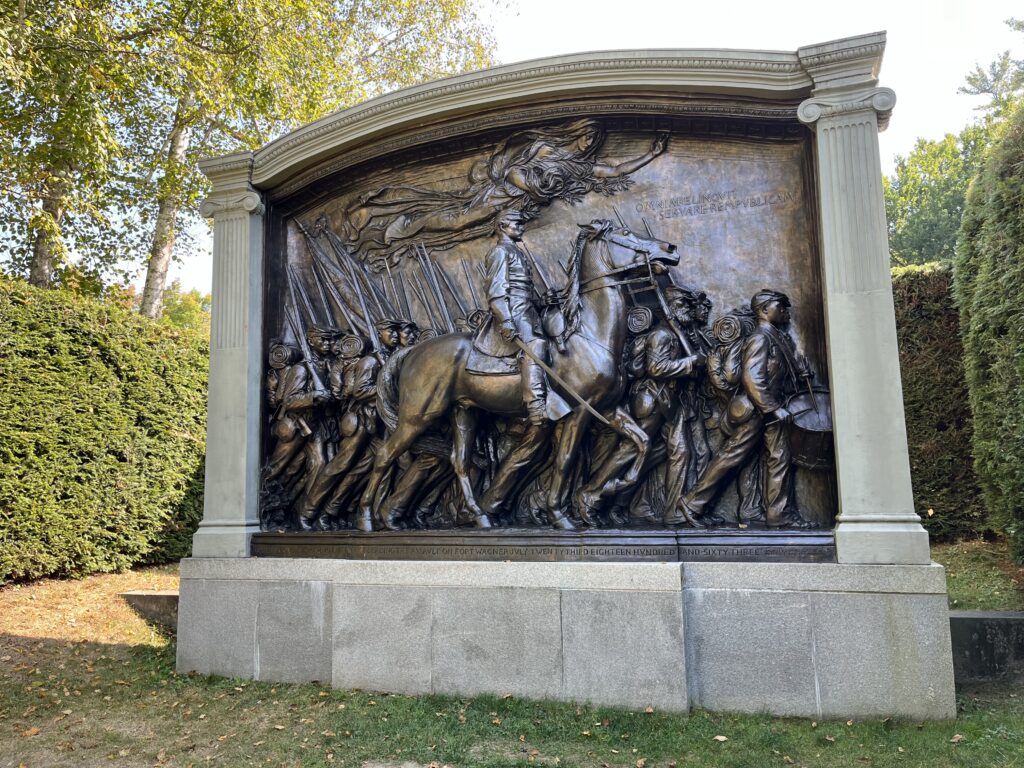
The grand Lincoln is not Saint-Gaudens’s only famous statue, of course, and soon we were regaled with stories behind his first major commission, a monument to Civil War Admiral David Farragut that sits in New York City’s Madison Square. Like the Standing Lincoln, the architectural exedra surrounding the Farragut was designed by his friend Stanford White. Farragut established Saint-Gaudens’ reputation as a master sculptor. His many other significant figures include the Adams Memorial, the Peter Cooper Monument (of Cooper Union fame), and the John A. Logan monument, as well as the fabulous equestrian statue of William Tecumseh Sherman at the corner of New York’s Central Park. And then there is the Memorial to Robert Gould Shaw and the Massachusetts Fifty-Fourth Regiment, a massive bronze relief honoring the United States Colored Troops regiment depicted in the film, Glory, the original of which sits on the edge of Boston Common facing the Massachusetts State House. I had seen the original in Boston last year on one of my road trips.

Robert Shaw Memorial at Saint-Gaudens Park in Cornish NH

Which gets me back to Maxwell Evarts family of the Windsor Mansion Inn. Maxwell’s father, William Maxwell Evarts, had served for several months as Attorney General to Abraham Lincoln’s second vice president and successor, Andrew Johnson. He later served as Secretary of State under Rutherford B. Hayes and then United States Senator for New York. Exceedingly wealthy, Evarts was a patron of the arts. His daughter, Hettie, married Evarts’ law partner, Charles C. Beaman (who had negotiated the reparations agreement associated with the British allowing the Confederacy to build the CSS Alabama). Together they served as both models and benefactors for Saint-Gaudens lucrative business creating bronze relief sculptures. Saint-Gaudens used the money to purchase Beaman’s estate, which he renamed “Aspet” and that now makes up the Saint-Gaudens National Historical Park.

Something I didn’t known. In addition to the prolific production of relief sculptures, Saint-Gaudens, and later his students, designed considerable coinage, including the ultra-high relief “double eagle” $20 gold coin for the US Mint, thanks to a recommendation from President Theodore Roosevelt.

The Saint-Gaudens site is so much more than his sculptures. There is his studio, the house, beautiful walking grounds and hiking trails, and a small temple where Saint-Gauden and his wife’s ashes are stored. The site is well worth the visit.

[Photos by David J. Kent]


Fire of Genius

Lincoln: The Fire of Genius: How Abraham Lincoln’s Commitment to Science and Technology Helped Modernize America is available at booksellers nationwide.

Limited signed copies are available via this website. The book also listed on Goodreads, the database where I keep track of my reading. Click on the “Want to Read” button to put it on your reading list. Please leave a review on Goodreads and Amazon if you like the book.

You also follow my author page on Facebook.

David J. Kent is Immediate Past President of the Lincoln Group of DC and the author of Lincoln: The Fire of Genius: How Abraham Lincoln’s Commitment to Science and Technology Helped Modernize America and Lincoln: The Man Who Saved America.

His previous books include Tesla: The Wizard of Electricity andEdison: The Inventor of the Modern World and two specialty e-books: Nikola Tesla: Renewable Energy Ahead of Its Time and Abraham Lincoln and Nikola Tesla: Connected by Fate.

Lincoln-Douglas Debates: On to Jonesboro and Charleston

After haggling out the arrangements and debates in Ottawa and Freeport in the northern part of Illinois, Abraham Lincoln and Stephen A. Douglas slowly made their way down to the southern part of the state for two debates in quick succession. Along the way they each gave a myriad of additional individual speeches to smaller venues.

Jonesboro, September 15, 1858

The third official Lincoln-Douglas debate was held in Jonesboro, which was as far south as Freeport had been north. They reflected two vastly different citizenries. Whereas the northern part of Illinois had largely been settled by northeasterners moving west, the southern part of the state was mostly settled by slave state migrants moving north. Unlike Freeport, the sparsely populated Jonesboro (about 1,500 residents) was heavily supportive of the Democratic party views on slavery (i.e., proslavery or pro-accommodating to southern rights to enslave other Americans based on the color of their skin). It’s safe to say that Lincoln was at a disadvantage.

Douglas was well aware of this. He charged Lincoln and the Republicans (which by now Democrats had started to refer to as “Black Republicans”) said one thing in northern Illinois, something different in central Illinois, and something wholly different in the southern part of Illinois. Douglas argued that Lincoln wanted full racial equality, a position that was anathema across Illinois in general and perhaps fatal in the deepest south portions of the state like Jonesboro. Lincoln not only denied he pitched differently in the north and south, but also went on offense to quote documents and speeches by Democrats to demonstrate that it was they, the self-avowed conservative Democrats who had entirely different stories across the state.

Lincoln’s main focus in Jonesboro was to argue that the expansion of slavery into the western territories would endanger the rest of the Union. He pointed out this was already happening as he looked back over the fight over slavery in Missouri, the upheaval over whether slavery could go into the territories taken after the Mexican War, and the resulting “Bleeding Kansas” violence. The only way past the crisis, he said, would be to put slavery on “the course of ultimate extinction.”

Jonesboro Lincoln-Douglas statues

Charleston, September 18,1858

Three days later the two men found themselves about 175 miles northeast in Charleston, where they would begin a wide counterclockwise swing through the remaining four debate sites. Charleston had many southern migrants from slave states but even the more antislavery residents were not in favor of equal political or social rights for African Americans. It was one thing to find slavery abhorrent, yet another to call for full equality. Douglas used this sentiment to his benefit by running a clearly racist campaign overall. In Jonesboro he had accused Lincoln of favoring racial equality. To emphasize Douglas’s constant fearmongering of amalgamation, or worse, his supporters held up a banner that read “Negro equality” with a picture of a white man, a negro woman, and a mulatto child. His goal was to either get Lincoln to declare he was for full equality or to declare he wasn’t for full equality. Admitting the former would have ended Lincoln’s campaign immediately in a time when racism was the norm, even among most abolitionists.

Painted into a corner, Lincoln chose to open the debate by saying that while he was entirely against slavery, he was not “in favor of bringing about in any way the social and political equality of the white and black races.” He further added that he thought “there a physical difference” that would “forever forbid the two races living together on terms of social and political equality. And inasmuch as they cannot so lie, while they do remain together there must be the position of superior and inferior, and I as much as any other man am in favor of having the superior position assigned to the white race.”

That particular passage and similar statements in the other debates continues to be analyzed to this day. Those so inclined to find fault with Lincoln see him as a typical racist. Those more understanding see it as a political hedging to avoid being booed off the platform, or worse, dragged through the streets and perhaps killed. Those more thoughtful analysts see Lincoln as a less racist man of his racist times struggling to maintain political viability to continue the opportunity of ending slavery.

Lincoln had some charges of his own. He accused Douglas of conspiring with Chief Justice Roger Taney, former President Franklin Pierce, and current President James Buchanan to enable the creation of a pro-slavery constitution for Kansas without allowing the actual residents of Kansas to express their views and vote on it. Not surprisingly, Douglas denied it. Douglas did declare that the government should exist as he believed the founders intended, with some states slave and others free.*

These two debates offered distinct contrasts in other ways as well. Jonesboro had the smallest attendance with perhaps 1,500 people present. Charleston had around 12,000 in attendance, including eleven railroad cars of people who traveled from Indiana to hear these two men speak on the most contentious issue of the day.

Charleston Lincoln-Douglas statues

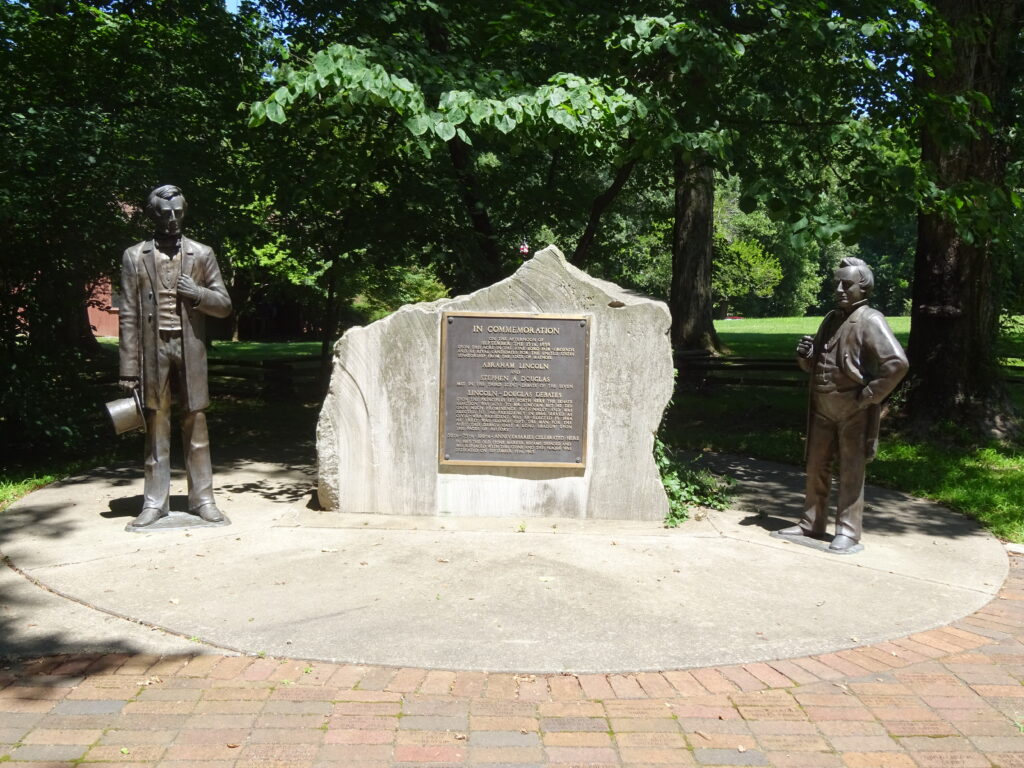
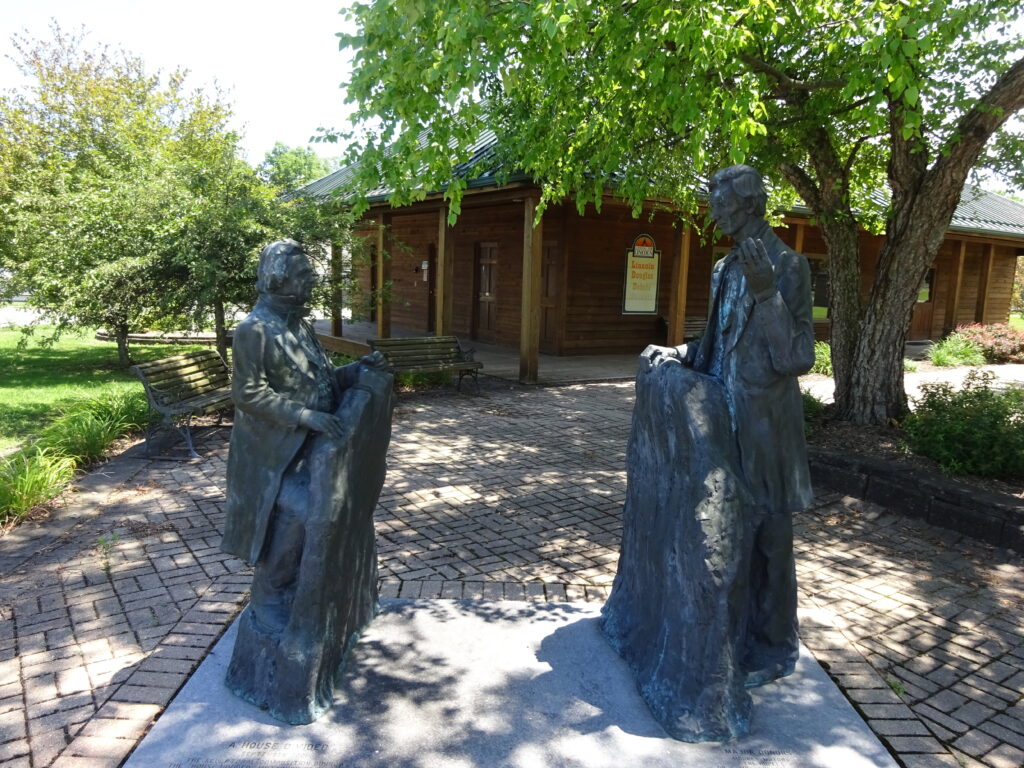
As with all the other of the seven debate sites, statues of Lincoln and Douglas have been erected. In Jonesboro, full-size bronzes of the two men stand on either side of a large limestone boulder carrying a bronze plaque. A “Looking for Lincoln” wayside marker explains the debate. The Charleston site also boasts full-size bronze sculptures, this time with the two men facing each other over rock-like “podiums.” Charleston is also the only site with a Debate Museum on the grounds, where visitors can pose for photos and watch a film that tells the story of the debate.

After Charleston, the next official debate would not occur for almost three weeks in Galesburg, where Lincoln would “go through college” for the very first time.

[Photos of Jonesboro (top) and Charleston (bottom) by David J. Kent.]


Fire of Genius

Lincoln: The Fire of Genius: How Abraham Lincoln’s Commitment to Science and Technology Helped Modernize America is available at booksellers nationwide.

Limited signed copies are available via this website. The book also listed on Goodreads, the database where I keep track of my reading. Click on the “Want to Read” button to put it on your reading list. Please leave a review on Goodreads and Amazon if you like the book.

You also follow my author page on Facebook.

David J. Kent is Immediate Past President of the Lincoln Group of DC and the author of Lincoln: The Fire of Genius: How Abraham Lincoln’s Commitment to Science and Technology Helped Modernize America and Lincoln: The Man Who Saved America.

His previous books include Tesla: The Wizard of Electricity andEdison: The Inventor of the Modern World and two specialty e-books: Nikola Tesla: Renewable Energy Ahead of Its Time and Abraham Lincoln and Nikola Tesla: Connected by Fate.

The Botswana Experience

Lioness, Chobe National ParkI recently returned from a 16-day trip to southern Africa. I’m still recovering from the 15-hour flight from Cape Town back to America (and the three-and-a-half-hour flight from Zimbabwe before that) but wanted to get an overview of the trip up as a preamble to more detailed future posts. The trip took us to South Africa, Botswana, Zimbabwe, and unexpectedly, Zambia.
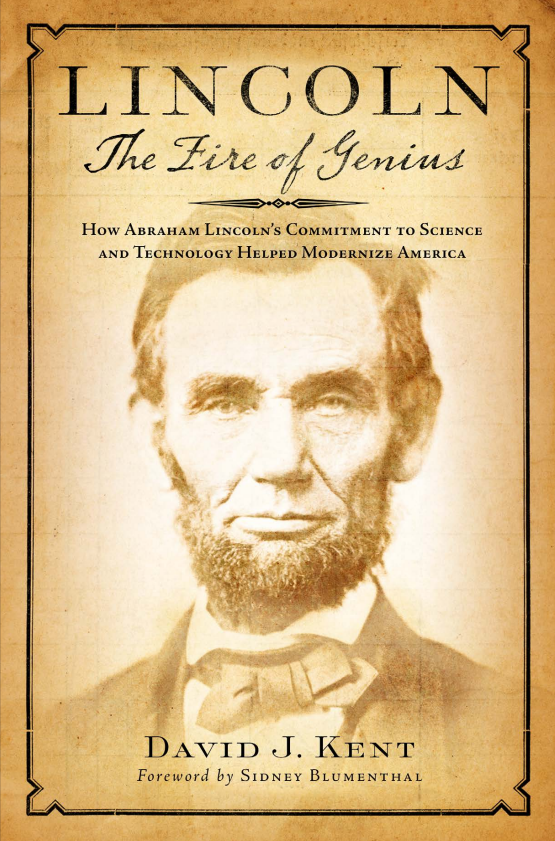

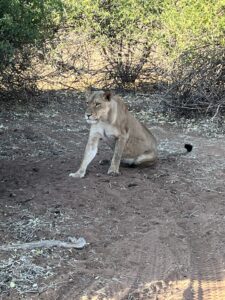
Photo: Lioness in Chobe National Park. She scooted her two young cubs under the nearby bush as soon as she saw us.

The first stop, and the first 15-hour flight, was to Cape Town, South Africa. Wary of arriving at the beginning of the organized tour with no buffer time, we planned a two-and-a-half-day stay in the most southwestern city of the southernmost country in Africa. Cape Town is a large, modern city most noted for its iconic football (aka, soccer) and rugby stadium and Table Mountain, the high plateau that dominates the skyline of the city. It also has Robben Island, where Nelson Mandela was held for 18 of the 27 years he was a political prisoner by the apartheid white supremacist government. The day up to the mountain via cable car was anticlimactic given it was socked in pretty conclusively with clouds and drizzle, but it was memorable in its own way anyway. We also rented a car and drove (on the left side) down the Cape Peninsula to Cape Point and the Cape of Good Hope (where we saw elands and ostriches). We also drank a lot of good South African wine, added my 61st aquarium visited, and enjoyed the sunny weather of the South African winter (cold in the morning, warm in the afternoon).

Then it was back to the airport and a flight to Maun, Botswana, known as the “Tourism Capital” of Botswana, mainly because it is an entryway into some of the more attractive safari parks in the country. Here we officially started our tour. From Maun we immediately boarded a small plane (a dozen seats) to fly up the Okavango Delta. The Delta is listed as a UNESCO World Heritage Site because it is one of the few interior delta systems that don’t flow into an ocean. In fact, the Delta begins in the Angola highlands and the river spreads out into the Botswana flatlands. The amount of surface water area varies significantly depending on season. Rather than flow into a large sea, the water just dries up. This is partly by rapid evaporation and transpiration and partly by sinking into the Kalahari Desert, which covers about 70 percent of Botswana. There was plenty of water while we were there, and plenty of birds, almost all of which were new to us. More on that in future posts.

Video above: An elephant in Okavango Delta warns us not to get any closer.

After a couple of days in the Delta we flew back to Maun and started the trek up through the Moremi Game Reserve to see elephants, various antelopes, zebras, wildebeest, and even more kinds of birds. From there we drove further north through the Chobe National Park. Chobe is known for its vast number of elephants, about 50,000 in the park alone. There are also large numbers of lions that prey on elephants. While they mostly look for calves or juveniles, the lions have been known to take small adults. At one point we crossed over the bridge over the River Khwai, which all of us conflated with the movie of the same name (but different spelling and location). I swear I heard whistling.

The final stop was across the border into Zimbabwe for its best-known feature – Victoria Falls. I’ll have much more on this in a future post, but the Falls are a must-see experience. The massive Zambesi River crosses through several countries on its way to the Indian Ocean. On the border between Zambia and Zimbabwe it drops over 100 meters (well over 300 feet) into a narrow gorge. Measuring in at about twice the height and twice the width of the combined Niagara Falls, Victoria Falls is classified as the largest waterfall in the world. The Zimbabwe side has the best view, with a walkway wiggling in and out along the cliffside where you’re sure to get wet from the mist. The Zambian side has a narrower view of one end.  

Video above: A small part of Victoria Falls, Zimbabwe

Which gets me to the unexpected visit to Zambia. The tour officially ended in Victoria Falls, the Zimbabwean town along the eponymous falls. But we were told by someone we ran into near Chobe that it was an easy walk across the bridge into Zambia, as long as you got a double-entry visa when you crossed into Zimbabwe from Botswana. Always willing to tag on another country, that’s what we did (even though the crossing, and especially the return, was not as easy as suggested).

And just like that it was time to go back home.

I plan to do additional posts on specific stops and/or events as soon as I can download and sort all the photos. Stay tuned.

[Photos by David J. Kent]

Fire of Genius

Lincoln: The Fire of Genius: How Abraham Lincoln’s Commitment to Science and Technology Helped Modernize America is available at booksellers nationwide.

Limited signed copies are available via this website. The book also listed on Goodreads, the database where I keep track of my reading. Click on the “Want to Read” button to put it on your reading list. Please leave a review on Goodreads and Amazon if you like the book.

You also follow my author page on Facebook.

David J. Kent is President of the Lincoln Group of DC and the author of Lincoln: The Fire of Genius: How Abraham Lincoln’s Commitment to Science and Technology Helped Modernize America and Lincoln: The Man Who Saved America.

His previous books include Tesla: The Wizard of Electricity andEdison: The Inventor of the Modern World and two specialty e-books: Nikola Tesla: Renewable Energy Ahead of Its Time and Abraham Lincoln and Nikola Tesla: Connected by Fate.