By now everyone has heard about the devastating earthquake that has left at least 3,700 people dead. At least 18 died when an avalanche buried the base camp of Mt. Everest. Rescue attempts are ongoing. For those who want to help, you can go here for links to vetted charities. The American Red Cross is also spearheading efforts to assist.
While the destruction and loss of life, and the much needed assistance to survivors, brings with it a sense of shock, the occurrence of earthquakes in Nepal and other regions near the Himalayan Mountains is not unexpected. In fact, earthquake experts gathered in Kathmandu, Nepal only a week ago to discuss the high likelihood of huge earthquakes. Little did they know one would occur so soon after they met.
The reason for high earthquake risk in the region has to do with why science traveling can be of such interest. Some of you may have heard about “plate tectonics,” or the movement of large “plates” of surface rock around the earth. The Himalayan Mountains are plate tectonics at work on a huge scale. In fact, they are still growing.
Roughly 150 million years ago, what has become the Indian subcontinent broke away from Antarctica. As it moved north it left behind what is now Madagascar. About 35 million years ago it smacked into Asia and as it continues to push it helps create the Himalayan Mountains. The tallest, Mt. Everest at 29,035 feet (8850 meters), is still getting taller by as much as 2+ inches (6+ cm) a year.
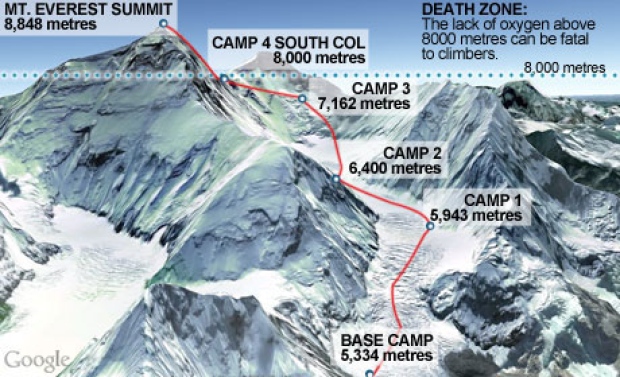
Why so tall? Because the Indian subcontinent was moving at breakneck speed. Racing along at 30 feet per year, it moved twice as fast as the slippage along the San Andreas fault. Usually once continents bang into each other the movement slows considerably, but India has kept moving at about 15 feet per year even after being blocked by Asia, hence the continued rapid growth of Mt. Everest and the rest of the Himalayas. The land has to go somewhere; in Nepal and environs, that somewhere is up.
All of this constant movement and pressure results in earthquakes since the movement tends to get stuck, then suddenly release and move great distances, then get stuck again. The current earthquake near Kathmandu registered 7.8 on the standard scale, but other big quakes have occurred nearby over the years, most notably a 6.9 quake in 2011 near Sikkim, India (along Nepal’s eastern border) and a massive 8.2 quake in 1934 in the same region.
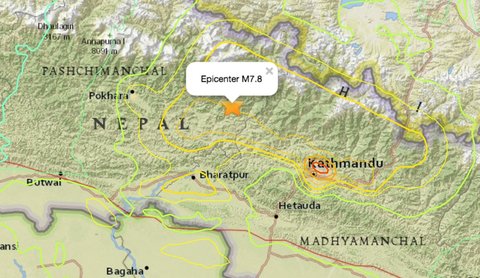
As science columnist Andrew Revkin notes, experts have been expecting another huge earthquake. Unfortunately, there is no way to predict when and where. The devastation caused by this quake is largely due to the shallowness of the epicenter (9.3 miles) and proximity to the capitol Kathmandu (50 miles). Lack of earthquake-resistant building standards and enforcement of any standards that do exist also contribute to the destruction.
If you can help, please do. Links to vetted assistance organizations can be found here, and the Red Cross is always on the job.
David J. Kent is the author of Tesla: The Wizard of Electricity (2013) and Edison: The Inventor of the Modern World (2016) (both Fall River Press). He has also written two e-books: Nikola Tesla: Renewable Energy Ahead of Its Time and Abraham Lincoln and Nikola Tesla: Connected by Fate. His next book, Lincoln: The Man Who Saved America, is scheduled for release in summer 2017.
Follow me by subscribing by email on the home page. And feel free to “Like” my Facebook author’s page and connect on LinkedIn. Share with your friends using the buttons below.
 Current writing projects are headlined by my forthcoming book on

 Here on Science Traveler the focus was on Abraham Lincoln, with several events commemorating his 2nd Inauguration and one of the finest speeches ever delivered.
  That wasn’t all Science Traveler was about. I also posted a photo retrospective of the
  On Hot White Snow I took a look at how we’ve moved
  The Dake Page posted a series of climate change-related pieces since the last update.
 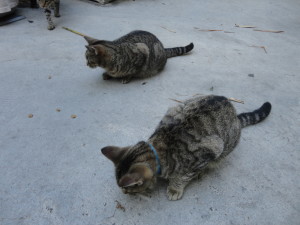 Not literally, of course, but as the guide informed us during our tour, Hemingway let dozens of feral cats roam his grounds freely. Many of them had six toes, a condition called polydactyly for you scientist-types out there. I recalled from my marine biology days that sailors thought polydactyl cats were good luck, or at the very least were better at catching rats. In any case, Hemingway was given a six toed cat by a ship’s captain and well, cats breed. There are currently 40-50 cats on the Hemingway property, which the guides regularly trot out for photo-ops.