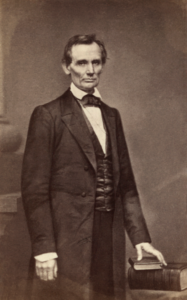
 Speaking on January 27, 1838, Abraham Lincoln noted that “the powerful influence by which the interesting scenes of the revolution had upon the passions of the people as distinguished from their judgment” had done much to maintain our institutions to that point. The Founders had put forth this nation as independent from Britain “in the advancement of the noblest cause – that of establishing and maintaining civil and religious liberty.”
But, Lincoln argued, “this state of feeling must fade, is fading, has faded, with the circumstances that produced it. The nation had reached a point where the passion of the revolution could no longer help us maintain our institutions, and in fact, passions “will in future be our enemy.”
Instead, Lincoln said that “reason, cold, calculating, unimpassioned reason, must furnish all the materials for our support and defense.” He went on to say that those materials must be molded into “general intelligence, sound morality, and in particular, a reverence for the constitution and laws.” We must all be good citizens, which means avoiding falling into tribal warfare against ourselves. “As a nation of freemen,” he argued, “we must live through all time or die by suicide.”
Which gets us to today. Back then he warned that citizens must be vigilant against both mob rule and abuses by the government. His entire time as president occurred during what in the Gettysburg Address he called “a great civil war, testing whether that nation, or any nation so conceived [in liberty] and so dedicated, can long endure.” Lincoln steered us through that cataclysm and would recognize a similar dynamic today.
Lincoln faced a portion of the United States that would destroy the union rather than allow rights to those they believed to be inferior. Then, as now, the same conservative forces were hijacked by a small number of wealthy men who pushed false narratives to rile the masses to rip apart the nation. Those false narratives inflamed passions and prejudices to convince what was essentially middle- and working-class Americans to blame the poorest Americans, distracting them from the wealthy classes that were exploiting them while benefiting themselves. Lincoln understood this was not a partisan belief but an acknowledgment of the real dynamic at play.
Today, in our 250th year as a nation, we must acknowledge the reality of similar dynamics at play. Rather than a separatist faction seceding from government, we have that faction taking control of government and using it against their people. Lincoln might see the parallels with the British Crown using tory “loyalists” against the rights of the citizenry of what became the United States. Tories opposed the freedoms of other Americans, supporting authoritarian rule. Those who stood up to the Crown fought on the right side of “the eternal struggle” between “right and wrong.” “The one is the common right of humanity and the other the divine right of kings.” Lincoln reminded us that “the approach of danger” to the nation will “spring up amongst us….If destruction be our lot, we must ourselves be its author and finisher.”
And so, we must stand firm, with reason, cold, calculating, unimpassioned reason, in our struggle against the takeover of our government by those who seek to use it to benefit the few instead of the many. As Lincoln noted in his 1861 message to Congress: “The struggle of today, is not altogether for today – it is for a vast future also.”
“We cannot escape history.”
In his Gettysburg Address, Lincoln said “the world will little note, nor long remember what we say here.” But we did remember what was said there. And we will remember what each and every one of us does here now, just as we remember the actions of those in 1930s and 1940s Germany. Our children and grandchildren will remember what we did here.
Will we stand up as our Founders stood up? Or will our semiquincentennial anniversary be our last?
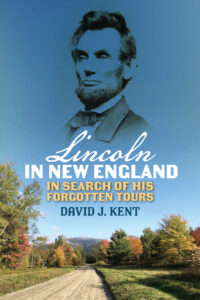
Coming in March 2026: Lincoln in New England: In Search of His Forgotten Tours
Join me on Goodreads, the database where I keep track of my reading. Please leave a review on Goodreads and Amazon if you like the book.
You also follow my author page on Facebook and on Instagram.
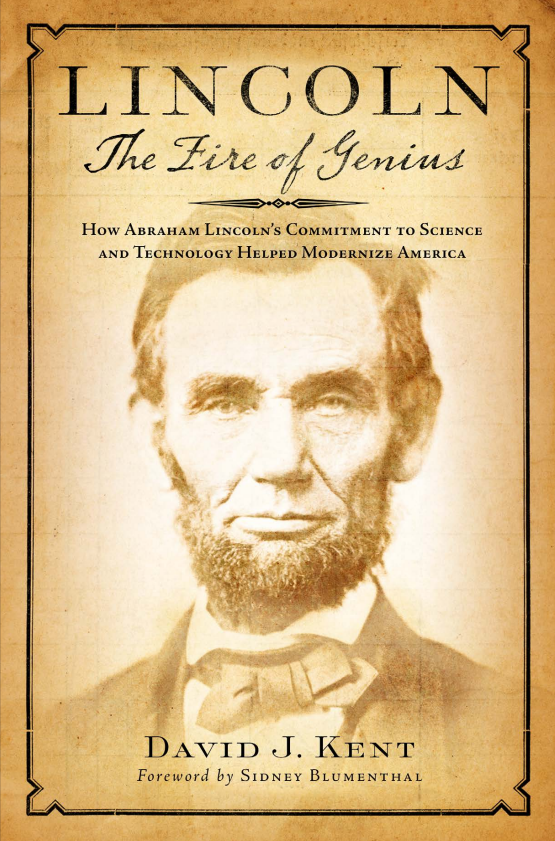
David J. Kent is Immediate Past President of the Lincoln Group of DC and the author of Lincoln: The Fire of Genius: How Abraham Lincoln’s Commitment to Science and Technology Helped Modernize America and Lincoln: The Man Who Saved America.
His previous books include Tesla: The Wizard of Electricity and Edison: The Inventor of the Modern World and two specialty e-books: Nikola Tesla: Renewable Energy Ahead of Its Time and Abraham Lincoln and Nikola Tesla: Connected by Fate.
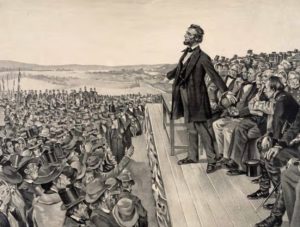 Union victories were coming more frequently in the late summer and fall of 1863, although not universally, as a loss at Chickamauga and the New York draft riots would attest. But now it was time for a more somber occasion.
 But wait, there’s more. This past year I made several “Chasing Abraham Lincoln” trips, including long road trips to Kentucky/Indiana and Illinois. Check out my