Update – Lincoln in New England Book Gets a New Title

Lincoln in New England cover coming soonBack in May I announced that I submitted the final manuscript for my new book about Lincoln’s two tours of New England. As the production process proceeds, I’ve been working with the editors to fine-tune the book. Most of that sausage-making is behind the scenes and won’t be noticeable to the public, but one change is rather obvious. I have a new title!

The title of the book in print will be…(imagine a drum roll here)…Lincoln in New England: In Search of His Forgotten Tours.

My original working title, Unable to Escape This Toil, came from a letter Abraham Lincoln had written to his wife Mary. He was in Exeter, New Hampshire at the time visiting his son Robert, who was at Phillips Exeter Academy studying to retake the Harvard entrance exams he had failed the previous summer. Lincoln had given a big (really big) speech at Cooper Union in New York, then planned a relaxing few days visiting his son. By the time he got there he had already given one additional speech and committed to at least five more. Another four were waiting for him when he arrived at the Exeter train station. In his letter home, Lincoln wrote: “I am unable to escape this toil,” he said, adding “If I had foreseen it, I think I would not have come East at all.” He was being a bit whiny and disingenuous, which I discuss in a paper that I just submitted to the Lincoln Forum Bulletin for publication this fall. In any case, the title seemed a big opaque to the general public, so we changed it to a much more descriptive Lincoln in New England. The subtitle is tweaked slightly to go with the new title.

As of this writing, Lincoln in New England: In Search of His Forgotten Tours is scheduled for release on Tuesday, March 3, 2026. You can even pre-order the book via the publisher website and other booksellers:

Globe Pequot (with links to Amazon, Barnes and Noble, Books-a-Million, and Bookshop)

Amazon

[The other links weren’t updated yet, so I’ll add them when they work]

Meanwhile, formatting of the book continues. It will include fifty black-and-white photos from my travels and of historical places, plus two maps to show Lincoln’s speaking tour routes.

Stay tuned for the cover reveal to come soon!

[Photos by David J. Kent, 2025]
Fire of Genius

Coming in March 2026: Lincoln in New England: In Search of His Forgotten Tours

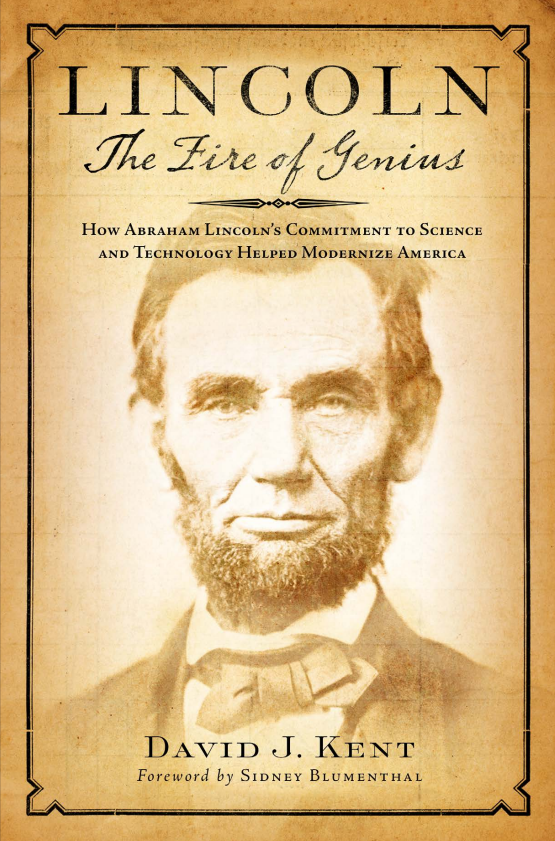
Also see – Lincoln: The Fire of Genius: How Abraham Lincoln’s Commitment to Science and Technology Helped Modernize America.

Join me on Goodreads, the database where I keep track of my reading. Please leave a review on Goodreads and Amazon if you like the book.

You also follow my author page on Facebook. Also follow me on Instagram.

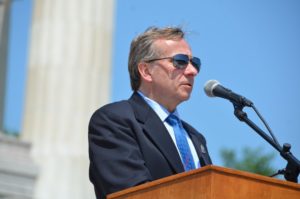
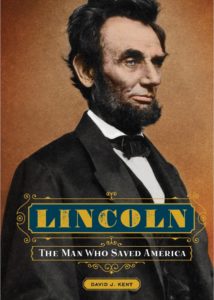
David J. Kent is Immediate Past President of the Lincoln Group of DC and the author of Lincoln: The Fire of Genius: How Abraham Lincoln’s Commitment to Science and Technology Helped Modernize America and Lincoln: The Man Who Saved America.

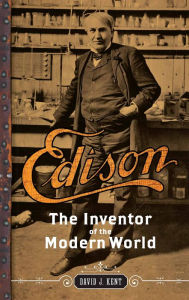
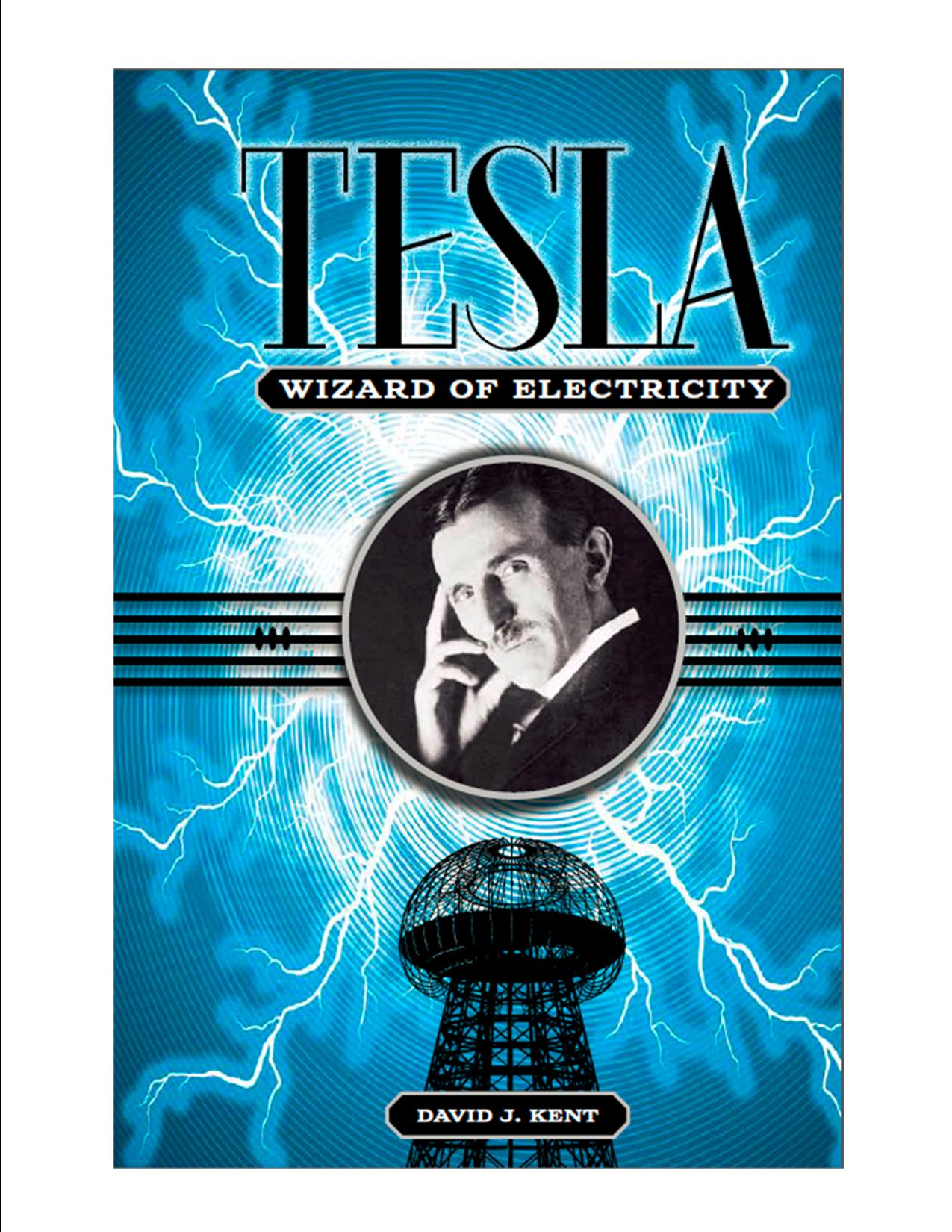
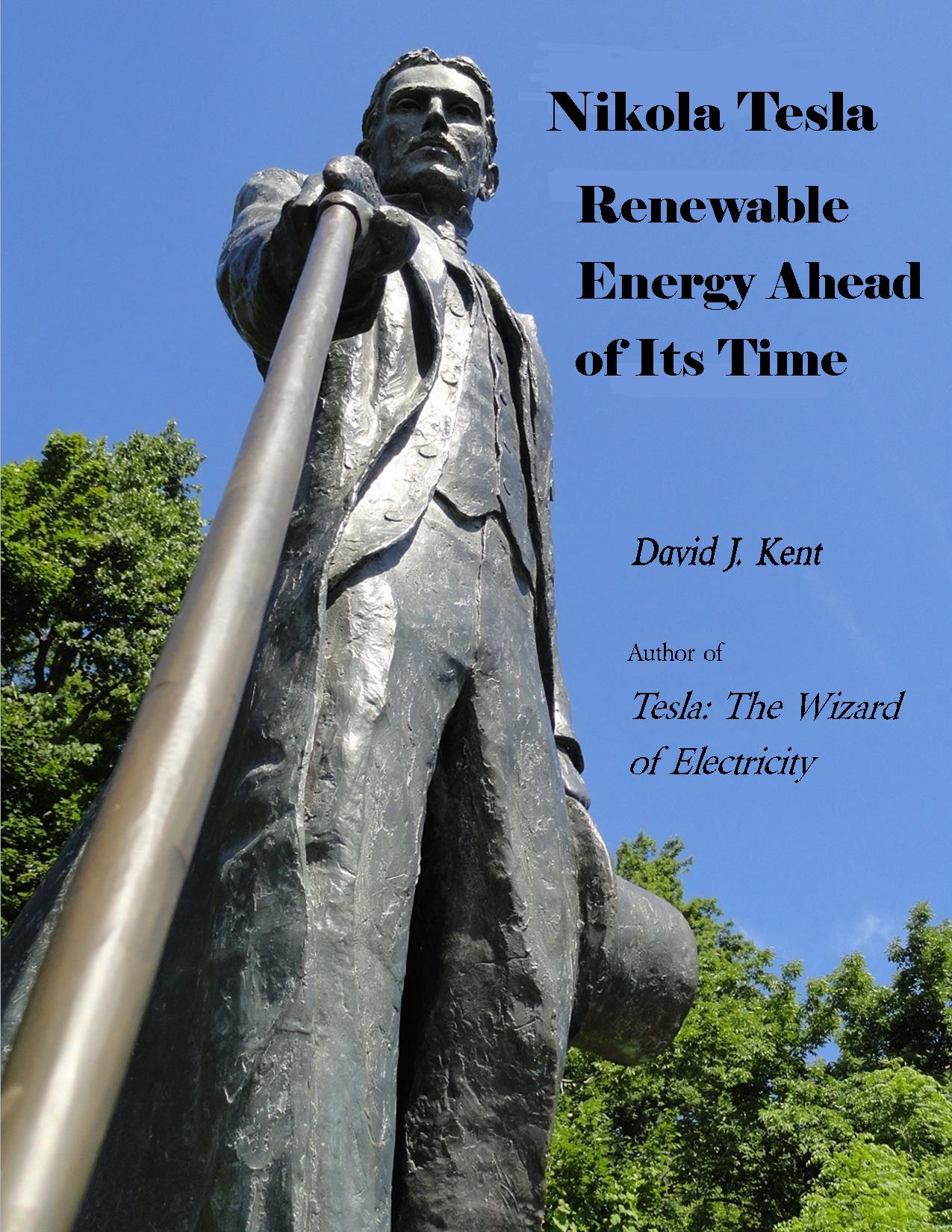
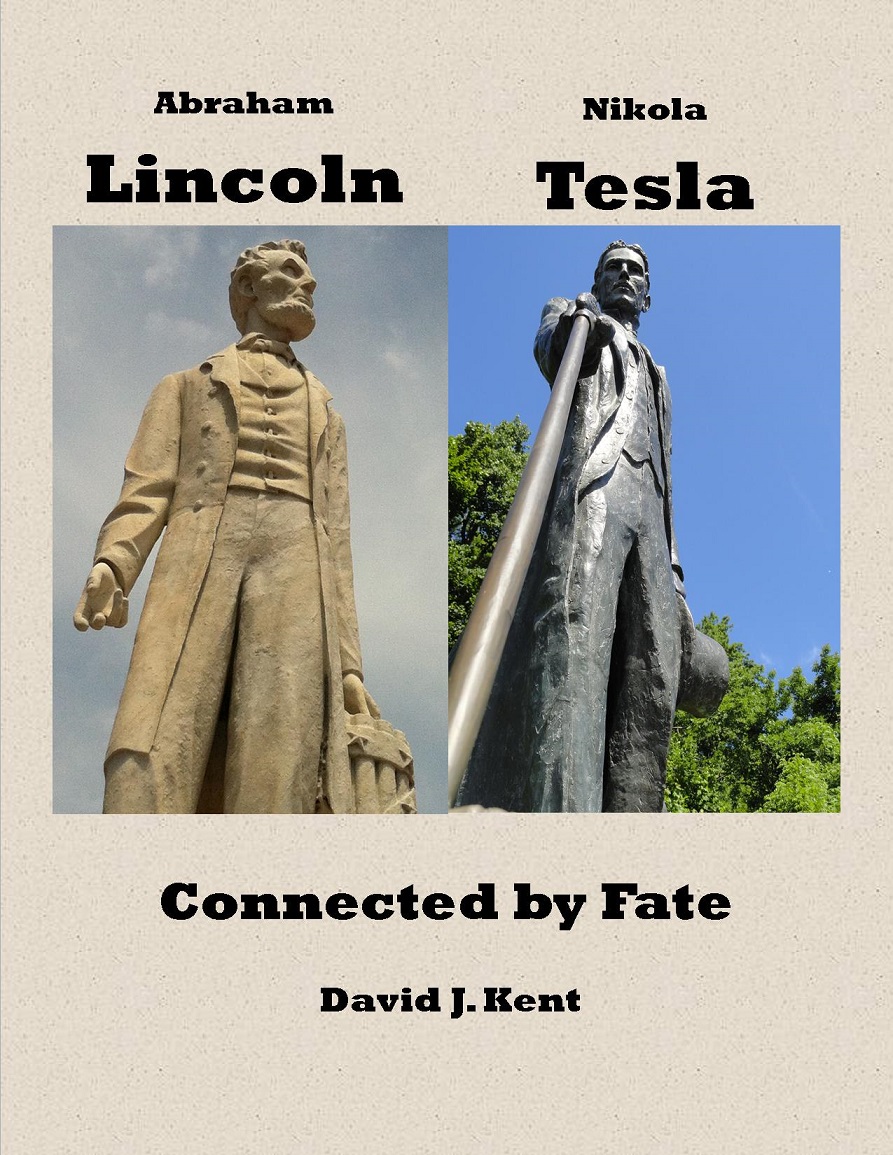
His previous books include Tesla: The Wizard of Electricity and Edison: The Inventor of the Modern World and two specialty e-books: Nikola Tesla: Renewable Energy Ahead of Its Time and Abraham Lincoln and Nikola Tesla: Connected by Fate.
Lincoln is Nominated for Vice President. Wait, What?

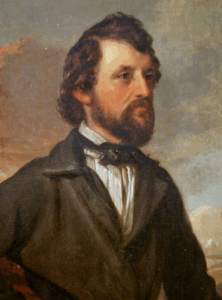
John C. FremontAbraham Lincoln is best known as the sixteenth President of the United States, long before the POTUS acronym was invented. He was elected in November 1860 and by the time he was inaugurated in March 1861, seven southern states had seceded, with four more joining them just over a month later after the new Confederacy attacked Fort Sumter. But this wasn’t the first time Lincoln had been put forward for executive office. In 1856 he was nominated by his fellow new Republican Party members for Vice President after the party had nominated John C. Fremont for President.
Lincoln didn’t win the final vote at the Republican convention. That went to the William L. Dayton of New Jersey. Lincoln and Dayton were joined by several other prominent figures of the time, such as Charles Sumner, Nathaniel Banks, Henry Wilson (all three from Massachusetts). When the first informal ballot was taken, Dayton led with 253 votes from the delegates to 110 votes for Lincoln. The next closest was Banks with 43. When the first official formal ballots were cast, Dayton had jumped up to 523 and Lincoln was down to 20. That’s not surprising as Dayton was considered the presumptive pick anyway. More surprising is that the one-term congressman who had been out of political office for over seven years was even being considered, no less placing a reasonable second.

Among those surprised to hear the news was Abraham Lincoln himself. When the Chicago newspaper containing the proceedings from the Republican convention held in Philadelphia reached Lincoln on June 20th, Lincoln joked that there must be some mistake. “I reckon that ain’t me; there’s another great man in Massachusetts named Lincoln, and I reckon it’s him.”

Presumably Lincoln was referring to Levi Lincoln, Jr., whom he had met in Worcester, Massachusetts during his visit to campaign for Zachary Taylor in 1848. Levi had been governor of Massachusetts and was Mayor of Worcester when the Whig’s held their state convention that year. Lincoln had gone there not just to promote Taylor, but to convince wayward Whigs who had formed a splinter party called the Free Soilers from accidentally handing the election to the Democrats. How successful he was in that attempt is part of my forthcoming book, Unable to Escape This Toil, but he joined several other prominent men at a dinner party at the Levi Lincoln mansion in the city and subsequently discovered that he and Levi were related through a common ancestor in Hingham.

In any case, Fremont lost that 1856 election so Lincoln wouldn’t have become vice president anyway, which is probably for the best. Four years later he would become the first Republican POTUS.

I’ll have more on Lincoln’s time in New England in future posts. Stay tuned for Lincoln in New England scheduled for release March 3, 2026.

[Photo of John C. Fremont in Public Domain, Wikimedia Commons]

Fire of Genius

Coming in March 2026: Lincoln in New England: In Search of His Forgotten Tours

Also see – Lincoln: The Fire of Genius: How Abraham Lincoln’s Commitment to Science and Technology Helped Modernize America.

Join me on Goodreads, the database where I keep track of my reading. Please leave a review on Goodreads and Amazon if you like the book.

You also follow my author page on Facebook. Also follow me on Instagram.

David J. Kent is Immediate Past President of the Lincoln Group of DC and the author of Lincoln: The Fire of Genius: How Abraham Lincoln’s Commitment to Science and Technology Helped Modernize America and Lincoln: The Man Who Saved America.

His previous books include Tesla: The Wizard of Electricity and Edison: The Inventor of the Modern World and two specialty e-books: Nikola Tesla: Renewable Energy Ahead of Its Time and Abraham Lincoln and Nikola Tesla: Connected by Fate.

Lincoln Nominates Zachary Taylor, Responds to His Wife, Goes to Massachusetts

Massachusetts State HouseOn June 11, 1848, congressman Abraham Lincoln arrived back in Washington, D.C. after having traveled all night from Philadelphia, where he attended the Whig National Convention that nominated Zachary Taylor for president. Upon his return he finds a letter from his wife Mary, who has been visiting her family in Kentucky for several months. These two events begin a campaign and a mystery.
Zachary Taylor was an odd choice to be the Whig nominee. Had had been fairly apolitical up to this point, having spent most of his life in the military. In fact, it was his military service in the Mexican War that ingratiated him to the American public, who clamored for him to be the next president of the United States. He was so popular that both the Whig and Democratic parties vied to make him their nominee. Taylor at first said he would only agree if he could do so “untrammeled with party obligations or interests of any kind,” the sort of divine elevation that George Washington had enjoyed after the Revolutionary War. Both the Whigs and Democrats quickly disavowed him of that politically naïve delusion. He agreed to sign on with the Whigs, finding them slightly less objectionable than the conservative Democrats of the South.

For his part, while Lincoln was in Philadelphia at the Whig Convention, he spurned his old beau ideal of a statesman, Henry Clay, and spoke out in favor of Taylor. Clay had been a nominee three times before, losing every time. Ever the vote counter, Lincoln wrote a friend that “Mr. Clay’s chance for an election, is just no chance at all,” going on to enumerate which states Clay could not carry. Based on his read of public sentiment, Lincoln noted, “in my judgment, we can elect nobody but Gen. Taylor.” And so Taylor became the Whig nominee. Lincoln was assigned to go to Massachusetts to make the case for Taylor, which as a I will discuss in future posts and in my forthcoming book, Unable to Escape This Toil: In Search of Abraham Lincoln’s Forgotten New England Tours, was not an easy task.

Which gets to the letter from Mrs. Lincoln. Mary and their two sons (Robert and Eddie) had been visiting her family in Lexington, Kentucky for months. They had been in a small boarding house room with Lincoln since he arrived in Washington to serve as Whig representative from Illinois, but boredom and conflicts with other tenants sent her south. Now she was planning to return to Washington. Lincoln, who had been happy to see her go, now seemed happy to have her come back. In his letter back to her the next day he wrote:

The leading matter in your letter, is your wish to return to this side of the Mountains. Will you be a good girl in all things, if I consent? Then come along, and that as soon as possible. Having got the idea in my head, I shall be impatient till I see you.

After noting that the congressional session was expected to end by July 17th, he added:

Come on just as soon as you can. I want to see you, and our dear—dear boys very much. Every body here wants to see our dear Bobby.

Here is where the mystery arises. When did Mary arrive in Washington, and did she accompany Lincoln on his tour of Massachusetts, which started on September 9th? On July 2nd he again wrote to Mary, who he presumed to have just started back, but then the record goes silent. The Lincoln Log mentions on July 23rd that “Mrs. Lincoln and boys probably arrive from Lexington about this time,” but this is merely conjecture based on Lincoln’s letter from three weeks before. No mention of Mary and the boys is recorded in the press or in the letters of Lincoln or any of his political escorts during Lincoln’s Massachusetts trip. The only indication that Mary was there comes from a letter she wrote in December 1867 (2.5 years after Lincoln’s assassination) rebutting statements by painter Francis Carpenter and claiming that “Mr. L. accompanied by my two little boys & myself, visited B[oston] & remained there 3 weeks, detained by the illness of our youngest son….” That would seem to confirm her presence, but there are several glaring errors in the letter that make suspect her memory of events that happened 20 years previously, especially given the extent of trauma she had experienced in that time. I dig more into this in a paper I’m writing for the Journal of the Abraham Lincoln Association.

Notwithstanding whether he was accompanied by his family or not, Lincoln definitely went to Massachusetts where he found more internal Whig conflicts than he could have imagined and learned valuable lessons that would position him for greatness.

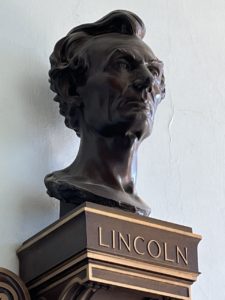
[Photo by David J. Kent, bust of Lincoln in the Massachusetts State House, Boston, MA]

Fire of Genius

Coming in February 2026: Lincoln in New England: In Search of His Forgotten Tours

Also see – Lincoln: The Fire of Genius: How Abraham Lincoln’s Commitment to Science and Technology Helped Modernize America.

Join me on Goodreads, the database where I keep track of my reading. Please leave a review on Goodreads and Amazon if you like the book.

You also follow my author page on Facebook. Also follow me on Instagram.

David J. Kent is Immediate Past President of the Lincoln Group of DC and the author of Lincoln: The Fire of Genius: How Abraham Lincoln’s Commitment to Science and Technology Helped Modernize America and Lincoln: The Man Who Saved America.

His previous books include Tesla: The Wizard of Electricity and Edison: The Inventor of the Modern World and two specialty e-books: Nikola Tesla: Renewable Energy Ahead of Its Time and Abraham Lincoln and Nikola Tesla: Connected by Fate.

Coming Soon: Unable to Escape This Toil – New Book from David J. Kent

It’s been submitted!

UPDATE: The book has been retitled: Lincoln in New England: In Search of His Forgotten Tours

I’m happy to say that I just submitted the manuscript for my newest book: Unable to Escape This Toil: In Search of Abraham Lincoln’s Forgotten New England Tours. The book is being published by Globe Pequot, the trade arm of Rowman & Littlefield Publishing Group. Unable to Escape This Toil is scheduled for release in February 2026.


Here is the Publisher’s Marketplace Announcement for the book:

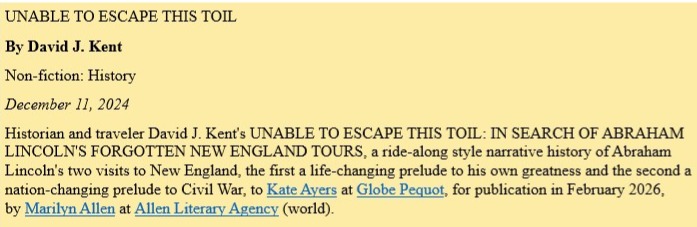
Unable to Escape This Toil Publishers Marketplace Announcement

As the announcement notes, the book is written in a “ride-along” style narrative, which means it blends coverage of my modern road trips of all the sites where Lincoln gave speeches during his two tours with the history of Lincoln’s times and issues. Readers get to visit the locations, check out what memorials remain of the sites, hear from local and regional experts, and get a sense of what the travel was like for Lincoln. Interwoven within the ride-along is the history of his time. Why was Lincoln there, and what did he accomplish?

In 1848, Lincoln’s first trip took him to Massachusetts between sessions of his single term as U.S. congressman. Zachary Taylor had been chosen as the Whig nominee for president, and the Whigs were finding he was not an ideal candidate. Lincoln spoke in Worcester to fend off a wayward Whig faction known as the Free Soilers, who were fielding their own nominee. In New Bedford he was expose to the growing abolitionist movement. He found himself dealing with another split in the Whig ranks between the Conscience and Cotton Whigs. The renowned writers of Concord were stirring up the transcendentalist pot against slavery. And Lincoln was discovering his Massachusetts ancestors. Lincoln went to Massachusetts “with hayseed in his hair” and came away vastly educated in the realities of the world

In 1860, Lincoln was back in New England, this time in Rhode Island, New Hampshire, and Connecticut. The twelve years since his last visit was one of life-altering chaos for him and for the nation. As tensions between North and South rose, Lincoln found himself taking his influential Cooper Union speech on the road trying to keep the new Republican Party from imploding while at the same time working hard to split the Democratic Party, now torn between its northern pro-slavery but pro-Union contingent led by Stephen A. Douglas and its southern pro-slavey but pro-secession faction looking for an alternative.

Lincoln’s first trip changed him. His second trip changed the country and sent us into the Civil War.


Now that the manuscript is in the hands of my editor, I’ll be giving more information on the forthcoming book as the cover and bookseller links become available. I hope you’ll bookmark this website and join my Facebook and Instagram pages. Keep on the lookout for free giveaways and other incentives as the release date gets closer. And as always, thanks for all your support.

If you haven’t already, check out my previous book, Lincoln: The Fire of Genius, and leave a review on Goodreads and Amazon to help get the word out.

Fire of Genius

Coming in February 2026: Lincoln in New England: In Search of His Forgotten Tours

Also see – Lincoln: The Fire of Genius: How Abraham Lincoln’s Commitment to Science and Technology Helped Modernize America.

Join me on Goodreads, the database where I keep track of my reading. Please leave a review on Goodreads and Amazon if you like the book.

You also follow my author page on Facebook. Also follow me on Instagram.

David J. Kent is Immediate Past President of the Lincoln Group of DC and the author of Lincoln: The Fire of Genius: How Abraham Lincoln’s Commitment to Science and Technology Helped Modernize America and Lincoln: The Man Who Saved America.

His previous books include Tesla: The Wizard of Electricity and Edison: The Inventor of the Modern World and two specialty e-books: Nikola Tesla: Renewable Energy Ahead of Its Time and Abraham Lincoln and Nikola Tesla: Connected by Fate.