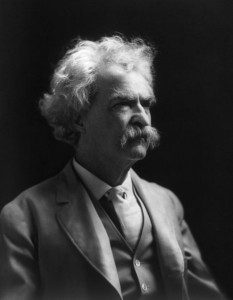
 Samuel Clemens, known to most of us by his pseudonym Mark Twain, was born in Florida, Missouri (but grew up after the age of four in Hannibal) on November 30, 1835, shortly after Halley’s Comet had made its regular but rare pass by the Earth. The 26-year-old Abraham Lincoln – an amateur astronomy buff who two years earlier had marveled at the Leonid meteor showers – may very well have been gazing at the skies when Mark Twain came into this world. At that age Lincoln lived in New Salem, Illinois, just a stone’s throw across the Mississippi River from Hannibal. In 1859, Lincoln rode the Hannibal and St. Joseph Railroad to give a speech in Council Bluffs, Iowa. The railroad just happened to be formed in the office of Mark Twain’s father thirteen years before.
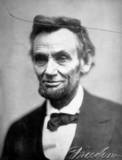 Lincoln floated flatboats down the Mississippi River to New Orleans as a young adult, then took steamboats back upriver. He often piloted steamboats around shoals near his New Salem home. Mark Twain had worked on steamboats on the river for much of his younger years, first as a deckhand and then as a pilot. Being a riverboat pilot gave him his pen name; “mark twain” is “the leadsman’s cry for a measured river depth of two fathoms (12 feet), which was safe water for a steamboat.” In 1883 Twain even titled his memoir, Life on the Mississippi. As we have already seen, Lincoln’s time traveling on and piloting steamboats eventually inspired his patent for lifting boats over shoals and obstructions on the river.
Lincoln would not have read any of Mark Twain’s stories (his first, The Celebrated Jumping Frog of Calaveras County, was published in 1865, about seven months after Lincoln had been assassinated). But Twain says his humorous writing style was strongly influenced by another pen named-humorist, Artemus Ward, and the Jumping Frog story was published in the New York Saturday Press only because he finished it too late to be included in a book Artemus Ward was compiling. This is the same Artemus Ward that was so often read by Abraham Lincoln to break the tensions of the Civil War.
In fact, Lincoln was so entranced by the humor of Ward that on September 22, 1862 he read snippets from one of Ward’s books to his cabinet secretaries before settling into the business of the day – the first reading of the preliminary Emancipation Proclamation.
Ironically, Mark Twain’s piloting job ended when the Civil War started, as much of the Mississippi River became part of the war zone. So what is a writer/river-boatman to do? Well, join the Confederate army of course. His unpaid service lasted only two weeks in 1861 before disbanding. He then left for Nevada to work for his older brother, out of harm’s way for the rest of the war, though his brief service for the confederacy did give him material for another of his humorous sketches, The Private History of a Campaign That Failed.” Later, Mark Twain would publish the memoirs of Civil War hero and President, Ulysses S. Grant.
Like Lincoln, Mark Twain was very interested in science and technology. Twain actually had three patents of his own, for a type of alternative to suspenders, a history trivia game, and a self- pasting scrapbook.
Lincoln and Twain never met, but I think they would have gotten along famously.
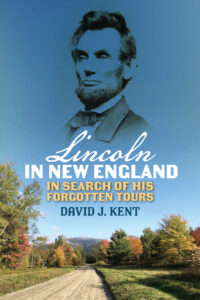
Now Available: Lincoln in New England: In Search of His Forgotten Tours. Or Order directly at:
Amazon Barnes & Noble Books-a-Million Bookshop
Join me on Goodreads, the database where I keep track of my reading. Please leave a review on Goodreads and Amazon if you like the book.
You also follow my author page on Facebook and on Instagram.
David J. Kent is Immediate Past President of the Lincoln Group of DC and the author of many books on Abraham Lincoln, Nikola Tesla, and Thomas Edison.