


 One of the great debates among Lincoln scholars is when he started thinking of himself as a viable candidate for president. Back in those days it was considered unseemly to actively campaign for such high elective office. Even the series of Lincoln-Douglas debates was ostensibly to make the case for the party such that enough local representatives could be elected to provide a sufficient majority in the state legislature, since it was the legislature who chose the U.S. Senators, the case until the 17th amendment in 1913 changed it to the direct vote we have today. His post-Cooper Union tour of New England certainly helped his case. Robert Lincoln later said that if he hadn’t failed his Harvard entrance exams, necessitating remedial study at Phillips Exeter Academy and Lincoln’s visit, his father may not have become president. In any case, several incidents suggest Lincoln was thinking about himself as a viable candidate for president both before, and especially after, his trip to New England.
Even the year before, Lincoln was invited along with other likely presidential contenders to attend an April 1859 dinner in Boston celebrating Thomas Jefferson’s birthday. That may have been a recognition of his minor celebrity status following the 1858 debates, but later that year, business magnate and influencer Jesse Fell coaxed Lincoln into providing an autobiographical sketch that was expanded and widely distributed across the country. In addition to enough viability to garner an invitation to give the Cooper Union speech, several of his New England hosts introduced him as presidential or vice-presidential material. On his return trip to New York, James Briggs told Lincoln that “I think your chance of being the next President is equal to that of any man in our country.”
Not long after he returned to Springfield, he replied to Ohio businessman, Samuel Galloway, who had suggested that the Ohio legislature supported Lincoln as the Republican nominee. It is in this letter where Lincoln first voices the idea that he is likely not the first choice of a very great many (those going to Seward, Chase, Bates, or a given state’s native son) and thus “our policy, then, is to give no offence to others – leave them in a mood to come to us, if they shall be compelled to give up their first love.”
Two weeks after that letter, he replied to Cincinnati lawyer Richard Corwine, who had also suggested Lincoln as a potential nominee. Lincoln told Corwine that: “Remembering that when not a very great man begins to be mentioned for a very great position, his head is very likely to be a little turned,” although he concluded he perhaps was not the fittest person to address the question. He then went on to say that while he thought “Mr. Seward is the very best candidate we could have for the North of Illinois,” Seward was “the very worst for the South of it” (because of southern Illinois more pro-slavery inclinations). He continued on in his analysis of the various contenders, while disqualifying himself to speak on his own behalf, again reflecting the tendency of the time to find self-promotion for high office as unseemly.
That said, by late April 1860 he was receiving more and more requests to “make himself available” for nomination. Writing back to Lyman Trumbull on April 29, Lincoln, again deferentially, says:
As you request, I will be entirely frank. The taste is in my mouth a little; and this, no doubt, disqualifies me, to some extent, to form correct opinions. You may confidently rely, however, that by no advice or consent of mine, shall my presentations be pressed to the point of endangering our common cause.
In other words, I’m all for the Republican candidate who can win the November elections. I won’t put my personal ambitions ahead of that goal, but if the party so chooses me as their nominee, I’m available.
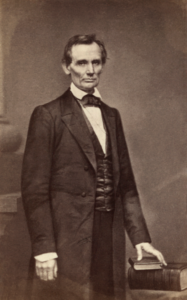
[Photo by Mathew Brady, February 27, 1860; public domain]
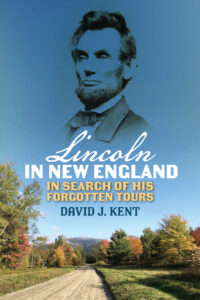
Now Available: Lincoln in New England: In Search of His Forgotten Tours
Join me on Goodreads, the database where I keep track of my reading. Please leave a review on Goodreads and Amazon if you like the book.
You also follow my author page on Facebook and on Instagram.
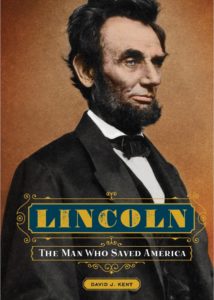
David J. Kent is Immediate Past President of the Lincoln Group of DC and the author of many books on Abraham Lincoln, Nikola Tesla, and Thomas Edison.



I love that photograph by Brady and have a print of it on my wall.
Some argue that the photograph made him president, mostly because it was printed on CDVs and distributed.