 I have just read your dispatch about sore tongued and fatigued horses. Will you pardon me for asking what the horses of your army have done since the battle of Antietam that fatigue anything? A. LINCOLN
General George B. McClellan was at it again. Or not at it, in a sense. McClellan had a habit of overestimating the enemy troop numbers and underestimating his own ability to attack. Lincoln was constantly frustrated.
In September 1862, Confederate General Robert E. Lee led his Army of Northern Virginia into western Maryland. Following their victory at a second battle of Bull Run, Lee moved his army north to a point near Sharpsburg, alongside Antietam Creek, where they took up defensive positions. With surprising aggressiveness, McClellan’s Army of the Potomac attacked Lee’s forces on September 17. The first assault came from Union General Joseph Hooker on Lee’s left flank, while General Ambrose Burnside later attacked the right. A surprise counterattack from Confederate General A.P. Hill helped push back Union forces. Eventually, Lee’s troops withdrew from the battlefield first. He moved his remaining army back across the Potomac into the safety of Virginia.
Always overly cautious, McClellan made no effort to follow. Lee had committed all of his 55,000 men, while McClellan only ordered a portion of his larger 87,000-man force into the fray. This numerical imbalance allowed Lee to create and exploit tactical advantages he should not have had. When questioned by Lincoln about his failure to pursue Lee, McClellan complained that his army and horses were sore-tongued and fatigued, and thus required rest. Lincoln responded tersely by telegram:
Will you pardon me for asking what the horses of your army have done since the battle of Antietam that fatigue anything?
Antietam was destined to be the single bloodiest day of battle in American history. The casualties for both armies totaled a staggering 22,717 dead, wounded, or missing.
Despite Lincoln’s frustration, Antietam stood out as an important battle in the fight for freedom. Although essentially a draw, the fact that Lee withdrew from the battlefield first allowed the North to record Antietam as a victory, something that Lincoln had been needing for some time. A few days later, Lincoln issued the Emancipation Proclamation.
[Adapted from Lincoln: The Man Who Saved America]
David J. Kent is an avid science traveler and the author of Lincoln: The Man Who Saved America, in Barnes and Noble stores now. His previous books include Tesla: The Wizard of Electricity and Edison: The Inventor of the Modern World and two specialty e-books: Nikola Tesla: Renewable Energy Ahead of Its Time and Abraham Lincoln and Nikola Tesla: Connected by Fate.
Check out my Goodreads author page. While you’re at it, “Like” my Facebook author page for more updates!
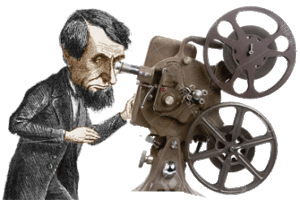 Technically, Lincoln didn’t attend the exhibition, but on this date, October 14, 1861, a committee of commissioners for the industrial exhibition in England visits President Lincoln in the White House and asks use of a government vessel to transport American contributions to the fair. Lincoln had supported United States participation.
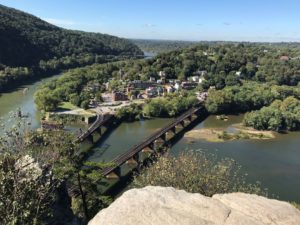 President Lincoln took a special train to Harpers Ferry on October 1, 1862. I drove my car to the National Park Service visitors center on October 1, 2021. Lincoln reviewed the troops on Bolivar Heights. I climbed to the overlook on Maryland Heights. One hundred and fifty-nine years separated us, but I still felt his presence.
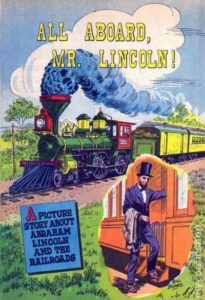 On June 23, 1854, Abraham Lincoln draws on his account at the Illinois Central Railroad. The ICRR had been a repeat source of work for the Lincoln, who had been focusing on his legal career after being relegated to the sidelines politically. He would not be in an elected position for eleven years. He did a variety of work for several railroads, but the ICRR by far was the most prolific and profitable. Still, he wasn’t making much money per case.
 Back in mid-July, I was happy to report that the Lincoln Group of DC was going back to live, in-person, programming. What a difference a couple of months makes. As readers will already have seen, our October meeting with Ron White, originally planned as a big in-person luncheon shindig complete with special surprises, is not going to happen. Ron has rightfully reconsidered his travel to the east coast because of the pandemic. Instead, Ron will give us a virtual presentation on
 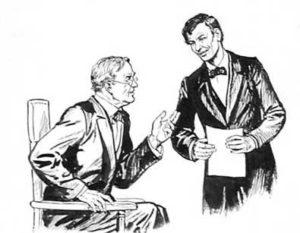 On September 10, 1856, Abraham Lincoln wrote an affidavit in a medical malpractice case that involved chicken bones. It was the first medical malpractice case in McLean County.
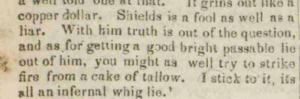 I see you printed that long letter I sent you a spell ago—I’m quite encouraged by it, and can’t keep from writing again.
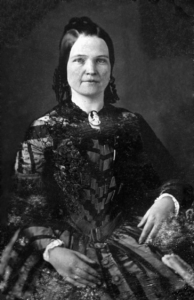 On this auspicious date in 1844, Mrs. Lincoln bought material to make corsets. Six yards of “gimp,” which was a strong twisted silk, wool, or cotton (not to be confused with the plastic form of gimp I used in Boy Scouts), along with ample amounts of lace. Presumably she already had whalebone or simply used over-starched fabric for stiffness. As critical as this was for containing the spreading remnants of Robert’s birth the previous year, this was only one of many important events happening on
 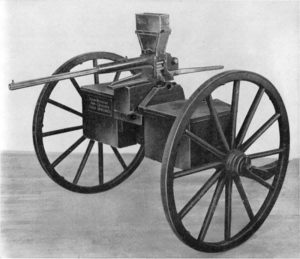 On August 17, 1861, Abraham Lincoln witnessed an exhibition of what Lincoln dubbed the “coffee mill gun.” Lincoln was always pushing for modernized weaponry beyond the standard muskets, which were inaccurate and slow to reload. He pushed Ordinance Chief James Ripley to put into service various breechloaders, rifles, carbines, and repeaters.
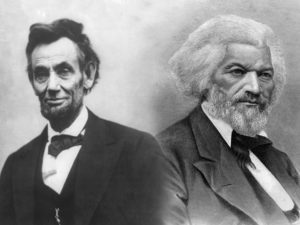 On August 10, 1863, Abraham Lincoln met with Frederick Douglass in the White House. Douglass had arrived unannounced, accompanied by Kansas Senator Samuel Pomeroy. They found the waiting room filled with people seeking an audience with the president, so Douglass, dressed in a dark suit on this sweltering August morning, assumed he would have a long wait. Instead, Lincoln’s secretary John Hay came quickly out to greet him and usher him into the inner sanctum.