It’s no secret that Beijing has an air pollution problem. The city’s PM2.5 (a measure of particulates in the air) routinely exceed unsafe levels; and I don’t mean exceed by just a tad, exceed by 800% or more. About 4000 people per day die in China from air pollution. I saw – literally – this pollution on my most recent visit to Beijing.
The view from the apartment where I was staying, in the southern part of the city far from the touristy areas, gave me a good indication of what I was to experience.
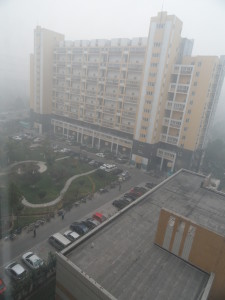
That isn’t fog; it’s smog, which smog permeated the air no matter where I went. Mid-afternoon on a “sunny” day, the huge portrait of Mao Zedong on the front wall of the Forbidden City was barely visible from Tian’anmen Square.
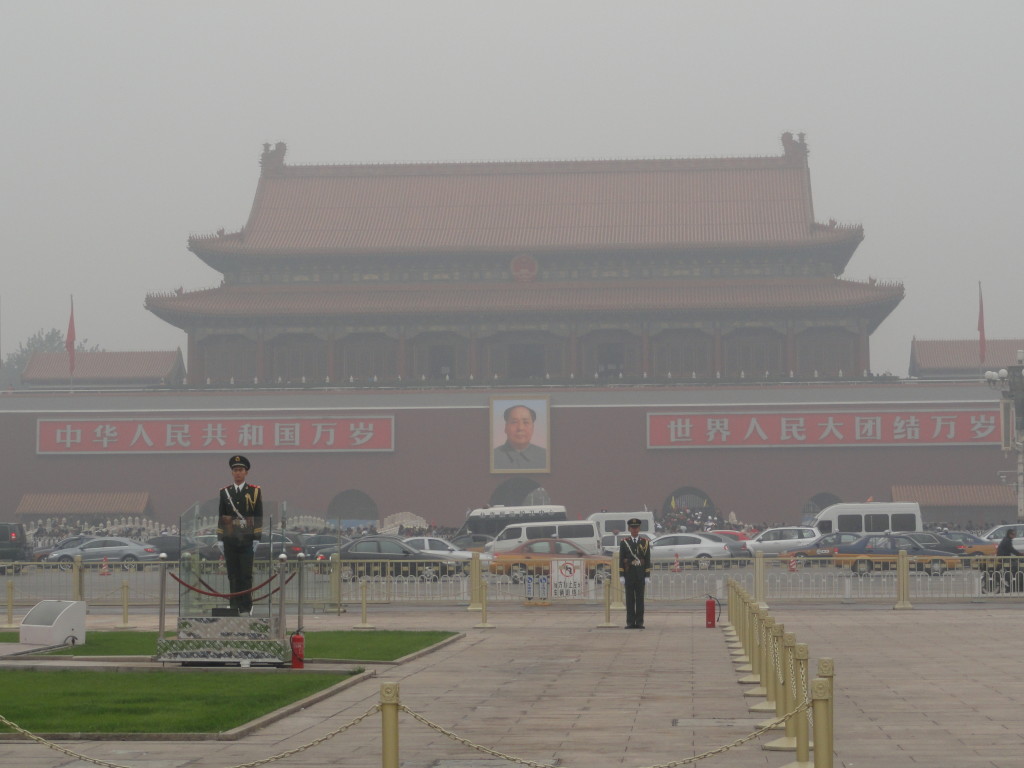
I didn’t just happen to pick a bad day; this is routine. So routine that the government installed huge television screens, ostensibly as tourist marketing advertisements, but often filled with beautiful vistas of Chinese landscapes. They even show photos of the Forbidden City on those days where the entire facade is hidden.
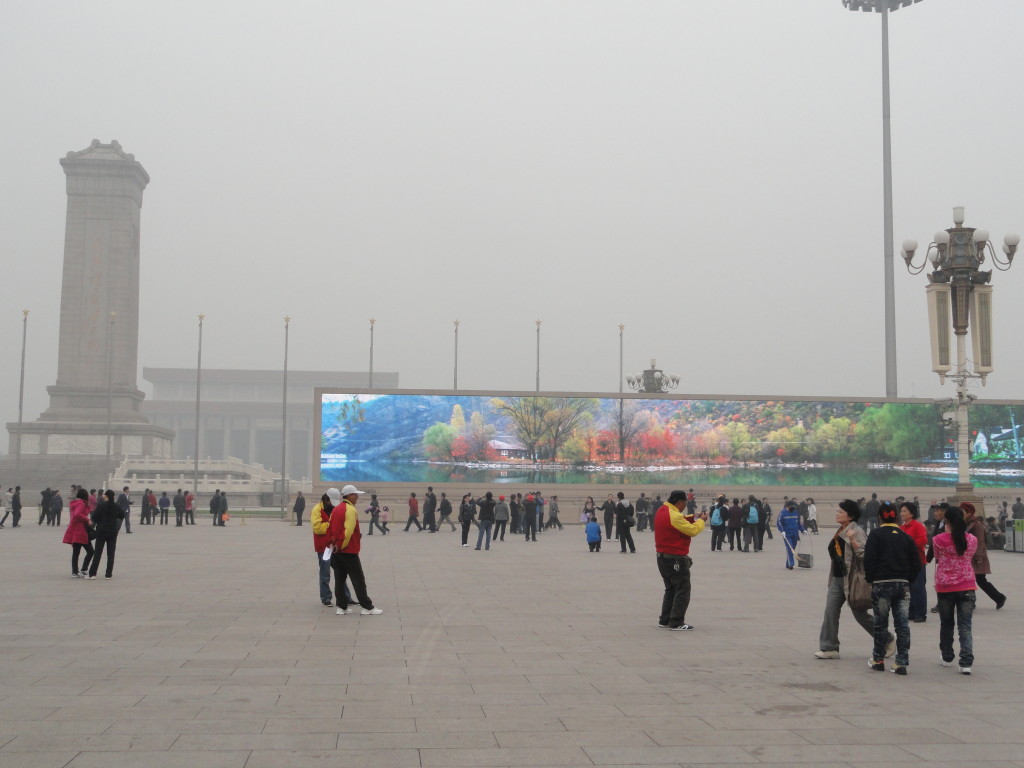
As I write this Beijing is preparing for its September 3rd remembrance of the end of World War II for China 70 years before. As with many big international events held in Beijing, including the 2008 Olympics and the 2014 APEC Summit, the Chinese government has ordered stopgap measures to make Beijing more palatable to foreign dignitaries. This means closing down much of the capital, shutting down factories, and banning odd/even tagged cars on alternate days. These result in temporary cleansing of the air – just long enough for the foreign press to get nice pictures. Once the grand show is over, the air clogs up again and residents don their dust masks in a feeble attempt at normalcy.
Science Traveler will cover more of the science of China in future posts. One area of interest is the impact of a growing middle class, and the consumption that goes with it, on energy demand. China has a coal and oil problem even worse than the United States, but it also has been building solar and wind capacity. Clearly they have to do something, not just for climate change considerations, but for the health of their own citizens.
David J. Kent is the author of Tesla: The Wizard of Electricity (2013) and Edison: The Inventor of the Modern World (2016) (both Fall River Press). He has also written two e-books: Nikola Tesla: Renewable Energy Ahead of Its Time and Abraham Lincoln and Nikola Tesla: Connected by Fate. His next book, Lincoln: The Man Who Saved America, is scheduled for release in summer 2017.
Follow me by subscribing by email on the home page. And feel free to “Like” my Facebook author’s page and connect on LinkedIn. Share with your friends using the buttons below.
 To be a writer you have to write…a lot. Much of your writing won’t see the light of day, but it’s critical to keep writing daily. That said,

 First there was Nikola Tesla, and now there is Thomas Edison. Those who follow this page know that my book
  Historian Richard Wightman Fox employs a unique concept in discussing Abraham Lincoln: Lincoln’s body. His body – the physical, the figurative, the aura, and the memory – is used to trace how he was perceived at the time and during several periods since then to the present day. In doing so, Fox has successfully provided a mirror into not only Abraham Lincoln, but ourselves.
 Thud.
Thud. Recently there has been a sudden surge in support for passing bills in both the House and Senate to modernize the four-decade-old Toxic Substances Control Act, i.e., TSCA. This post will explain why this is happening, why TSCA Reform can pass now, and why it should pass – even though it likely will do nothing substantial to make us safer.