 On September 14, 1848, Abraham Lincoln converged on the city of New Bedford, Massachusetts, to campaign for the Whig presidential candidate, Zachary Taylor. On August 14, 2026, Sam Waterston – the eminent actor who often performed Abraham Lincoln’s words in venues across the nation – followed in Lincoln’s footsteps to New Bedford. This time, Waterston was not quoting Lincoln. He was reading an excerpt from Herman Melville’s Moby Dick to commemorate the unveiling of a new statue of Melville on the grounds of the Seamen’s Bethel Chapel in New Bedford.
In my book released earlier this year, Lincoln in New England: In Search of His Forgotten Tours, I related my own visit to New Bedford and the Seamen’s Bethel:
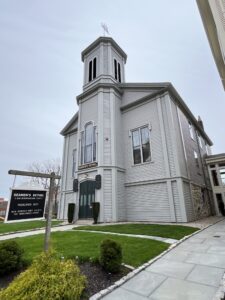
My old marine biology days flashed back as I toured the area around the Historical Park. Across the street from the visitor center was the Custom House, an important facility back in the whaling days and now shared by branch offices of the U.S. Customs and Border Control Agency and the National Marine Fisheries Service, that latter for which I had worked coming out of college. A block away was the New Bedford Whaling Museum and the Mariners’ Home built in 1795 and since 1850 housing and feeding poor, unskilled whaling crew back in port from their long voyages. Next door was Seamen’s Bethel Church, built in 1832 “to protect the rights and interests of Seamen, and to furnish them with…moral, intellectual and religious instruction.” A young man named Herman Melville joined one of these long-haul voyages in 1839, which led him to write the classic whaling epic, Moby Dick. While in the novel Melville writes that “the town itself is perhaps the dreariest place to live in,” he added “in the same New Bedford there stands a whaleman’s chapel and few are the moody fishermen, shortly bound for the Indian or Pacific Oceans who failed to make a Sunday visit to this spot.” Today the Seamen’s Bethel church proudly highlights its whaling heritage and its connection to the giant white sperm whale that became Ahab’s – and Melville’s – obsession.
As noted in the city’s account of the statue unveiling, Herman Melville famously “worshipped at the Seamen’s Bethel almost 200 years ago before sailing out on the whaling journey that inspired Moby-Dick.” The new statue sculpted by Stefanie Rocknak it titled Melville and Jonah’s Journey and “was inspired by Chapter 9 of the literary masterpiece when Father Mapple offers a sermon about Jonah, who was swallowed by a whale but was saved after repenting and committing himself “to preach truth to the face of falsehood.” The bronze statue stands “7½ feet off the ground [and] captures Melville standing firm and composed with sea swirls around his feet as three large whale ribs emerge from the water “representing Melville’s own journey into and out of the whale. Yet, Melville rises above them, his mouth open, as though beginning to speak – to tell the story of Moby-Dick, this truth.” Waterston’s reading brought out the power and emotion of the passage that inspired the statue.
The full unveiling ceremony at the Seamen’s Bethel can be watched on YouTube below:
Lincoln and Melville would cross paths again. During the Civil War, Melville visited President Lincoln in the White House to lobby for government employment. Unfortunately for Melville, Lincoln could not accommodate him and Melville went away empty-handed. After the war, he became a customs inspector in New York City and wrote poetry, his most successful days as a writer behind him.
I discuss New Bedford more in Lincoln in New England, as well as his entire 1848 tour of Massachusetts and his later visits to Connecticut, Rhode Island, and New Hampshire in 1860. The first trip made Lincoln the Lincoln we think of him as; the second trip made him president.
[Photo credit: Seamen’s Bethel by David J. Kent]
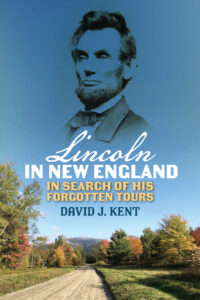
Now Available: Lincoln in New England: In Search of His Forgotten Tours. Or Order directly at:
Amazon Barnes & Noble Books-a-Million Bookshop
Join me on Goodreads, the database where I keep track of my reading. Please leave a review on Goodreads and Amazon if you like the book.
You also follow my author page on Facebook and on Instagram.
David J. Kent is Immediate Past President of the Lincoln Group of DC and the author of many books on Abraham Lincoln, Nikola Tesla, and Thomas Edison.