In Search of Abraham Lincoln in the Balkans

Abraham Lincoln is everywhere, or so it seems. The Lincoln Sculpture Project Map created by David Wiegers and Scott Schoeder (an LGDC board member) has reached close to 700 sculptures around the world, with new ones being added as soon as they go up. During my recent travels in the Balkans, I went in search of one of the more elusive – and apparently cryptic – statues, in of all places, Skopje, North Macedonia.
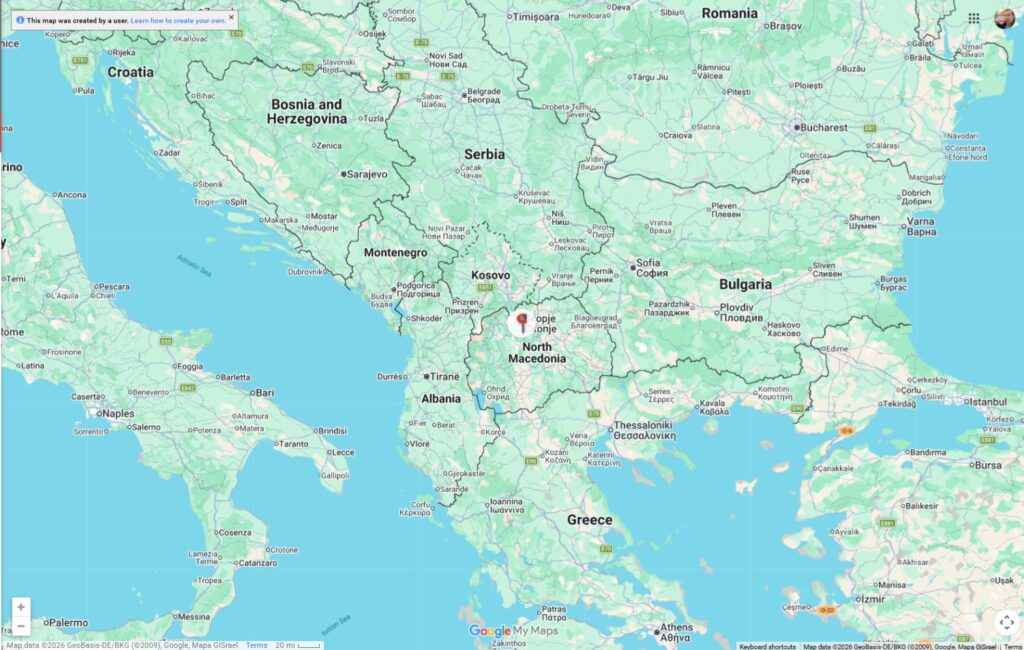
Lincoln Sculpture Project Map of Skopje, North Macedonia

The map above gives you an idea of the area under discussion. That sole red flag designating a Lincoln sculpture is Skopje, the capital of North Macedonia. Like other nations in the region, Macedonia was once part of Yugoslavia following the second World War, then became its own nation during the ensuing split in 1991. A complicated naming dispute with Greece led to the “North” being officially added to the name in 2018. My recent trip took me to Serbia, Bosnia and Herzegovina, Montenegro, Albania, and North Macedonia. It was on the final stop that I eagerly raced through the record heat (highs were generally near or even over 100F the entire time) to find the Ministry of Foreign Affairs and Foreign Trade, a modern building erected during a spurt of growth in 2011-2014.

As part of the design, the government planned to erect dozens of statues on the top and midlevel of this building, as well as the surrounding buildings, the bridges over the river, and the nearby main square. There are statues everywhere. But was there a Lincoln statue?

According to the Sculpture Project Map there is, but they had no photograph, no information on the sculptor, or any other details. My snooping around came up with an article published at the time of the project noting that the statues along the rooftop would include many world leaders, not the least of which were Winston Churchill, George Washington, and Abraham Lincoln. Confirming that became a chore.
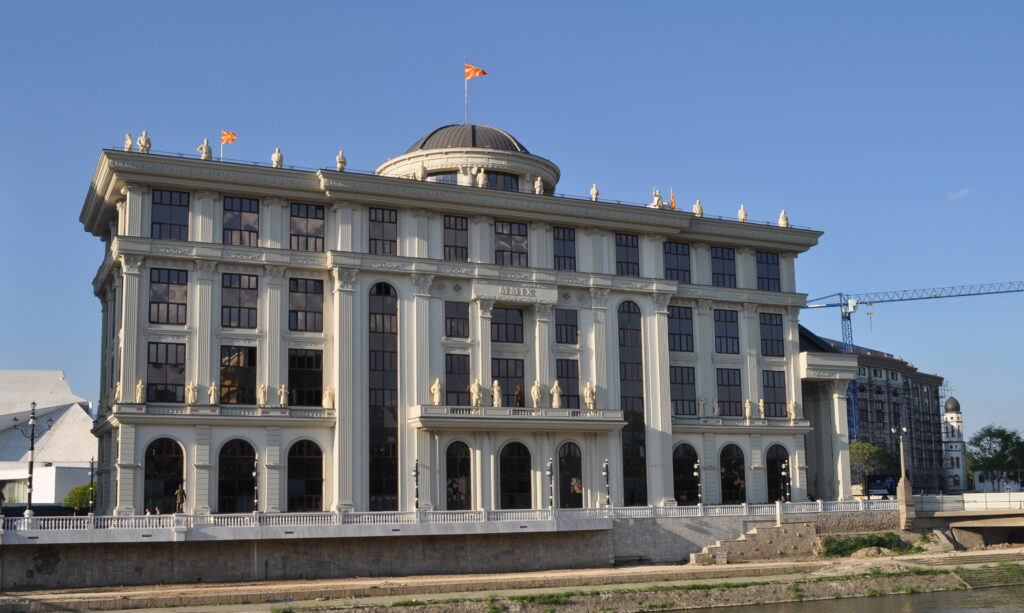
Ministry of Foreign Affairs and Foreign Trade

I found the Ministry building easily enough. It was one of several newer buildings dominating the opposite side of the river from the main square, itself dominated by a huge equestrian statue of Alexander the Great (or perhaps not, the story is a bit murky). As you can see, there are many statues at the first level windows, but the Lincoln statue was supposed to be at the roofline where there are even more statues.

Unfortunately, you can’t see any of the roof statues from the lane immediately in front of the building. You have to cross to the other side of the Vardar River to see anything, and only by zooming in from that distance can you make out the roof statues. Making matters worse, the statues are placed around all four sides of the roof, and the back side is particularly difficult to gain access at the proper distance.
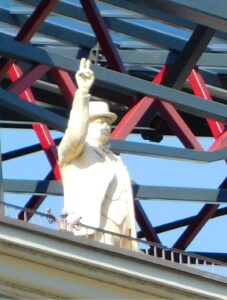
Winston Churchill, SkopjeZooming in further on my photos once I got back home and could enlarge them on my bigger screen, I could easily make out Winston Churchill. I also saw Ghandi. There was one guy who sort of looked like Ulysses S. Grant, but I don’t think it was. And there were plenty of other apparent heads of state over history, some of whom looked familiar but mostly not.

Nowhere did I see George Washington or Abraham Lincoln.

I made some queries on the ground, asking the two gentlemen at the front desk of my hotel. Neither even knew where the building was even though it was only a 10–15-minute walk away. The official tour guide for my group had never heard of any Lincoln statues, and more disconcerting, neither did the city tour guide who took us down to the main square and across the river in the shadow of the building. He did, however, suggest that the project may not have been completed and that its intended effect – sparking a nationalistic fever – didn’t quite work out the way they envisioned (i.e., many thought it a waste of money).

They did seem to finish the “Bridge of Art,” a footbridge crossing the river near the Ministry building. Those thirty-five statues depict distinguished educators, artists, writers, composers, and actors from Macedonia. Skopje is also the hometown of Mother Teresa, and there is a memorial home with its own chapel there for her (she also is featured prominently in other churches in the city). Skopje is a beautiful place to visit, so if anyone else gets there, spend some time looking for Lincoln and let me know if you find him.

Meanwhile, I’ll be in Southeast Asia in the early autumn, and the Lincoln Sculpture Project Map shows there is a Lincoln sculpture in northern Thailand. To paraphrase Sherlock Holmes (and William Shakespeare), “the game is afoot!’
Lincoln in New England book cover


Now Available: Lincoln in New England: In Search of His Forgotten Tours. Or Order directly at:

Amazon          Barnes & Noble          Books-a-Million          Bookshop

Join me on Goodreads, the database where I keep track of my reading. Please leave a review on Goodreads and Amazon if you like the book.

You also follow my author page on Facebook and on Instagram.

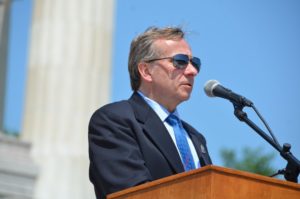
David J. Kent is Immediate Past President of the Lincoln Group of DC and the author of many books on Abraham Lincoln, Nikola Tesla, and Thomas Edison.
Abraham Lincoln Goes to Hartford – Wide Awakes and Sculpture Walks

Sometimes you find Abraham Lincoln in unexpected places. Take Hartford, Connecticut for example. Lincoln came to Hartford in early March of 1860, somewhat less than fresh off his successful speech at Cooper Union. His intent was to stretch out his trip east to visit his son Robert in Exeter, New Hampshire. Robert had spectacularly failed his Harvard College entrance exams and was doing remedial work at Phillips Exeter Academy in hopes of passing on the next go-around. The visit turned into an unexpected tour of three New England states. Local Republican operatives enlisted Lincoln to speak on behalf of each state’s governor and congressional races in the upcoming election. As a side benefit, it raised Lincoln’s profile just in time for the critical Republican National Convention happening in Chicago in May.

His Hartford version of the Cooper Union speech included some added features involving wens (aka, tumors), snakes in bed with children (an allegory for slavery), and opinions on a recent shoemakers strike in Massachusetts. And then there were the Wide Awakes.

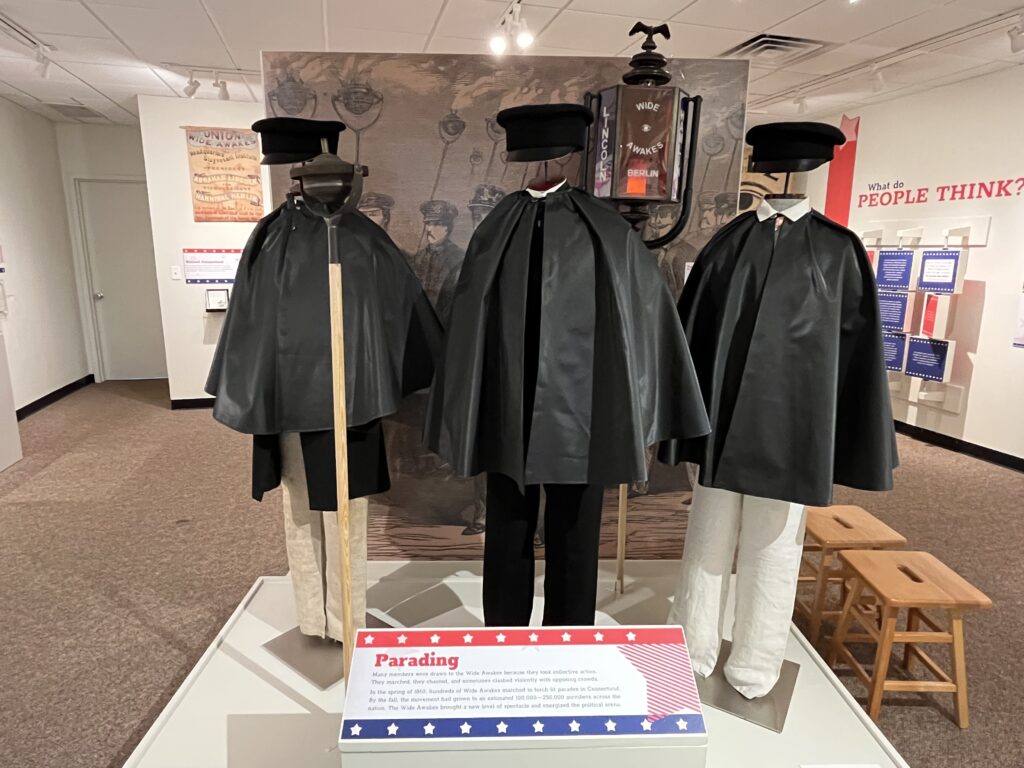
Wide Awake exhibit at the CT Museum, Hartford

On my most recent New England road trip I stopped at the Wide Awake exhibit at the Connecticut Museum of Culture and History in Hartford. The exhibit had only opened a few days before, but I had heard about it from Jon Grinspan, the author of a book by that name. I was able to join an “exhibit talk” tour by Christina Rewinski, the lead museum educator, so I was able to learn first-hand even more than what I already knew from reading the book and speaking directly with Jon. In a nutshell, the Wide Awakes started as a group of five young men (ages 17-25) who decided to support the reelection campaign of incumbent Republican gubernatorial candidate, William Buckingham, and the Republican party in general. Donning oilcloth capes and carrying torches, these five men surreptitiously escorted a surprised Cassius Clay, a well-known abolitionist who had spoken that night for Buckingham. Gaining momentum, the five quickly became twenty so they officially formed as an advocacy group under the Wide Awake banner. The very next night they again found a politician to escort: Abraham Lincoln. Lincoln was in town as one of eleven stops on his New England tour and found his carriage surrounded by a growing group of uniform-ish clad marchers as he wended his way back to his hotel for the night.

Viewing the unannounced group with a mix of confusion and amusement, Lincoln would watch the Wide Awake movement grow to several hundred thousand young men across the northern states, actively supporting the candidacy and election of Lincoln as the first Republican president. Lincoln would hold them at arm’s length – the exhibit examines how their militaristic style was seen by some, especially in the South, as a prelude to war – but appreciated the enthusiasm for his campaign they generated. The exhibit gives a history of the “Hartford Originals” and how the Wide Awakes grew exponentially over the next few months, only to effectively dissolve soon after the election (although many members enlisted to fight for the Union in the Civil War). The exhibit is well worth the visit if your travels take you nearby. It runs through March 16, 2025.

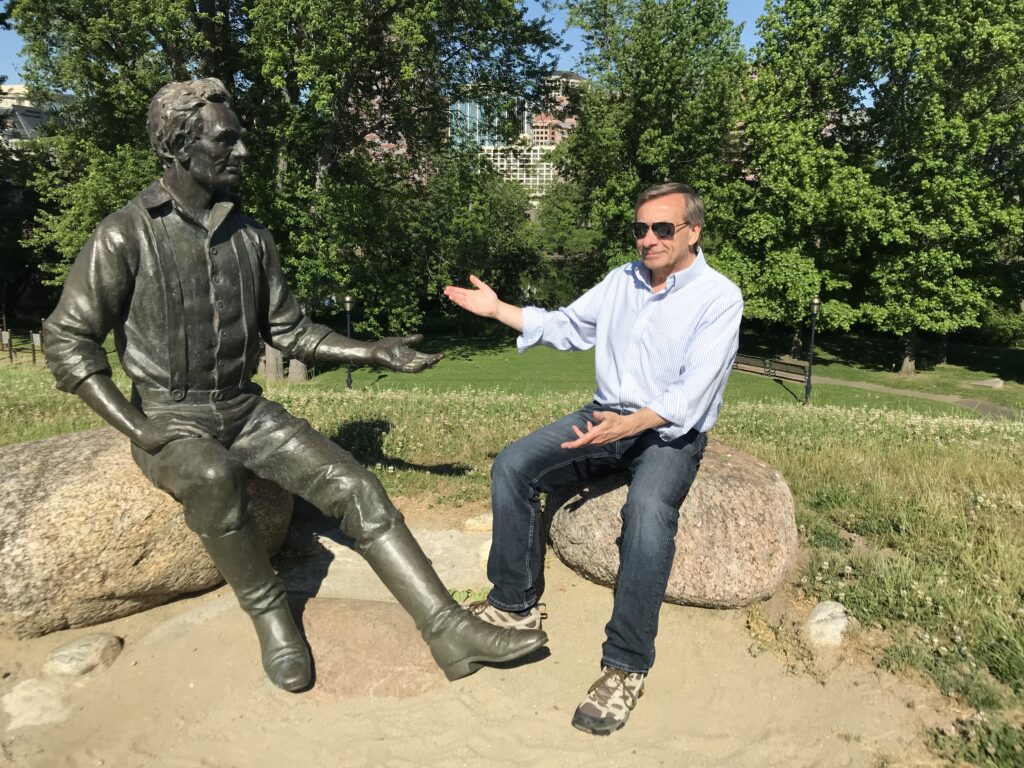
A Welcome Conversation on Hartford Lincoln Sculpture Walk

But Wide Awakes aren’t the only Lincoln connections in Hartford. Funded by a generous grant from the Lincoln Financial Group, the city created a Lincoln Sculpture Walk along River Front Park. When I visited there were fourteen sculptures by various artists lining both sides of the river. Some are obviously Lincoln scenes while others are more abstract or relate to some history associated with Lincoln. “Perseverance,” for example, by Darrell Petit, are two massive stones pushed against each other, signifying Lincoln’s perseverance despite the many setbacks in his life, including political defeats, financial failure, death of loved ones, and public humiliation. Similarly, “Right to Rise” by Don Gummer is a vertical sculpture that symbolizes Lincoln’s belief that each resident, regardless of origin, can rise up the economic ladder and better themselves through hard work and diligence. My favorite sculpture along the walk is “A Welcome Conversation” by Dan Sottile. A twenty-something Lincoln sits on a large rock, apparently in New Salem, his arm outstretched toward another empty rock as if inviting the viewer to join him in conversation. I did exactly that.

More on Lincoln in New England coming soon.

[Photos of Wide Awake exhibit at CT Museum (top) by David J. Kent and Hartford Sculpture Walk (bottom) by Ru Sun.]


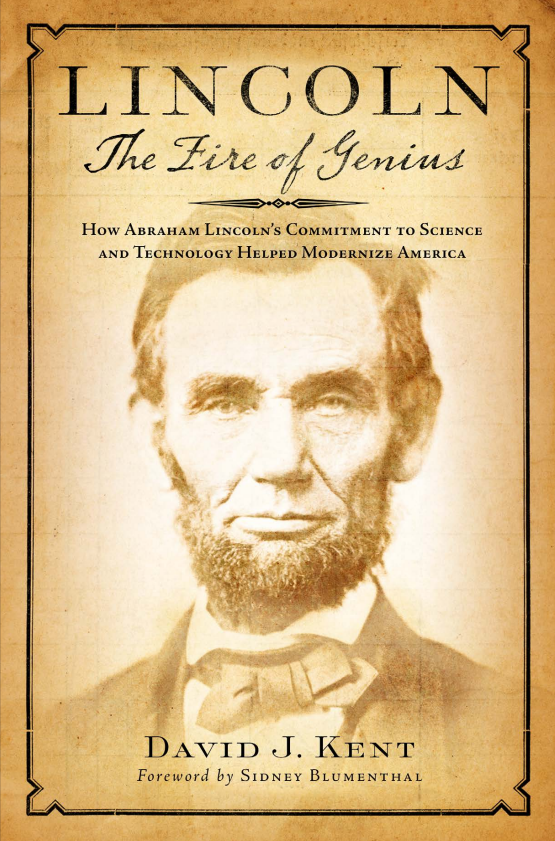
Fire of Genius

Lincoln: The Fire of Genius: How Abraham Lincoln’s Commitment to Science and Technology Helped Modernize America is available at booksellers nationwide.

Limited signed copies are available via this website. The book also listed on Goodreads, the database where I keep track of my reading. Click on the “Want to Read” button to put it on your reading list. Please leave a review on Goodreads and Amazon if you like the book.

You also follow my author page on Facebook.

David J. Kent is Immediate Past President of the Lincoln Group of DC and the author of Lincoln: The Fire of Genius: How Abraham Lincoln’s Commitment to Science and Technology Helped Modernize America and Lincoln: The Man Who Saved America.

His previous books include Tesla: The Wizard of Electricity andEdison: The Inventor of the Modern World and two specialty e-books: Nikola Tesla: Renewable Energy Ahead of Its Time and Abraham Lincoln and Nikola Tesla: Connected by Fate.