 Lincoln’s Whig Party passed on their traditional party leader Henry Clay to nominate General Zachary Taylor as their nominee for the 1848 presidential nomination. Taylor had been the hero of Buena Vista in the recently ended Mexican War, and the public was clamoring for the war hero to be the next commander-in-chief. Lincoln himself spoke out in Taylor’s favor at the Whig convention held in Philadelphia. To balance the ticket featuring the Southern Taylor, the Whigs chose northern Whig Millard Fillmore as the vice-presidential nominee. On July 27, 1848, congressman Lincoln rose in the House of Representative chambers (now Statuary Hall) to address the “presidential question,” i.e., why Taylor would be a good Whig.
Taylor was an odd choice for the Whigs, to put it mildly. The Whigs went on record opposing the legality of the war and Lincoln had railed against it, although he and the party made sure to support the troops with adequate supplies. And yet here they were begging for Taylor to be their party’s nominee for president. Even more perplexing, Taylor was a southern plantation owner enslaving hundreds of people, which contradicted the Whig concern (at least for the Northern Whigs) that slavery would expand into the extensive territory taken from Mexico (today’s states of New Mexico, Arizona, California, Nevada, Utah, and parts of Colorado and Wyoming). While not an issue at the time, one of his six children, Sarah, was briefly married to Jefferson Davis, then a subordinate officer to her father in the Black Hawk War. [Very briefly, it turns out, as both contracted malaria on their honeymoon and while Taylor survived, Sarah died three months after their wedding.]
And then there was the question of whether Taylor was even a Whig. He had been in the military most of his life and was at best apolitical, considering himself an independent. Some of his views did seem to be in line with Whig priorities, primarily that the president should defer to the congress for the making of laws and avoiding the veto unless the proposed law was clearly unconstitutional. But others were unknown (he rarely expressed them) and he was not in favor of restarting the national bank or raising tariffs, two traditional Whig priorities. And what about slavery?
Interestingly, despite being a southerner and a slaveholder, Taylor was against the expansion of slavery into the newly gained western territories. This was not so much an antislavery position as it was his belief that slavery was impractical in the drier climate of the southwest, the inaccessible mountains of the Rockies, or the cold of the remaining Louisiana Purchase territories of the upper Midwest. Since you could not produce sufficient cotton and sugar in those areas to make it profitable, he argued, it made no sense to expand there.
All these points were addressed by Lincoln in his 1848 House speech. Critics in both his own party and the Democratic Party questioned whether Taylor believed in Whig principles. Lincoln insisted that Taylor’s principles were secure, that he would not be an activist president, allowing congress (especially the Whigs in congress) to set the agenda for the nation. If congress managed to pass the Wilmot Proviso banning slavery in all the new western territories, Taylor would sign the bill. Overall, he would be a good Whig. In contrast, Lincoln charged, the Democratic nominee, Lewis Cass, had shown in his senate career that he could not be trusted, having flipflopped on internal improvements and other issues supported by Whigs and blocked by Democrats. After his House speech, Lincoln promoted Taylor’s candidacy at several other venues in the Washington area.
But there was a bigger problem. While it seemed no one in the party was overly ecstatic about the Zachary Taylor/Millard Fillmore ticket, Conscience Whigs in New England were particularly incensed. More radical than moderate Whigs in their belief that slavery must be barred from spreading into the territories, the Conscience Whigs argued that Taylor showed the party had lost its way. In response, they teamed up with the “Barnburner” Democrats of upstate New York to start a separatist Free Soil Party, nominating former Democratic president Martin Van Buren to rival both the Whigs and the Democrats.
Realizing the danger of this splinter group to Taylor’s election chances, the Whigs sent dozens of party leaders to New England to make the Taylor case. The Illinois State Whig Committee named Lincoln a Taylor elector-at-large and sent him to Massachusetts to bring the Free Soilers back into the fold. While there, Lincoln would discover more fissures in the party. He also was exposed to a growing abolitionist fervor that influenced his thinking for years to come. All of this I discuss in depth in my newest book, Lincoln in New England: In Search of His Forgotten Tours.
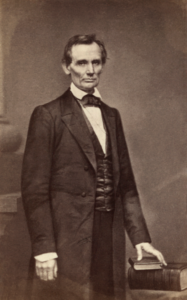
[Photo by Mathew Brady, February 1860, Library of Congress, Public Domain]
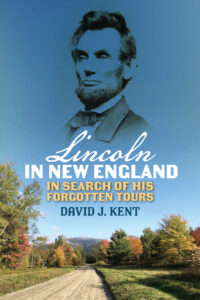
Now Available: Lincoln in New England: In Search of His Forgotten Tours. Or Order directly at:
Amazon Barnes & Noble Books-a-Million Bookshop
Join me on Goodreads, the database where I keep track of my reading. Please leave a review on Goodreads and Amazon if you like the book.
You also follow my author page on Facebook and on Instagram.
David J. Kent is Immediate Past President of the Lincoln Group of DC and the author of many books on Abraham Lincoln, Nikola Tesla, and Thomas Edison.