 On June 11, 1848, congressman Abraham Lincoln arrived back in Washington, D.C. after having traveled all night from Philadelphia, where he attended the Whig National Convention that nominated Zachary Taylor for president. Upon his return he finds a letter from his wife Mary, who has been visiting her family in Kentucky for several months. These two events begin a campaign and a mystery.
Zachary Taylor was an odd choice to be the Whig nominee. Had had been fairly apolitical up to this point, having spent most of his life in the military. In fact, it was his military service in the Mexican War that ingratiated him to the American public, who clamored for him to be the next president of the United States. He was so popular that both the Whig and Democratic parties vied to make him their nominee. Taylor at first said he would only agree if he could do so “untrammeled with party obligations or interests of any kind,” the sort of divine elevation that George Washington had enjoyed after the Revolutionary War. Both the Whigs and Democrats quickly disavowed him of that politically naïve delusion. He agreed to sign on with the Whigs, finding them slightly less objectionable than the conservative Democrats of the South.
For his part, while Lincoln was in Philadelphia at the Whig Convention, he spurned his old beau ideal of a statesman, Henry Clay, and spoke out in favor of Taylor. Clay had been a nominee three times before, losing every time. Ever the vote counter, Lincoln wrote a friend that “Mr. Clay’s chance for an election, is just no chance at all,” going on to enumerate which states Clay could not carry. Based on his read of public sentiment, Lincoln noted, “in my judgment, we can elect nobody but Gen. Taylor.” And so Taylor became the Whig nominee. Lincoln was assigned to go to Massachusetts to make the case for Taylor, which as a I will discuss in future posts and in my forthcoming book, Unable to Escape This Toil: In Search of Abraham Lincoln’s Forgotten New England Tours, was not an easy task.
Which gets to the letter from Mrs. Lincoln. Mary and their two sons (Robert and Eddie) had been visiting her family in Lexington, Kentucky for months. They had been in a small boarding house room with Lincoln since he arrived in Washington to serve as Whig representative from Illinois, but boredom and conflicts with other tenants sent her south. Now she was planning to return to Washington. Lincoln, who had been happy to see her go, now seemed happy to have her come back. In his letter back to her the next day he wrote:
The leading matter in your letter, is your wish to return to this side of the Mountains. Will you be a good girl in all things, if I consent? Then come along, and that as soon as possible. Having got the idea in my head, I shall be impatient till I see you.
After noting that the congressional session was expected to end by July 17th, he added:
Come on just as soon as you can. I want to see you, and our dear—dear boys very much. Every body here wants to see our dear Bobby.
Here is where the mystery arises. When did Mary arrive in Washington, and did she accompany Lincoln on his tour of Massachusetts, which started on September 9th? On July 2nd he again wrote to Mary, who he presumed to have just started back, but then the record goes silent. The Lincoln Log mentions on July 23rd that “Mrs. Lincoln and boys probably arrive from Lexington about this time,” but this is merely conjecture based on Lincoln’s letter from three weeks before. No mention of Mary and the boys is recorded in the press or in the letters of Lincoln or any of his political escorts during Lincoln’s Massachusetts trip. The only indication that Mary was there comes from a letter she wrote in December 1867 (2.5 years after Lincoln’s assassination) rebutting statements by painter Francis Carpenter and claiming that “Mr. L. accompanied by my two little boys & myself, visited B[oston] & remained there 3 weeks, detained by the illness of our youngest son….” That would seem to confirm her presence, but there are several glaring errors in the letter that make suspect her memory of events that happened 20 years previously, especially given the extent of trauma she had experienced in that time. I dig more into this in a paper I’m writing for the Journal of the Abraham Lincoln Association.
Notwithstanding whether he was accompanied by his family or not, Lincoln definitely went to Massachusetts where he found more internal Whig conflicts than he could have imagined and learned valuable lessons that would position him for greatness.
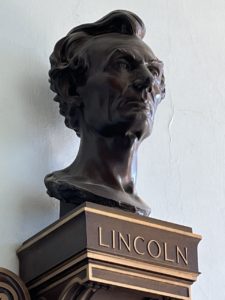
[Photo by David J. Kent, bust of Lincoln in the Massachusetts State House, Boston, MA]
Coming in February 2026: Lincoln in New England: In Search of His Forgotten Tours
Join me on Goodreads, the database where I keep track of my reading. Please leave a review on Goodreads and Amazon if you like the book.
You also follow my author page on Facebook. Also follow me on Instagram.
David J. Kent is Immediate Past President of the Lincoln Group of DC and the author of Lincoln: The Fire of Genius: How Abraham Lincoln’s Commitment to Science and Technology Helped Modernize America and Lincoln: The Man Who Saved America.
His previous books include Tesla: The Wizard of Electricity and Edison: The Inventor of the Modern World and two specialty e-books: Nikola Tesla: Renewable Energy Ahead of Its Time and Abraham Lincoln and Nikola Tesla: Connected by Fate.
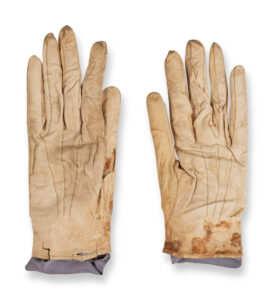 A major auction of Abraham Lincoln artifacts held May 21, 2025, brought in nearly $8 million dollars. The largest amount for any single item was over $1.5 million (including auction fees) for a pair of blood-stained gloves that Lincoln wore the night of the assassination.
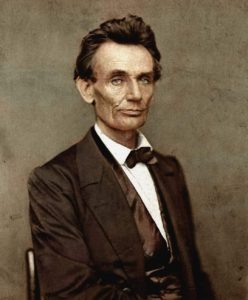 Abraham Lincoln was not happy. He had worked hard to get Zachary Taylor elected as president as a Whig, and yet he was being passed over for the lucrative General Land Office job. Worse, he was being ignored, something the man who had been Whig leader in the Illinois legislature and recent representative to Congress. On May 16, 1849, he made his dissatisfaction with Taylor’s appointment of Justin Butterfield to the Land Office in Illinois.
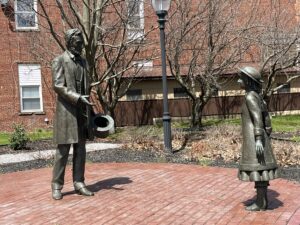 Abraham Lincoln traveled through upstate New York in early 1861 on his way to Washington, DC for his inauguration, stopping in Westfield, Buffalo, Albany, Peekskill, and New York City. Twelve years before, in 1848, he stopped in Buffalo and saw Niagara Falls on his way home between sessions of congress after he toured around eastern Massachusetts giving speeches in support of Zachary Taylor as the Whig nominee for president [Spoiler: Taylor won] In late April of this year, traveled much the same route in northern New York on my way to the Lincoln Forum spring conference at Hildene in Manchester, Vermont.


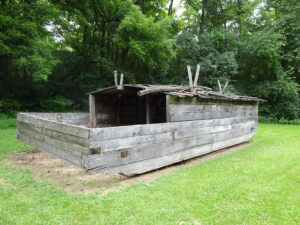 In 1828, nineteen-year-old Abraham Lincoln and neighbor Allen Gentry made what was the first of Lincoln’s two flatboat trips to New Orleans. Gentry’s father funded the trip. A typical investment required about $75 (over $2000 today) for the flatboat alone. The cargo could be worth over $3000 ($82,000 today). A successful trip could be immensely profitable; an unsuccessful one financially devastating.
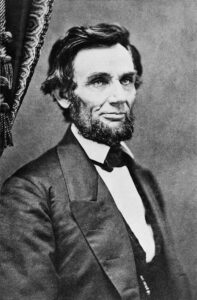 On April 10, 1861, two days before the Confederacy opened fire on Fort Sumter, Ambrose W. Thompson met with Lincoln to gain support for a coal mining project in the Chiriqui region of the Granadian Confederation (now Panama near the border with Costa Rica). Thompson headed a corporation that had been created to provide coal to the U.S. Navy. Lincoln again relied on Smithsonian Secretary Joseph Henry for scientific advice. Henry wrote to John Peter Lesley, one of the leading geologists in the United States and an expert on coal. In his confidential letter he said he was writing on behalf of President Lincoln and Secretary of State Seward to get Lesley’s opinion on the value of the coal deposit in the Chiriqui district. Interest in the coal was two-fold. It was needed for coal-fired boilers for steam ships and railroad locomotives, but it also offered itself as a possible solution to the likely emancipation of enslaved people. Lincoln and others had hoped that freed slaves (and other free blacks) could be relocated to avoid the problems of a racially mixed society. Should the Chiriqui coal be viable, it could serve as an economic basis for such a colony. Henry asked Lesley to give him “in addition to your opinion derived from general scientific principles any reliable information you may possess relative to this matter.”
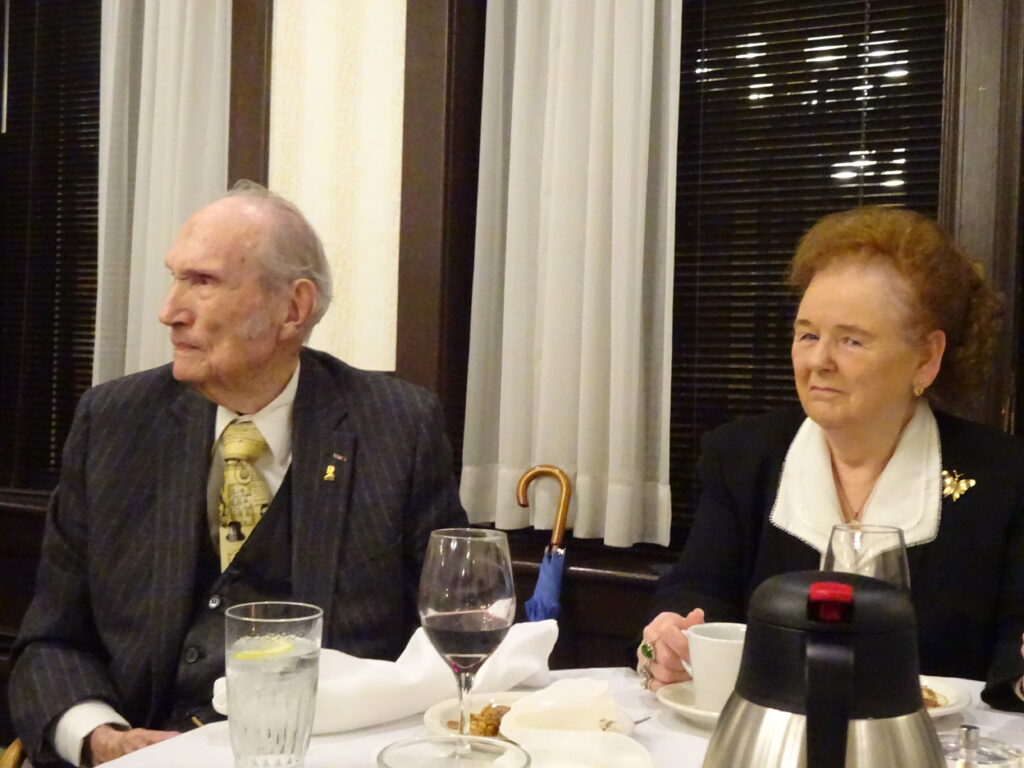 The dean of all Abraham Lincoln scholars passed away on March 31, 2025. He was 101. Wayne Calhoun Temple, known to everyone as “Doc,” celebrated his 101st birthday on February 5th.
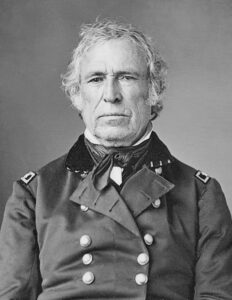 Abraham Lincoln stood at the podium in the U.S. House of Representative chambers on July 27, 1848. His topic – the presidential question. Notwithstanding the negative reaction to his previous “spot resolutions” speech, Lincoln was still considered an effective speaker and thus was called upon to help convince people that Zachary Taylor was the correct choice as the Whig nominee for president. Lincoln had strongly supported the nomination of Taylor over the aging Henry Clay, previously Lincoln’s beau ideal of a statesman. He even spoke at the nominating convention in favor of Taylor.