 On November 4, 1842, Abraham Lincoln rushed around to his friends and invited them to his one-day’s notice wedding to Mary Todd. The sudden marriage came as a shock to their family and friends, many of whom weren’t aware the couple had resumed their courtship almost two years after the ignominious “fatal first” that ended their prior engagement.
Even Lincoln seemed a bit shell shocked when a week later he wrote to a friend. Mostly a dry letter dealing with legal issues, Lincoln’s last line was “Nothing new here, except my marrying, which to me, is a matter of profound wonder.” Some have argued that Mary seduced him into premarital sex, thus forcing Lincoln into a quick marriage. Friends reported that he went to the altar muttering he was going to hell. In any case, their first son Robert was born on August 1, 1843, a mere 8 months, 3 weeks, and 4 days after the wedding.
As I’ve noted in a prior post, though an odd couple in a ofttimes tempestuous marriage, the two remained together for more than two decades, ending only at the hands of an assassin.
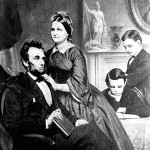
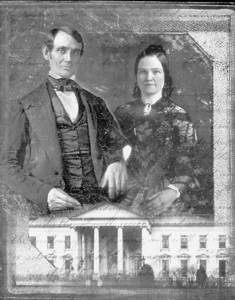
One note about the image used above. It never happened. Lincoln was 6’4″ in height, so the 5’2″ Mary refused to have any photographs taken with her towering husband. Despite many photographs of Lincoln and Mary independently, none appear to exist with the two of them together. She wouldn’t even consent to a photo similar to the image above where he is sitting and she is standing. There are many etchings and paintings done after the fact, but no actual photographs. And then there is this:
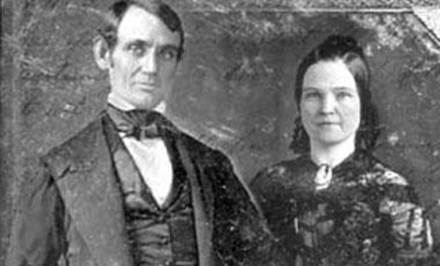
This photograph purporting to show them together is not what it seems. It is actually a cropped closeup of two separate photos, one of him and one of her, that have been cut out, partially reversed, retouched, and rephotographed together along with a photo of the White House. Think of it as the 19th century version of Photoshop. 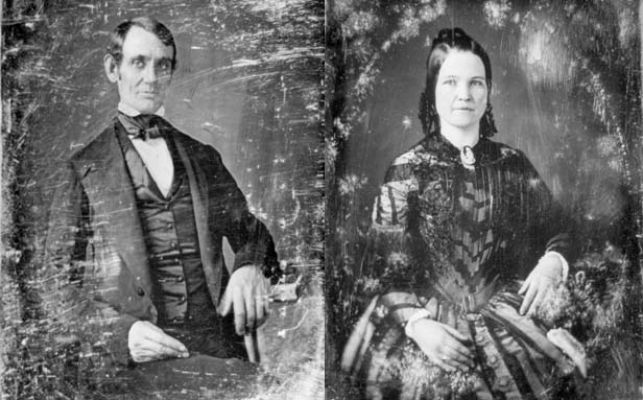
So happy anniversary to Abraham and Mary Todd Lincoln. May your memories live on forever.
Interested in Abraham Lincoln? Then check out the Lincoln Group of the DC.
David J. Kent is a science traveler. He is also the author of Lincoln: The Man Who Saved America, now available. His previous books include Tesla: The Wizard of Electricity and Edison: The Inventor of the Modern World (both Fall River Press). He has also written two e-books: Nikola Tesla: Renewable Energy Ahead of Its Time and Abraham Lincoln and Nikola Tesla: Connected by Fate.
Check out my Goodreads author page. While you’re at it, “Like” my Facebook author page for more updates!
Follow me by subscribing by email on the home page. Share with your friends using the buttons below.
 Abraham Lincoln was reelected for a second term in 1864, which surprised everyone,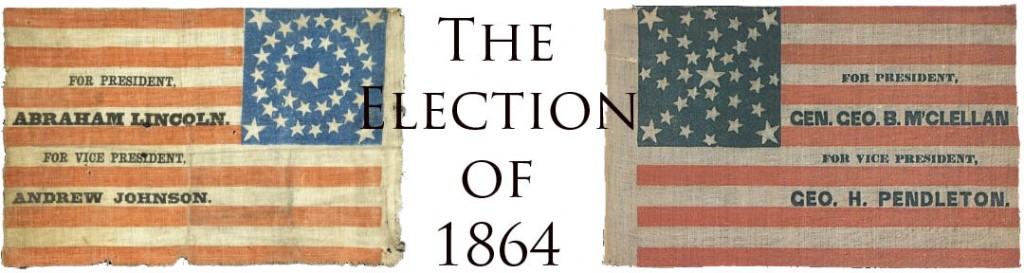

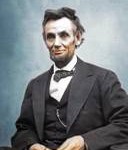 As the Civil War raged on, things weren’t looking so good for the reelection of Abraham Lincoln. In August 1864 Lincoln asked his entire cabinet to sign the back of what became the “
 As noted last Friday,
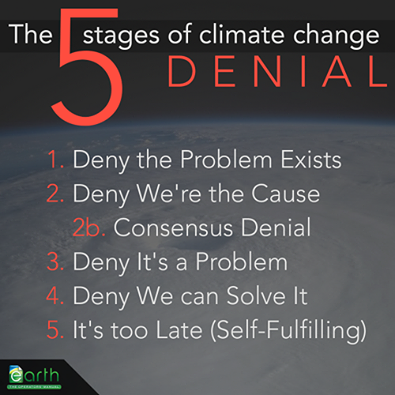
 Man-made climate change has been described by scientists and policymakers as one of the greatest challenges of our time. It has also been called a hoax by fossil fuel industry lobbyists and oil-state politicians.