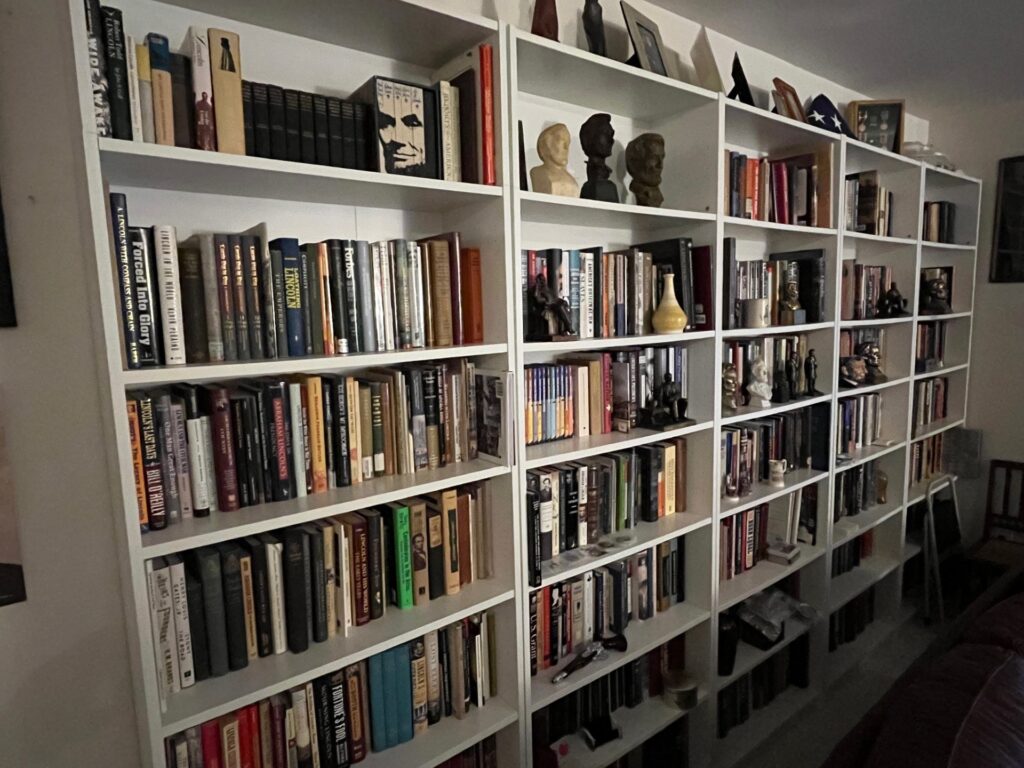
As usual, the year sped by, which means it’s time to take stock of all my Abraham Lincoln book acquisitions for 2025. I began the year thinking I would continue reducing the number of books I acquire. Then reality hit to the point of purchasing a new set of Lincoln bookshelves for my office library (the number of shelves in my upstairs Lincoln library stayed the same). Those shelves quickly filled up as I reorganized and then added 43 new books to my collection. There are still a few weeks left in the year, but I think I’m now done with acquisitions. The 43 new ones compare to slightly more than half that number in 2024 (25), and even more than the 37 acquisitions in 2023 and 34 in 2022. So much for reducing the total. You can read about past years acquisitions by scrolling through this link.
The oldest publication date of book acquired this year was 1907 for a 9-volume set of the Life and Works of Abraham Lincoln. Other older books have publication dates in the 1920s, 1930s, several from the 1950s, and all the way up to today. Only 12 of the books are those published in 2025 (< 30%), in contrast to last year when the new books were half the total. In part that has to do with the mechanism by which I acquire the books and my intentional efforts to reduce the number of books I buy. Several of the Lincoln books that I read this year were taken out from my local public library, although I admit in some cases, I still bought the book after reading the library copy. The acquisition method had a bigger impact on the number of older books I obtained. Books from various secondary sales outlets (used bookstores, secondary sellers on Amazon and eBay, Lincoln Forum donation table, etc.) tend to be older. Newer books tend to come from traditional booksellers. I bought one old book via an auction because it was a rare compendium that I needed for research.
There were two other means of obtaining books. In the spring I was asked to moderate the White House Historical Association’s History Happy Hour program with author Michael Vorenberg, whose new book, Lincoln’s Peace, was very popular this year (and a great book I highly recommend). To facilitate my interview of him, he had his publisher send me the book (which he later signed at the ALI Symposium). I was also asked by two separate academic publishers to review two book proposals they had received. After reviewing each proposal – two different Lincoln-related topics and completely independent of each other despite the coincidence of the publishers asking me for review nearly at the same time – the publishers offered me payment for my time in the form of books from their catalogues. The result was nearly a quarter of my acquisitions this year came from that process.
A total of 13 of the 43 books are signed. While a few were obtained already signed (usually to some previous owner), I was able to get many signed and inscribed to me by the authors at various Lincoln events I attend. I’m on the board of the Abraham Lincoln Institute, which means I take advantage of my participation in the annual program at Ford’s Theatre each March to get authors to sign my copies of their books. This year I attended a special event at President Lincoln’s Cottage in Washington, DC, which is where I purchased and got both Lucas Morel and Jonathan White to sign to me their new book on Frederick Douglass. I’m also on the board of advisors for the Lincoln Forum, so I get inscriptions from other authors at that meeting every November. This year, as Forum chairman Harold Holzer signed my copy of one of his books, he told me “You’ll be doing this in the spring,” in reference to me being on the program of the 2nd Annual Lincoln Forum Spring Conference at Hildene (Robert Lincoln’s summer home) in Manchester, Vermont. More on that when I do my Year in the Writer’s Life post.
Topics covered in the books run the gamut from compendiums of speeches and letters to Lincoln’s views on religion to his time as a lawyer to the presidency. One unique perspective was given by Stacy Lynn in a book entitled, Loving Lincoln, which explored women’s interactions with Lincoln. Most were women Lincoln romanced, had as legal clients, or simply confided in. Others were women who had opinions on Lincoln. This latter group included the author, whose career as a researcher with the Lincoln Papers project and her own personal experiences gave her additional insights into how women felt about him. Richard Carwardine’s book, Righteous Strife, did a deep dive into the religious nationalism of both North and South in Lincoln’s time and how that impacted his personal beliefs and official duties. Carwardine’s book won the Lincoln Forum book prize and likely will win others.
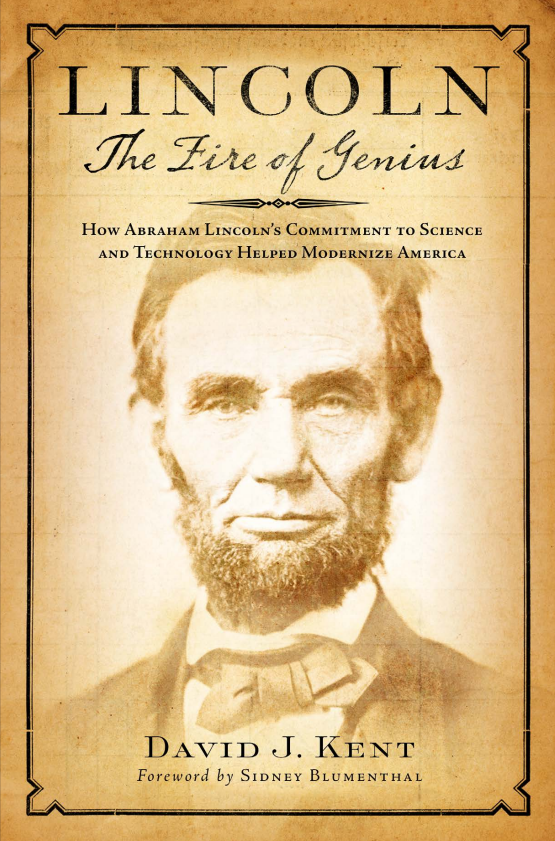
Several of the books I acquired this year dealt with people and events associated with Lincoln. There were books about Robert Todd Lincoln (Goff), Civil War journalist William Howard Russell (Crawford; Miller), Frederick Douglas (Morel and White), Cassius Marcellus Clay (Marshall), John Hay (McFarland), Judge David Davis (McKoski), and Mary Lincoln (Pritchard). One new book by constitutional scholar Akhil Reed Amar, Born Equal, focuses on Lincoln’s role in the rebirth of the Founders’ concept of “all men are created equal,” a timely topic as we approach the 250th anniversary of the Declaration of Independence in 2026. I also found two books (Crouch; Herber) that were related to Lincoln in the sense that they examined the scientific world before, during, and after the Civil War, an area that Lincoln helped institutionalize and I discussed in detail in my own previous book, Lincoln: The Fire of Genius.
Finally, there are two larger-format books that document collections of Lincoln papers and relics. Abraham Lincoln: His Life in Print by David Rubenstein and Mazy Boroujerdi includes essays by historians and photos of Rubenstein’s personal collection of documents that were displayed in 2024 at the Grolier Club in New York City. Lincoln: The Life and Legacy That Defined a Nation in 100 Objects by Christina Shutt and Ian Patrick Hunt is a companion book to an ongoing special exhibit at the Abraham Lincoln Presidential Library and Museum in Springfield, Illinois.
I’ll dig into my reading list on my Hot White Snow site closer to the end of this year, but needless to say, I haven’t read all of the books that I acquired this year – at least yet. I’m currently reading the Carwardine book I mentioned above and will get to the McKoski, Marshall, and Ambar books shortly. I read less in 2025 because I spent most of the first half of the year writing, and that trend will continue as I spend most of the first half of 2026 promoting my new book, Lincoln in New England: In Search of His Forgotten Tours (pre-order now!).
Also watch for my Year in the Writer’s Life and Year in Traveling posts coming in the next few weeks!
See the 2025 list showing author/title/publication date below my signature blurb below.
[Personal photo of David J. Kent library of Lincoln books]
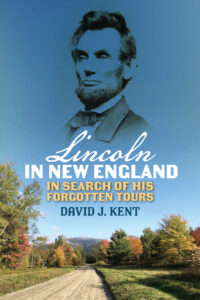
Coming in March 2026: Lincoln in New England: In Search of His Forgotten Tours
Also see – Lincoln: The Fire of Genius: How Abraham Lincoln’s Commitment to Science and Technology Helped Modernize America.
Join me on Goodreads, the database where I keep track of my reading. Please leave a review on Goodreads and Amazon if you like the book.
You also follow my author page on Facebook and on Instagram.
David J. Kent is Immediate Past President of the Lincoln Group of DC and the author of Lincoln: The Fire of Genius: How Abraham Lincoln’s Commitment to Science and Technology Helped Modernize America and Lincoln: The Man Who Saved America.
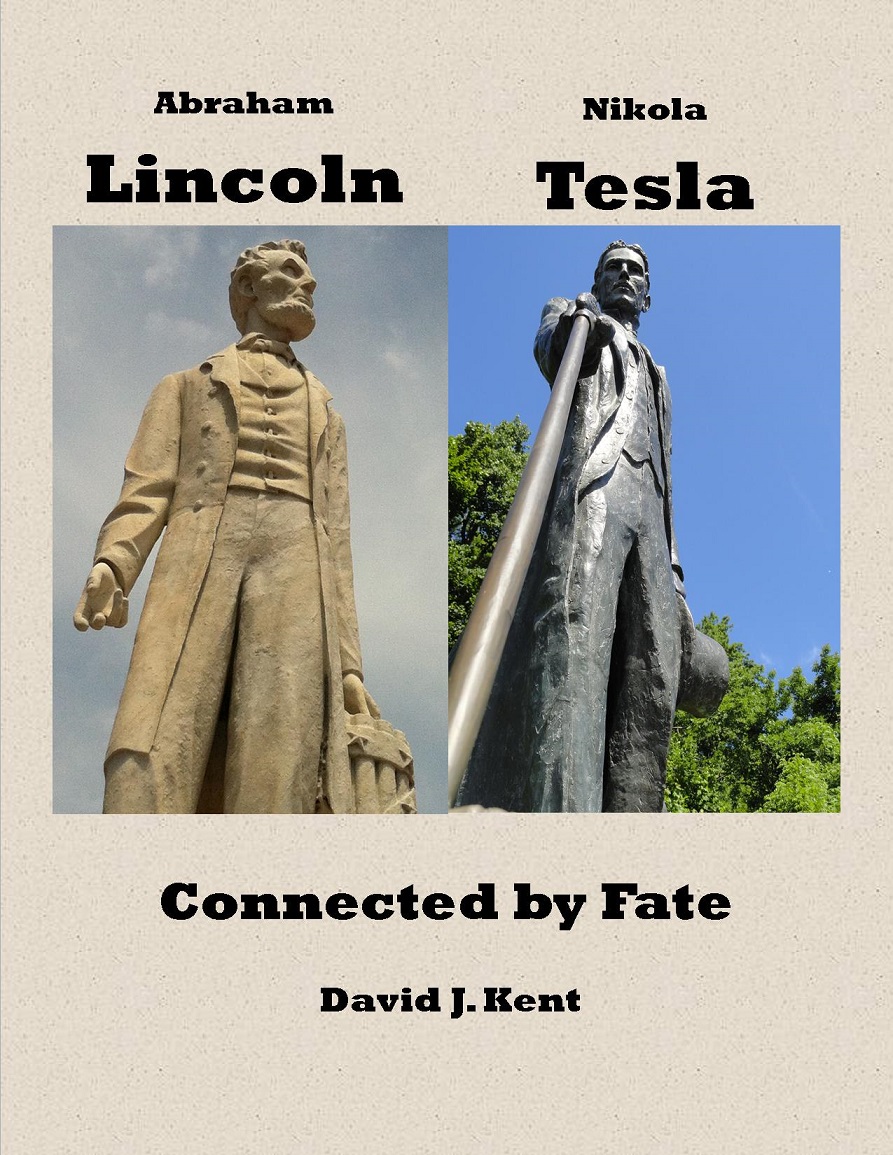
His previous books include Tesla: The Wizard of Electricity and Edison: The Inventor of the Modern World and two specialty e-books: Nikola Tesla: Renewable Energy Ahead of Its Time and Abraham Lincoln and Nikola Tesla: Connected by Fate.
Here is the 2025 list! [Author, Title, Date of Publication]
|
Abraham Lincoln’s Political Career Through 1860: Duel with James Shields (Lincoln Financial Foundation Collection) |
2018 |
|
Lincoln’s Log Cabin Library |
|
|
The 150th Anniversary of the Birth of Abraham Lincoln, 1809-1959, Commemoration Ceremony |
1958 |
|
Life and Works of Abraham Lincoln, Centenary Edition |
1907 |
|
First Edition of Abraham Lincoln’s Preliminary and Final Emancipation Proclamations (see notes) |
? |
| Amar, Akhil Reed |
Born Equal: Remaking America’s Constitution, 1840-1920 |
2025 |
| Ambar, Saladin |
Murder on the Mississippi: The Shocking Crimes That Shaped Abraham Lincoln |
2025 |
| Babcock, Bernie |
Booth and the Spirit of Lincoln |
1925 |
| Boritt, Gabor S. (ed) |
The Historian’s Lincoln: Pseudohistory, Psychohistory, and History |
1996 |
| Burr, Nelson R. |
Abraham Lincoln: Western Star Over Connecticut |
1984 |
| Carwardine, Richard |
Righteous Strife: How Warring Religious Nationalists Forged Lincoln’s Union |
2025 |
| Crawford, Martin (ed) |
William Howard Russell’s Civil War: Private Diary and Letters, 1861-1862 |
1992 |
| Crouch, Tom D. |
Smithson’s Gamble: The Smithsonian Institution in American Life, 1836-1906 |
2025 |
| Dekle, George R., Sr. |
Abarham Lincoln’s Most Famous Case: The Almanac Trial |
2014 |
| Fish, Daniel (reprint by Oakleaf, Joseph Benjamin) |
A Reprint of the List of Books and Pamphlets Relating to Abraham Lincoln |
1926 |
| Friedman, Jean E. |
Abraham Lincoln and the Virtues of War: How Civil War Families Challenged and Transformed Our National Values |
2015 |
| Goff, John S. |
Robert Todd Lincoln: A Man in His Own Right |
1969 |
| Hanchett, William |
Out of the Wilderness: The Life of Abraham Lincoln |
1994 |
| Hayes, Melvin L. |
Mr. Lincoln Runs for President |
1960 |
| Henson, D. Leigh |
Lincoln’s Rise to Eloquence: How He Gained the Presidential Nomination |
2024 |
| Herber, Elmer Charles, Collector and Editor |
Correspondence Between Spencer Fullerton Baird and Louis Agassiz – Two Pioneer American Naturalists |
1963 |
| Horan, James D. |
Mathew Brady: Historian With a Camera |
1955 |
| Kashatus, William C. |
Abraham Lincoln, the Quakers, and the Civil War: A Trial of Principle and Faith |
2014 |
| Leacock, Stephon |
Lincoln Frees the Slaves |
1934 |
| Leidner, Gordon |
Abraham Lincoln and the Bible: A Complete Compendium |
2023 |
| Lynn, Stacy |
Loving Lincoln: A Personal History of the Women Who Shaped Lincoln’s Life and Legacy |
2025 |
| Marshall, Anne E. |
Cassius Marcellus Clay: The Life of an Antislavery Slaveholder and the Paradox of American Reform |
2025 |
| McFarland, Philip |
John Hay: Friend of Giants, The Man and Life Connecting Abraham Lincoln, Mark Twain, Henry James, and Theodore Roosevelt |
2017 |
| McKoski, Raymond J. |
David Davis: Abraham Lincoln’s Favorite Judge |
2025 |
| Miller, Ilana D. |
Reports from America: William Howard Russell and the Civil War |
2001 |
| Morel, Lucas and White, Jonathan W. (Editors) |
Measuring the Man: The Writings of Frederick Douglass on Abraham Lincoln |
2025 |
| Newman, Ralph G. (ed) |
Lincoln For The Ages |
1960 |
| Pritchard, Myra Helmer, Edited & Annotated by Jason Emerson |
The Dark Days of Abraham Lincoln’s Widow, As Revealed by Her Own Letters |
2023 |
| Radford, Victoria (Ed.) |
Meeting Mr. Lincoln: Firsthand Recollections of Abraham Lincoln by People, Great and Small, Who Met the President |
1998 |
| Rubenstein, David M. and edited by Boroujerdi, Mazy |
Abraham Lincoln: His Life in Print: Books and Ephemera from the David M. Rubenstein Americana Collection |
2024 |
| Shutt, Christina and Hunt, Ian Patrick |
Lincoln: The Life and Legacy That Defined a Nation in 100 Objects |
2025 |
| Spannous, Nancy Bradeen |
From Subject to Citizen: What Americans Need to Know about Their Revolution |
2025 |
| Trueblood, Elton |
Abraham Lincoln: A Spiritual Biography |
1986 |
| van der Linden, Frank |
Lincoln: The Road to War |
1998 |
| Vorenberg, Michael |
Lincoln’s Peace: The Struggle to End the American Civil War |
2025 |
| Whitney, Henry Clay as edited and intro by Burlingame, Michael |
Lincoln the Citizen, February 12, 1809 to March 4, 1861 |
2025 |
| Winn, Ralph B. |
A Concise Lincoln Dictionary: Thoughts and Statements |
1959 |
| Zuckert, Michael P. |
A Nation So Conceived: Abraham Lincoln and the Paradox of Democratic Sovereignty |
2023 |


 In honor of Abraham Lincoln’s birthday, the

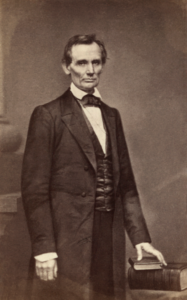 Speaking on January 27, 1838, Abraham Lincoln noted that “the powerful influence by which the interesting scenes of the revolution had upon the passions of the people as distinguished from their judgment” had done much to maintain our institutions to that point. The Founders had put forth this nation as independent from Britain “in the advancement of the noblest cause – that of establishing and maintaining civil and religious liberty.”
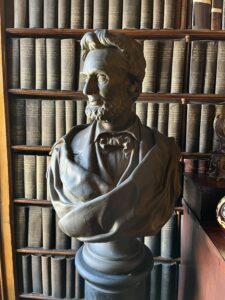 February through April is peak “Abraham Lincoln Season,” with many events associated with his birthday, final stages of the war, and assassination. The year 2026 is also the 250th anniversary of the Declaration of Independence, and Lincoln was a stalwart adherence to its principle of “all men are created equal.” And this year also sees the release of my newest book,
 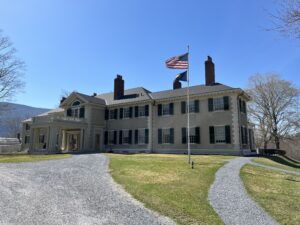 The Lincoln Forum meets annually in November in Gettysburg, PA. But in 2025 the Forum started a new tradition – a spring symposium at Robert Lincoln’s home in Manchester, Vermont he called Hildene. I attended the first meeting and I’m officially on the program as a speaker for the 2026 program running from May 1 to 3, 2026.
 The year 2025 was an incredibly busy writing year for me, so it’s time to recap my Year in a Writer’s Life. You can check out my other year-end posts by reading about