Abraham Lincoln never traveled outside the United States other than a few hours on the Canadian side of Niagara Falls. While he had planned to after his presidency, he never traveled overseas. He definitely never went to Edinburgh or anywhere else in Scotland. And yet, Edinburgh has not only a statue of Lincoln but also other connections to our sixteenth president. I became aware of these connections during my recent Lincoln-themed road trip around the United Kingdom.
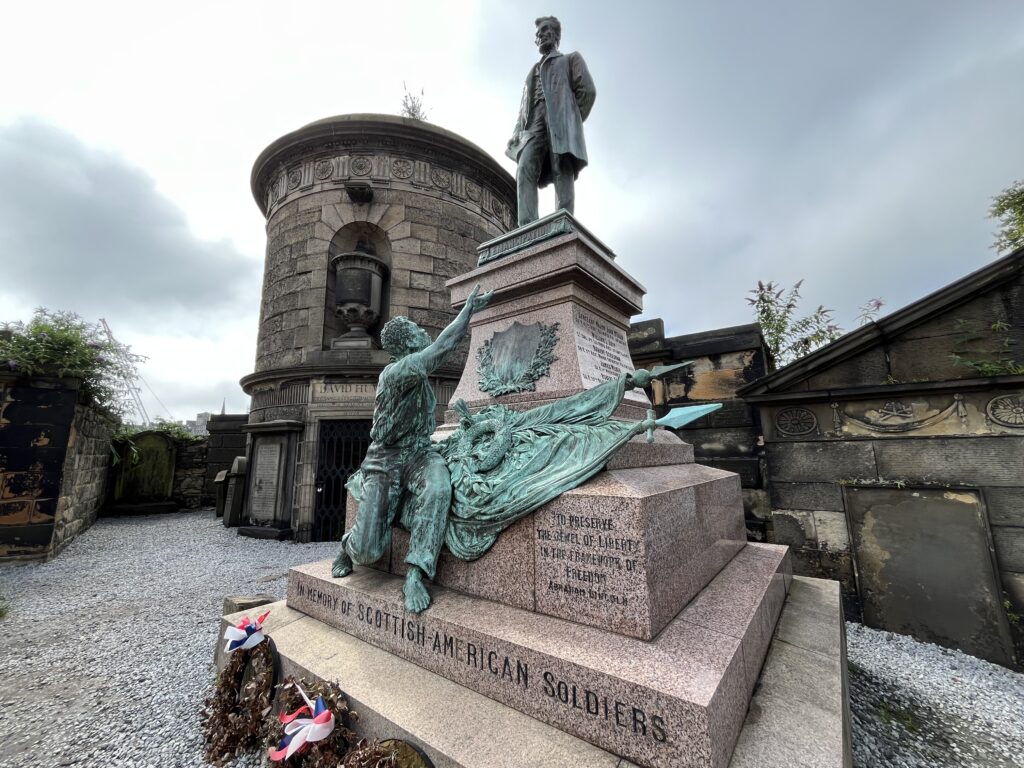
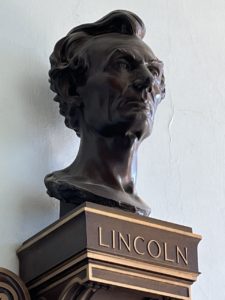
The most obvious is a grand full-length statue of Lincoln that tops the Emancipation Monument in Edinburgh’s Old Calton Burial Ground. Created by the well-known American sculptor George E. Bissell (whose bust of Lincoln sits two feet from me as I type these words), the monument also includes a second figure, a crouching, freed formerly enslaved man extending his arms in gratitude to the imposing Lincoln above him. In a sense, the juxtaposition is reminiscent of the more controversial Thomas Ball Emancipation (Freedman’s) Memorial in Washington, DC. Unlike the Ball statue, however, this figure is fully clothed and resting on furled flags, symbols of victory. This remains the only American Civil War Memorial outside the United States and is a tribute not just to Lincoln but to the memory of Scottish American soldiers who fought in the war. Unveiled in 1893, the Lincoln statue was the first life-sized statue of an American President unveiled in Europe. Philosopher David Hume’s stone tower serves as an impressive backdrop to the Lincoln monument.
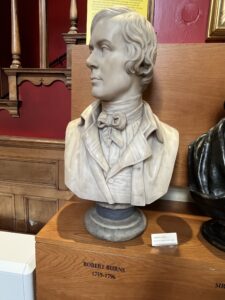 Another connection is to Robert Burns, the Scottish poet whom Lincoln had a particular fascination. Lincoln had supposedly discovered Burns from Jack Kelso, an enigmatic friend from Lincoln’s New Salem days. Kelso had emigrated to the United States from Scotland, where he had previously been a Glasgow schoolteacher. He apparently owned many volumes of Burns that Lincoln read over and over (ditto for Shakespeare). Lincoln was hooked and recited Burns from memory on many occasions through his life. Robert Burns is eminently present in Edinburgh, including a large monument at the foot of Calton Hill (not far from the aforementioned Lincoln statue). Burns is also one of the three Scottish writers featured in the Writers’ Museum tucked into Lady Stair’s Close a few steps off the Royal Mile that leads to the Edinburgh Castle. He is joined there by Robert Louis Stevenson and Sir Walter Scott.
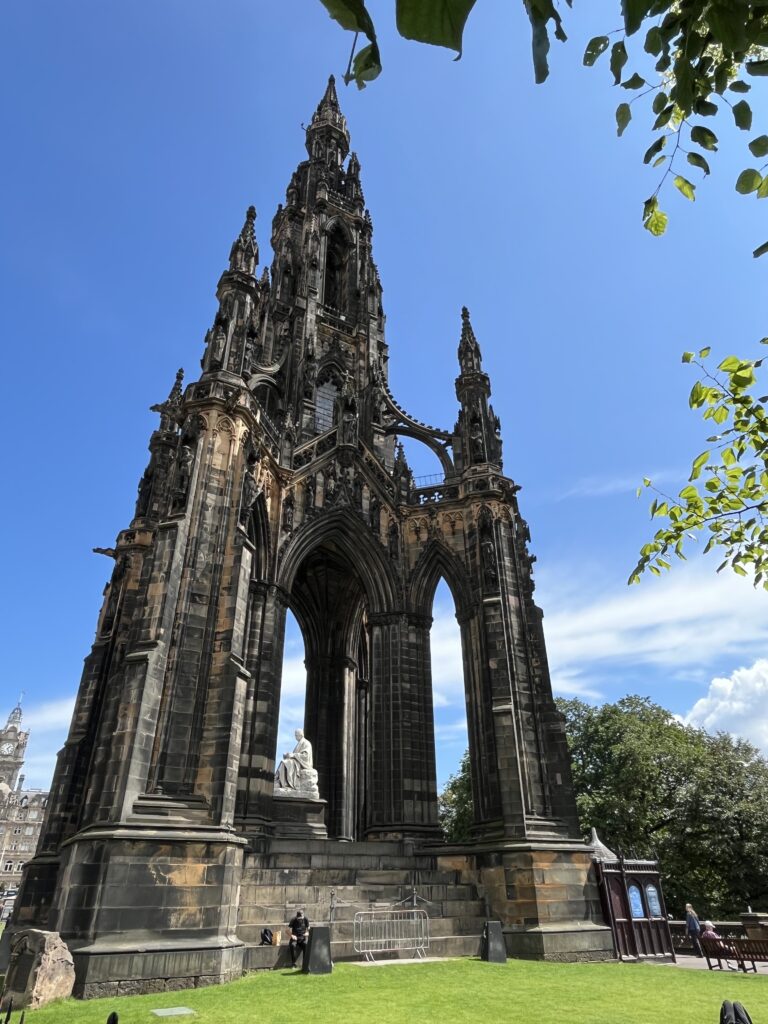
Sir Walter Scott provides yet another, albeit somewhat indirect, connection to Lincoln. The Scott Monument is a Victorian Gothic multi-towered structure that is the second-largest monument in the world to a writer. It dominates the skyline from most of Edinburgh along Princes Street near the Waverly Railway Station (named after Scott’s Waverly novels). Here’s where the Lincoln connection comes in. Way back in 1838 a man named Frederick Bailey escaped from slavery, moved briefly to New York and married Anna Murray, changing their last name to Johnson. They quickly moved on to New Bedford, Massachusetts, where they stayed with Nathan and Mary Johnson. It turns out Johnson was a common name and seeking something more distinctive, Frederick asked Nathan to help pick a new last name. Nathan was a fan of, you guessed it, Sir Walter Scott, and suggested Frederick take on the name Douglas, the name of two principal characters in Scott’s poem “The Lady of the Lake.” Frederick decided to give it a little flair and added the extra “s,” giving us the man we all know today as Frederick Douglass.
There is another, more obscure, connection to Lincoln in Scotland. During my travels I also stayed one night in an old mansion overlooking the cliffs in Dunbar on the far eastern Scottish coast. Dunbar is the birthplace of John Muir, who as I discussed in a previous post, was instrumental in making Yosemite a National Park. Lincoln, of course, had designated Yosemite as the first federal land to be set aside for protection.
I’ll have more on my Lincoln road trip through the UK in future posts, so stay tuned.
[Photos by David J. Kent, 2025]
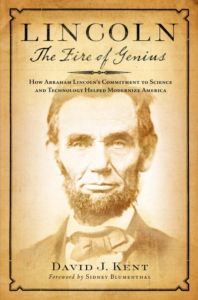
Coming in March 2026: Lincoln in New England: In Search of His Forgotten Tours
Join me on Goodreads, the database where I keep track of my reading. Please leave a review on Goodreads and Amazon if you like the book.
You also follow my author page on Facebook. Also follow me on Instagram.
David J. Kent is Immediate Past President of the Lincoln Group of DC and the author of Lincoln: The Fire of Genius: How Abraham Lincoln’s Commitment to Science and Technology Helped Modernize America and Lincoln: The Man Who Saved America.
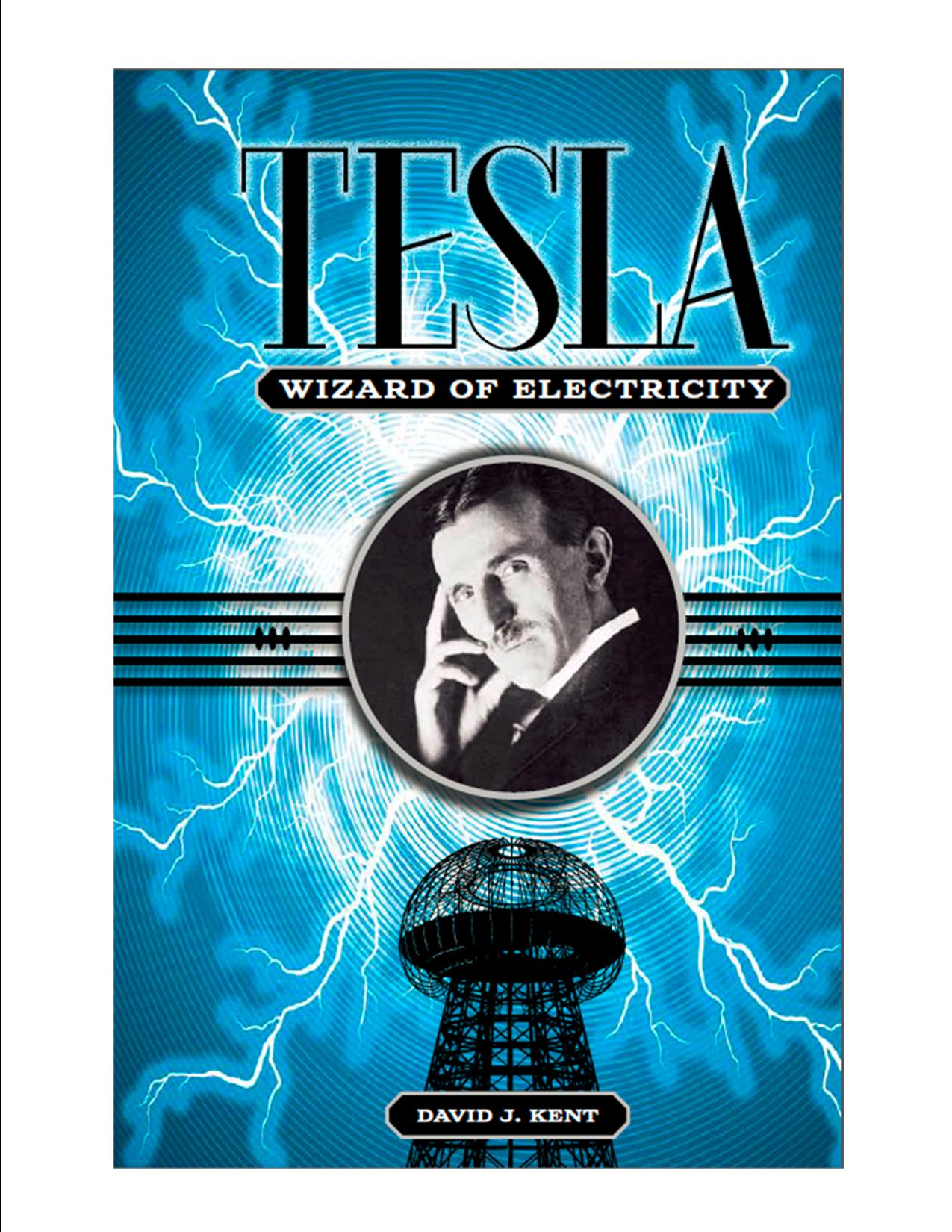
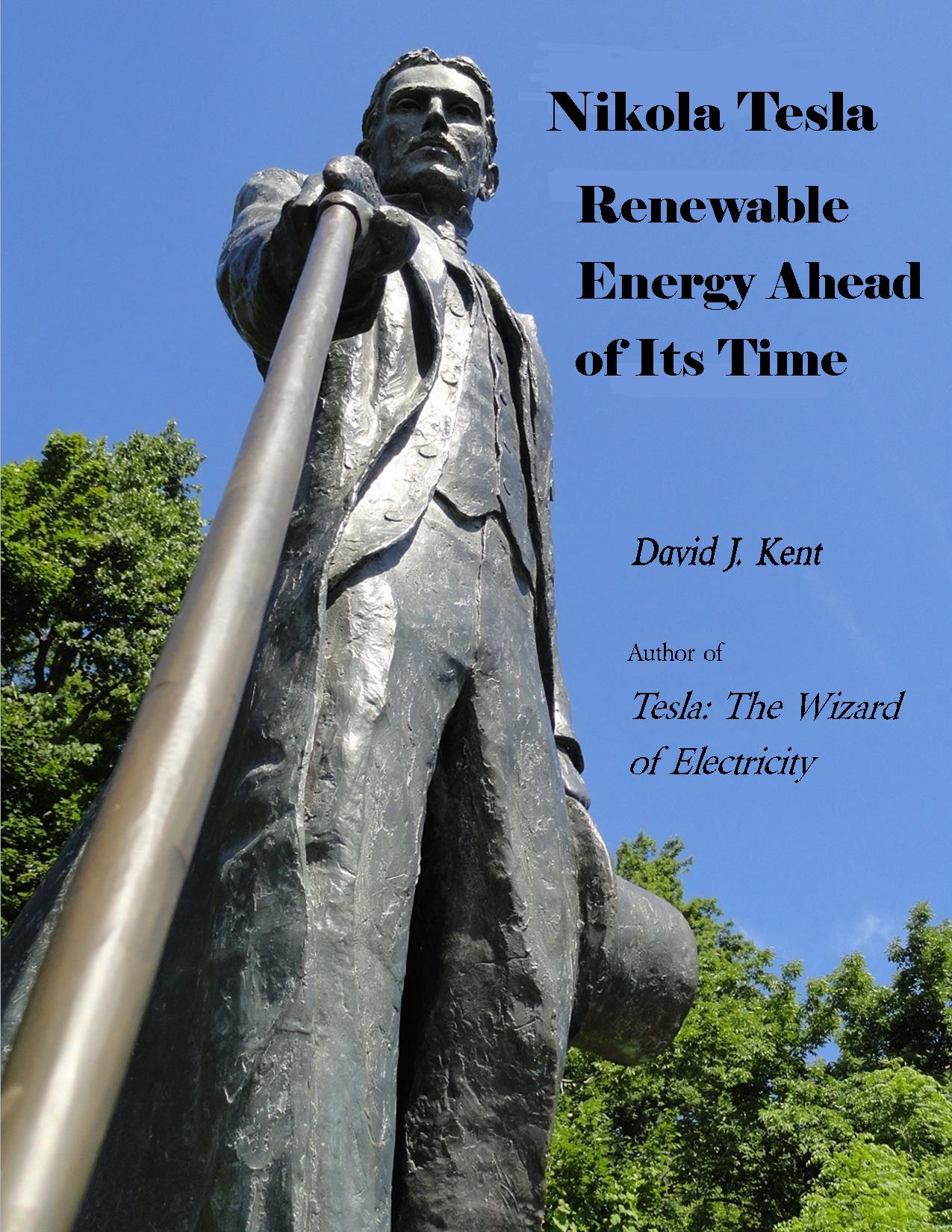
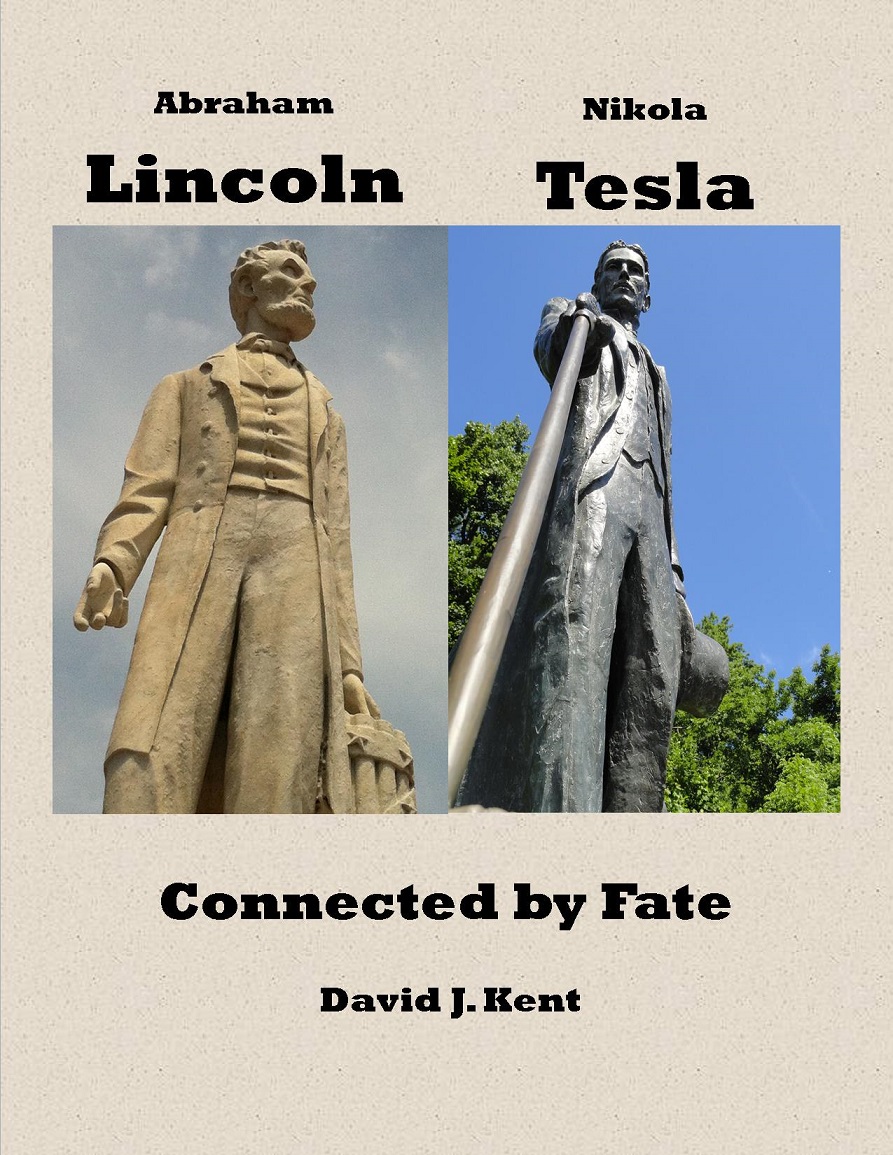
His previous books include Tesla: The Wizard of Electricity and Edison: The Inventor of the Modern World and two specialty e-books: Nikola Tesla: Renewable Energy Ahead of Its Time and Abraham Lincoln and Nikola Tesla: Connected by Fate.
 Back in May
 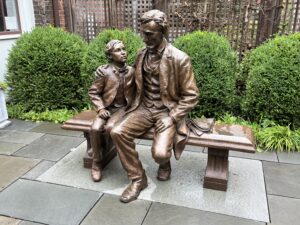 The American Civil War Museum in Richmond, Virginia once had a statue depicting Abraham Lincoln and his son Tad sitting on a park bench. As of this writing it is no longer there, and hasn’t been since 2023. So, where is it?
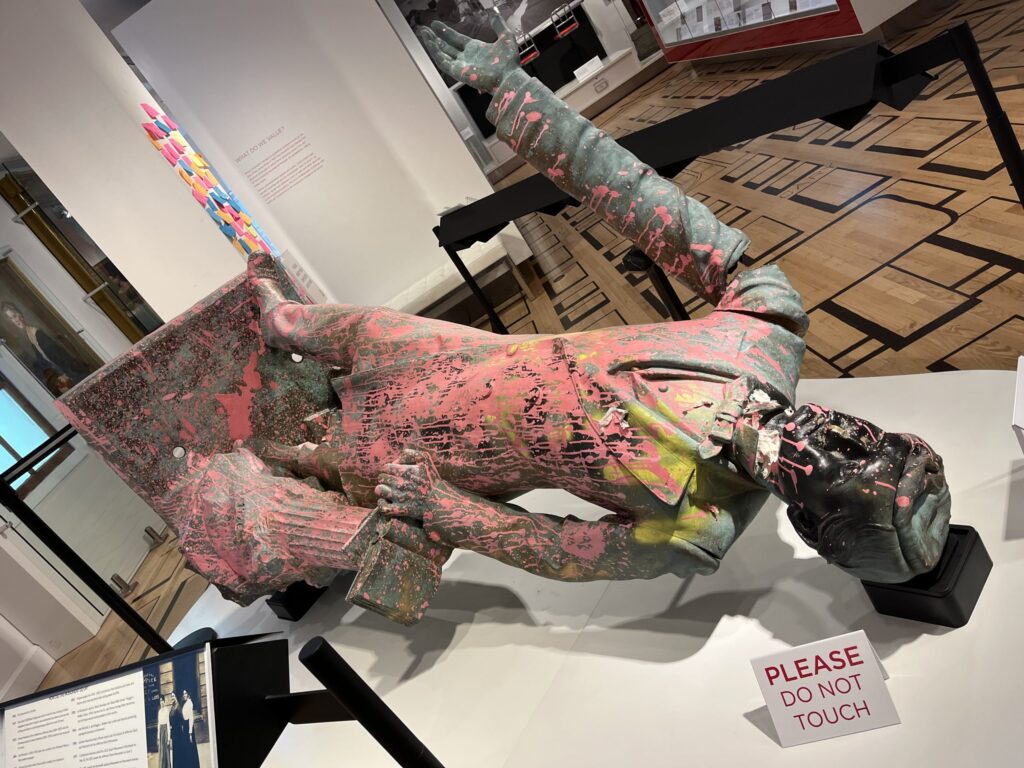 While at the Valentine I also got to see another “Civil War President.” A statue of Jefferson Davis had stood for many decades along Monument Avenue in Richmond. During the 2020 protests over the murder of George Floyd in Minnesota, the Davis statue was vandalized with paint, then pulled down. That statue now sits – or more accurately, lays – in the Valentine’s main gallery. Pink and yellow paint splatters the bronze, Davis’s head is bashed in from the fall off his pedestal, and his right arm is nearly severed. The display symbolizes the city’s change in attitude over its prior adulation of Confederate figures. All of its many dozens of Confederate statues have now been removed, with the exception of a few remaining on the grounds of the Viriginia State Capitol (you walk past them as you proceed from the equestrian statue of George Washington to the Governor’s Mansion). They are now joined by two large group statues, one featuring the many women who fought for voting rights and the other of Barbara Johns and others who fought the battle that would become Brown v. Board of Education. Johns is scheduled to replace Robert E. Lee in the U.S. Capitol’s Statuary Hall. Interestingly, it was Edward Virginius Valentine who had sculpted both the Lee statue (now removed from the hall and currently at Richmond’s Museum of History and Culture) and the one of Davis now at the Valentine Museum. Hopefully, Johns will make it into Statuary Hall soon, perhaps after the new governor takes off after this fall’s election.
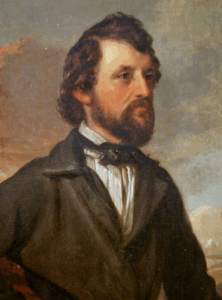 Abraham Lincoln is best known as the sixteenth President of the United States, long before the POTUS acronym was invented. He was elected in November 1860 and by the time he was inaugurated in March 1861, seven southern states had seceded, with four more joining them just over a month later after the new Confederacy attacked Fort Sumter. But this wasn’t the first time Lincoln had been put forward for executive office. In 1856 he was nominated by his fellow new Republican Party members for Vice President after the party had nominated John C. Fremont for President.
 On June 11, 1848, congressman Abraham Lincoln arrived back in Washington, D.C. after having traveled all night from Philadelphia, where he attended the Whig National Convention that nominated Zachary Taylor for president. Upon his return he finds a letter from his wife Mary, who has been visiting her family in Kentucky for several months. These two events begin a campaign and a mystery.
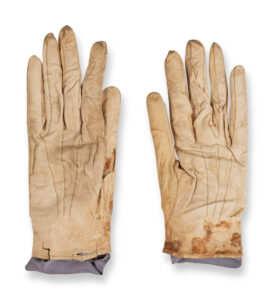 A major auction of Abraham Lincoln artifacts held May 21, 2025, brought in nearly $8 million dollars. The largest amount for any single item was over $1.5 million (including auction fees) for a pair of blood-stained gloves that Lincoln wore the night of the assassination.
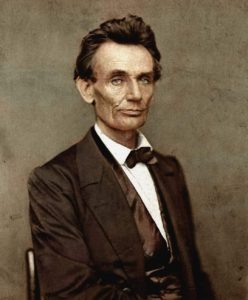 Abraham Lincoln was not happy. He had worked hard to get Zachary Taylor elected as president as a Whig, and yet he was being passed over for the lucrative General Land Office job. Worse, he was being ignored, something the man who had been Whig leader in the Illinois legislature and recent representative to Congress. On May 16, 1849, he made his dissatisfaction with Taylor’s appointment of Justin Butterfield to the Land Office in Illinois.
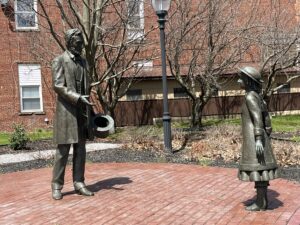 Abraham Lincoln traveled through upstate New York in early 1861 on his way to Washington, DC for his inauguration, stopping in Westfield, Buffalo, Albany, Peekskill, and New York City. Twelve years before, in 1848, he stopped in Buffalo and saw Niagara Falls on his way home between sessions of congress after he toured around eastern Massachusetts giving speeches in support of Zachary Taylor as the Whig nominee for president [Spoiler: Taylor won] In late April of this year, traveled much the same route in northern New York on my way to the Lincoln Forum spring conference at Hildene in Manchester, Vermont.


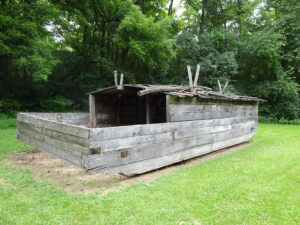 In 1828, nineteen-year-old Abraham Lincoln and neighbor Allen Gentry made what was the first of Lincoln’s two flatboat trips to New Orleans. Gentry’s father funded the trip. A typical investment required about $75 (over $2000 today) for the flatboat alone. The cargo could be worth over $3000 ($82,000 today). A successful trip could be immensely profitable; an unsuccessful one financially devastating.