 May 10, 1862 was a busy day for President Abraham Lincoln. He had arrived at Fortress Monroe days before and today, along with Secretaries Chase and Stanton, accompanied General Wool to a landing place where troops were preparing to march on Norfolk. Lincoln served as his own commanding general in Hampton Roads, directing and pushing for the taking of Norfolk and the Gosport Navy Yard in nearby Portsmouth. He even guided a landing party on Confederate-held soil in search of a spot for the Union Army to make their trek into the city as it was being abandoned by the Confederates. Following this excursion, Lincoln returned to Fortress Monroe and remained there the rest of the day.
But he was also engaged with the progress of the campaign. Learning that troops commanded by Colonel Carr and General Mansfield were not taking part in the attack on Norfolk, Lincoln became enraged. Bouncing his hat off the floor, he dictated a series or orders involving those troops. When there was some pushback by field commanders, Lincoln wrote Flag Officer Goldsborough to provide cover: “You are quite right in supposing the movement made by you and therein reported was made in accordance with my wishes verbally expressed to you in advance.” By 11 pm, General Wool informed Lincoln that Norfolk was now under Union control. As I wrote previously:
Meanwhile, all this activity being directed by Lincoln created problems for the CSS Virginia. Unwilling to take on the Monitor and its supporting ships, the Virginia‘s commander began preparations to run the ship up into the James River. Unfortunately, removing ballast to reduce how low the ship sat in the water made the Virginia neither capable of moving into shallower water nor in a position to fight its way out to the sea. Facing an unfathomable situation, commander Josiah Tattnall opted to save his crew for the future and destroy the Virginia to keep it out of Union hands. Lincoln and others could see the burning hulk from the Monitor and Fort Monroe. The Confederacy’s first ironclad was no more.
As they made their way back to Washington on the USS Baltimore, Secretary Chase wrote his daughter:
“So ended a brilliant week’s campaign of the President,” Chase wrote. He was “quite certain that if he [Lincoln] had not come down, Norfolk would still have been in the possession of the enemy & the Merrimac as grim & defiant & as much a terror as ever.”
This was the only case of a sitting president taking active command of troops in the field during a time of war.
As busy as he was trying to keep the country together during its greatest trial, Lincoln spent much of his time encouraging a more active, strategic warfare. He recognized that the North’s strength was that it had the greater numbers while the South had the greater ability to concentrate forces due to its defensive nature. Just as he did in Norfolk, he pushed his generals to “make our advantage an over-match of his; and this can only be done by menacing him with superior forces at different points, at the same time.” Often, that meant serving as his own General-in-Chief and making things happen.
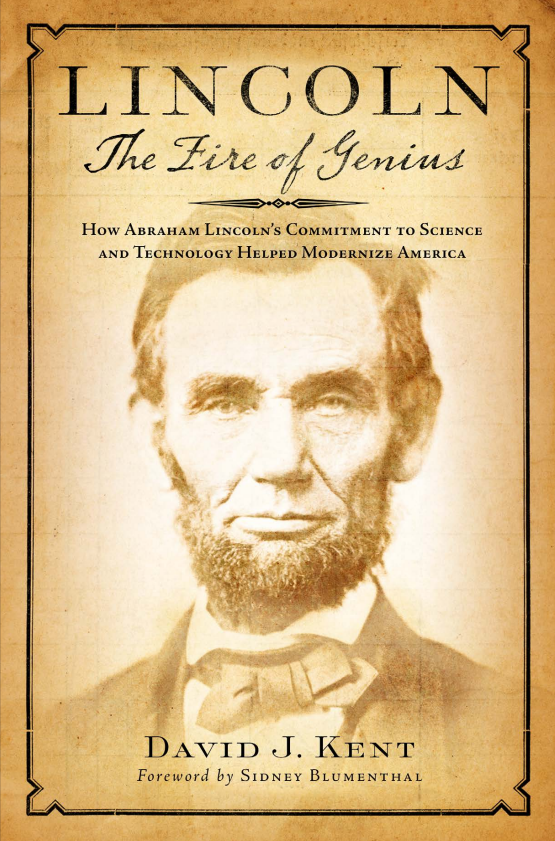
More on this topic in Lincoln: The Fire of Genius.
 The book is available for pre-order on the Rowman & Littlefield website (Lyons Press is a trade imprint of Rowman). You can also pre-order it on Amazon and Barnes and Noble (click on the respective links to pre-order). Release date is scheduled for September 1, 2022.
The book is also listed on Goodreads, the database where I keep track of my reading. Click on the “Want to Read” button to put it on your reading list. That will also ensure you get informed of the release date AND will let you try for one of ten free hardcover copies of the book that I’ll be giving away this summer. I’ll also be giving away as many as a hundred e-books. [The book will also be put out on audio]
You also follow my author page on Facebook.
I’ll have much more about the book over the next few months, so join my mailing list here to keep informed.
David J. Kent is President of the Lincoln Group of DC and the author of Lincoln: The Man Who Saved America. His previous books include Tesla: The Wizard of Electricity and Edison: The Inventor of the Modern World and two specialty e-books: Nikola Tesla: Renewable Energy Ahead of Its Time and Abraham Lincoln and Nikola Tesla: Connected by Fate.
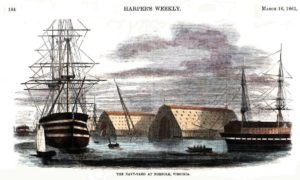
[Photo of The Navy Yard at Norfolk. Harper’s Weekly, 1861. Courtesy Library of Congress.]
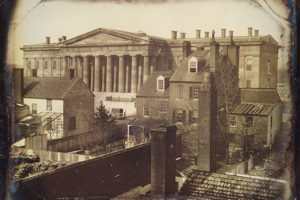 At noon on Thursday, May 2, 1861, President Abraham Lincoln raised the flag over the Patent Office at 7th and F streets, NW, Washington, DC.
 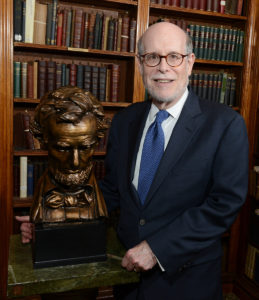 One part of the process of putting together a book is asking prominent experts in the field to read an advance copy and provide back cover “blurbs.” I am very happy to report that one of the most highly respected and prolific leaders on Abraham Lincoln – Harold Holzer – has offered the following praise for
 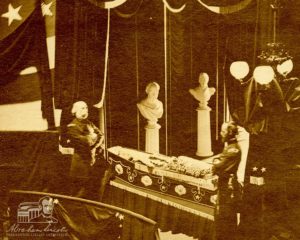 Abraham Lincoln died at 7:22 am on the morning of April 15, 1865. The final chapter in Lincoln: The Fire of Genius is called “Assassination Science.” It starts this way:
 I will be giving a presentation on April 13, 2022, titled “
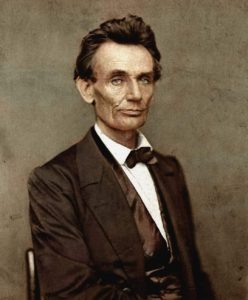 Abraham Lincoln once advised in the prosecution of Isaac Wyant, who had his arm amputated after being shot in a border dispute with Anson Rusk. Following his recovery, Wyant sought out and shot Rusk four times, then pleaded not guilty by reason of temporary insanity. Lincoln’s old friend Leonard Swett was on the side of the defense.
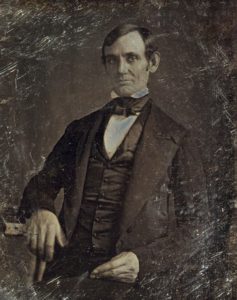 On March 23, 1860, one of Lincoln’s more famous cases came to trial in the U.S. District Court. Johnston v. Jones & Marsh, more commonly known as the Sand Bar case, was important both because of its subject matter (it highlighted Lincoln’s experience with technology) and because, in an age where trial transcripts were almost never kept, journalist Robert Hitt was paid to sit through the entire trial and create a comprehensive 482-page trial transcript, although he omitted the closing arguments.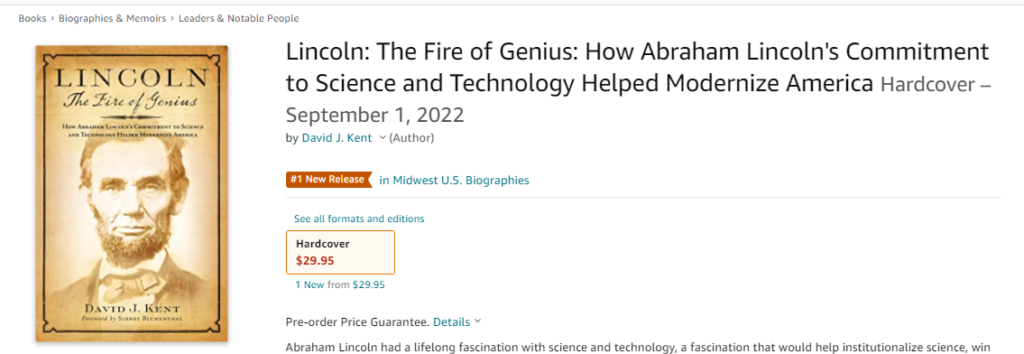
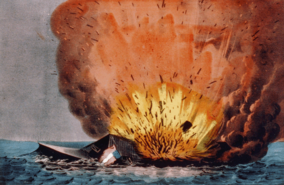 Abraham Lincoln spent much of his day on March 9, 1862 fretting over the battle of the ironclads. The Union ironclad Monitor had fought to a draw with the Confederate ironclad Virginia (former the USS Merrimack) at Hampton Roads, Virginia. The Virginia had been created from the burnt out hull of the Merrimack, left behind at Gosport Navy Yard at the beginning of the war after the state of Virginia seceded. The Merrimack was converted by the Confederate Navy into a seemingly indestructible metallic monster soon to prey on Union ships. Even though the ship was now officially the Virginia, the alliteration of Monitor and Merrimack (and the end of the Confederacy) means most people refer to the ship by its former name, both then and now.*
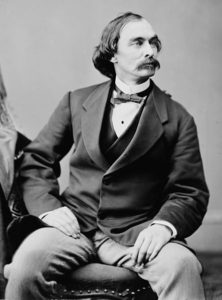 Abraham Lincoln had a knack for meeting Arctic explorers. On March 1, 1862, Lincoln wrote to Secretary of War Edwin Stanton: