 “Upon the subject of education,” Abraham Lincoln wrote in his Communication to the People of Sangamo County in 1832, “I can only say that I view it as the most important subject which we as a people can be engaged in.”
True to his word, on December 2, 1840, during his tenure in the Illinois state legislature, Lincoln offered a resolution: “That the committee on education…inquire into the expediency of providing by law for examination as to qualifications of persons offering themselves as school-teachers, that no teacher shall receive any part of the public school fund who shall not have successfully passed an examination.” This resolution is embodied in sec. 81 of common school code adopted at this session.
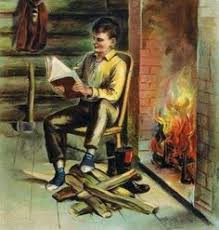
Up to that point, teachers on the frontier weren’t required to have any qualifications beyond “readin, writin, and cipherin’ to the Rule of Three.” The state of education on the frontier was so limited that “if a straggler supposed to understand Latin, happened to so-journ in the neighborhood, he was looked upon as a wizzard.” Even with his limited access to formal education, Lincoln quickly outclassed his occasional teachers in capability, mostly because he did what he could to “pick up from time to time under the pressure of necessity” any other education. To give him proper credit, that included teaching himself English grammar, Euclid geometry, surveying, and the law.
In fact, a closer look at Lincoln’s ciphering book (often referred to as his “sum book”) shows that Lincoln was less than forthcoming about his educational achievements, intentionally downplaying his expertise for political expediency. The ciphering book includes an additional page covering his practice with the double rule of three, a slightly more complicated skill than he suggested. There are also several fragmented pages in which he practices both simple and compound interest, and calculation of a discount rate. Based on these few entries, only a fraction of the original 100-page volume, Lincoln clearly gained more intense mathematical knowledge than suggested in his biographical sketch. Early twentieth century researcher M.L. Houser went so far as to suggest Lincoln received a “collegiate education” before he was 18 years old. Taking Lincoln at his word that he ciphered clear through Pike’s Arithmetick, with additional study in Daboll’s book, he would have covered more advanced skills such as reduction (converting unlike numbers), vulgar (simple) fractions, decimals (called decimal fractions), duodecimals, and the inverse rule of three. He likely studied square and cube roots (and their extraction), permutations, and involutions. The two books also provided instruction in practical mathematics that he would find useful in his later life as a store clerk, including gauging the volume of casks used for liquid goods, ways to calculate payments, and general bookkeeping skills. Pike’s provides information on mechanical powers of levers, an introduction to physics that Lincoln would have found useful in loading and unloading flatboats. From Daboll’s he could have learned geometrical progression, or how to determine the sum of the terms in any series of numbers increasing or decreasing by one common multiplier.
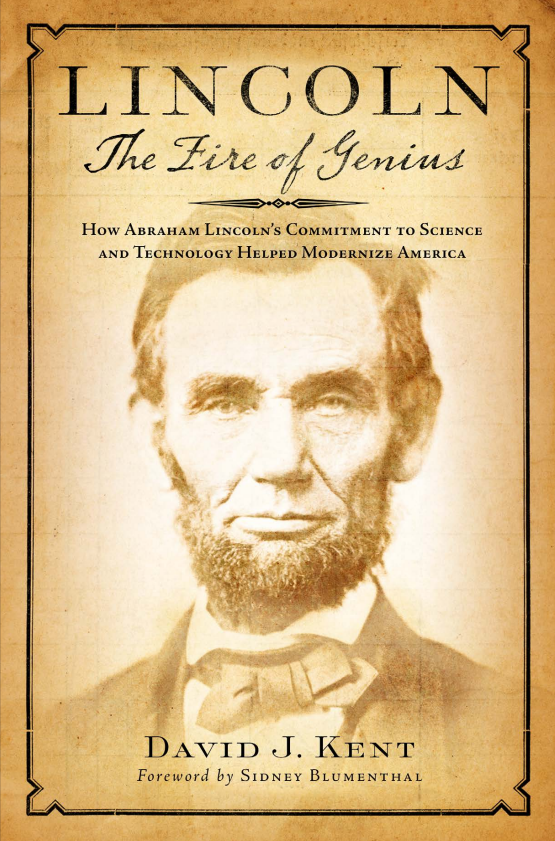
But there is so much more about Lincoln’s education that I discuss in my book, Lincoln: The Fire of Genius.
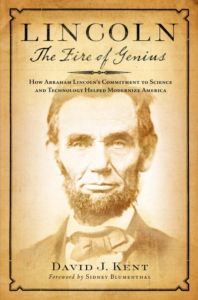
Lincoln: The Fire of Genius: How Abraham Lincoln’s Commitment to Science and Technology Helped Modernize America is available at booksellers nationwide.
Limited signed copies are available via this website. The book also listed on Goodreads, the database where I keep track of my reading. Click on the “Want to Read” button to put it on your reading list. Please leave a review on Goodreads and Amazon if you like the book.
You also follow my author page on Facebook.
David J. Kent is President of the Lincoln Group of DC and the author of Lincoln: The Fire of Genius: How Abraham Lincoln’s Commitment to Science and Technology Helped Modernize America and Lincoln: The Man Who Saved America.
His previous books include Tesla: The Wizard of Electricity and Edison: The Inventor of the Modern World and two specialty e-books: Nikola Tesla: Renewable Energy Ahead of Its Time and Abraham Lincoln and Nikola Tesla: Connected by Fate.
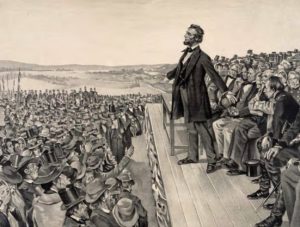 Most people know what Lincoln was doing on November 19, 1863 because they had to memorize the Gettysburg Address in school. But the rest of the day itself is less known. Looking at The Lincoln Log, which is an expanded online version of a book called “Lincoln Day-by-Day,” provides some fascinating detail. Keep in mind that Lincoln arrived in Gettysburg the evening before, taking time to touch up the final passages at David Wills’s house on the square in downtown Gettysburg. The following is what he did almost hour by hour on November 19th, according to
 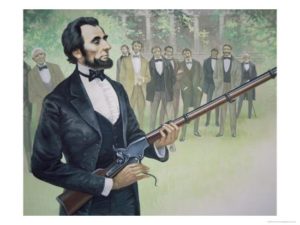 Lincoln took a scientific approach to military strategy. The Anaconda plan’s focus was on securing the coastlines and the Mississippi River. Recognizing New Orleans as the hub of the cotton trade and commerce, Lincoln saw it as the first port to be targeted for blockade. He also hoped to block southern ship traffic from Charleston, South Carolina to cut off Confederate attempts to woo Great Britain and France to their side. Helping him make this happen was Alexander Dallas Bache and the Coast Survey. The Coast Survey had been authorized by Thomas Jefferson, and Bache, who was Benjamin Franklin’s great-grandson, was quick to send nautical charts of the Chesapeake Bay to Lincoln. He also forwarded two terrestrial maps produced by the Survey that had far-reaching influence on Lincoln’s decisions on emancipation and military strategy.
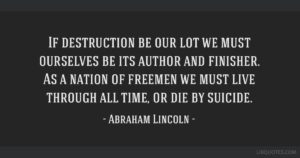 Abraham Lincoln spoke these words in a speech generally referred to as the
 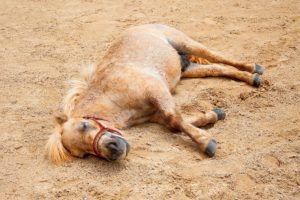 I have just read your dispatch about sore tongued and fatigued horses. Will you pardon me for asking what the horses of your army have done since the battle of Antietam that fatigue anything? A. LINCOLN
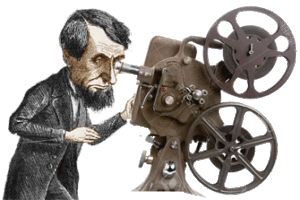 Technically, Lincoln didn’t attend the exhibition, but on this date, October 14, 1861, a committee of commissioners for the industrial exhibition in England visits President Lincoln in the White House and asks use of a government vessel to transport American contributions to the fair. Lincoln had supported United States participation.
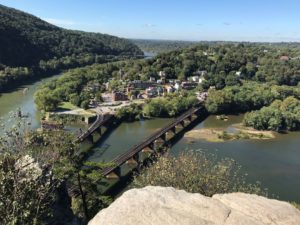 President Lincoln took a special train to Harpers Ferry on October 1, 1862. I drove my car to the National Park Service visitors center on October 1, 2021. Lincoln reviewed the troops on Bolivar Heights. I climbed to the overlook on Maryland Heights. One hundred and fifty-nine years separated us, but I still felt his presence.
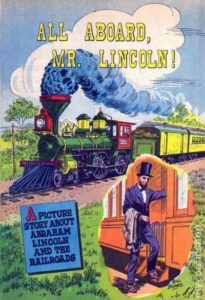 On June 23, 1854, Abraham Lincoln draws on his account at the Illinois Central Railroad. The ICRR had been a repeat source of work for the Lincoln, who had been focusing on his legal career after being relegated to the sidelines politically. He would not be in an elected position for eleven years. He did a variety of work for several railroads, but the ICRR by far was the most prolific and profitable. Still, he wasn’t making much money per case.
 Back in mid-July, I was happy to report that the Lincoln Group of DC was going back to live, in-person, programming. What a difference a couple of months makes. As readers will already have seen, our October meeting with Ron White, originally planned as a big in-person luncheon shindig complete with special surprises, is not going to happen. Ron has rightfully reconsidered his travel to the east coast because of the pandemic. Instead, Ron will give us a virtual presentation on
 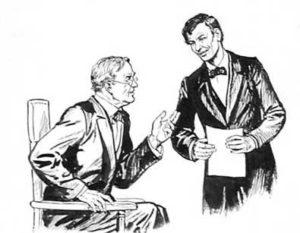 On September 10, 1856, Abraham Lincoln wrote an affidavit in a medical malpractice case that involved chicken bones. It was the first medical malpractice case in McLean County.