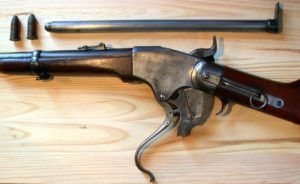
 On August 17, 1863, Christopher M. Spencer, inventor of Spencer rifle, presents his new repeating rifle to President Abraham Lincoln and demonstrates how to assemble it. Lincoln was always keen on implementing new military technology during the Civil War, although his generals were not always so eager to follow his lead. Chief of Ordnance James Wolfe Ripley argued that more advanced weaponry was not self-evidently better in the field. Complicated weapons in the hands of untested soldiers and poor weather conditions led to vast inefficiencies in his mind, so Ripley denied the use of some of the new-fangled ideas Lincoln liked.
Lincoln did understand this concept and rarely overruled Ripley and officers in the field if they felt they knew better. John Hay acknowledged that “Lincoln had a quick comprehension of mechanical principles and often detected a flaw in an invention which the contriver had overlooked.” But just as keenly he understood how some mechanics could be useful, so Lincoln continued to push the idea of advancing weaponry as much as was practical. When something of particular value in his mind came along, he was more assertive in telling Ripley and others to put it into circulation. One example was the Spencer repeating rifle.
Spencer was born in Manchester, Connecticut, just east of the capital, Hartford. Only thirty years old when he first walked into the White House without challenge carrying one of his rifles and a supply of cartridges, Spencer was already an avid inventor. He would later go on to invent a steam-powered horseless carriage. He had previously worked for Samuel Colt’s firearms factory. This new rifle featured breech-loading repeating rounds capability, a huge step forward from the standard issue musket.
Most breech-loading rifles were still single-shot weapons. The Spencer had a seven-round tube magazine that loaded from the butt of the rifle, feeding each shell into the breech with a lever that expelled the spent shell. Experienced users could fire twenty rounds per minute, compared to only two or three with a muzzleloader. The short barrel made it perfect for cavalry, which was its main use both during and after the Civil War. Lincoln personally tested the rifle. Spencer had a private meeting with the president, who found the mechanism fascinating. Spencer later suggested, perhaps a bit hyperbolically, that Lincoln put the rifle back together after watching Spencer take it apart and lay the parts on the table. The next day, Lincoln and Spencer went out to the field behind the White House, set up a board “about six inches wide and three feet high, with a black spot on either end, about forty yards away.” Six of Lincoln’s seven shots hit close to the bull’s-eye. John Hay, Lincoln’s secretary, admitted that “the President made some pretty good shots.”
Finding the Spencer repeating rifle to be a sufficient advancement, Lincoln overruled Ripley’s reticence and ordered the military to purchase ten thousand units for distribution. By the end of the war, nearly one hundred thousand Spencer rifles and carbines were in service. Various breechloaders, rifles, carbines, and repeaters by Spencer, Enfield, Sharps, Whitworth, Springfield, and others played important roles in the war, including Berdan’s sharpshooters at Gettysburg and the critical Battle of Chickamauga.
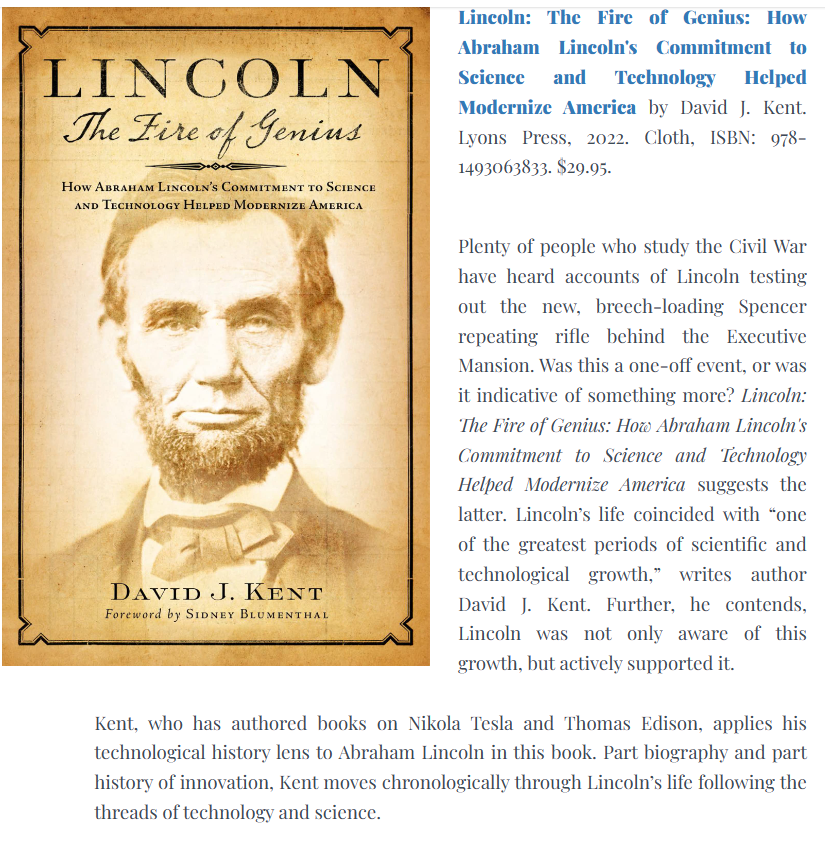
[Adapted from Lincoln: The Fire of Genius, available from all booksellers now]
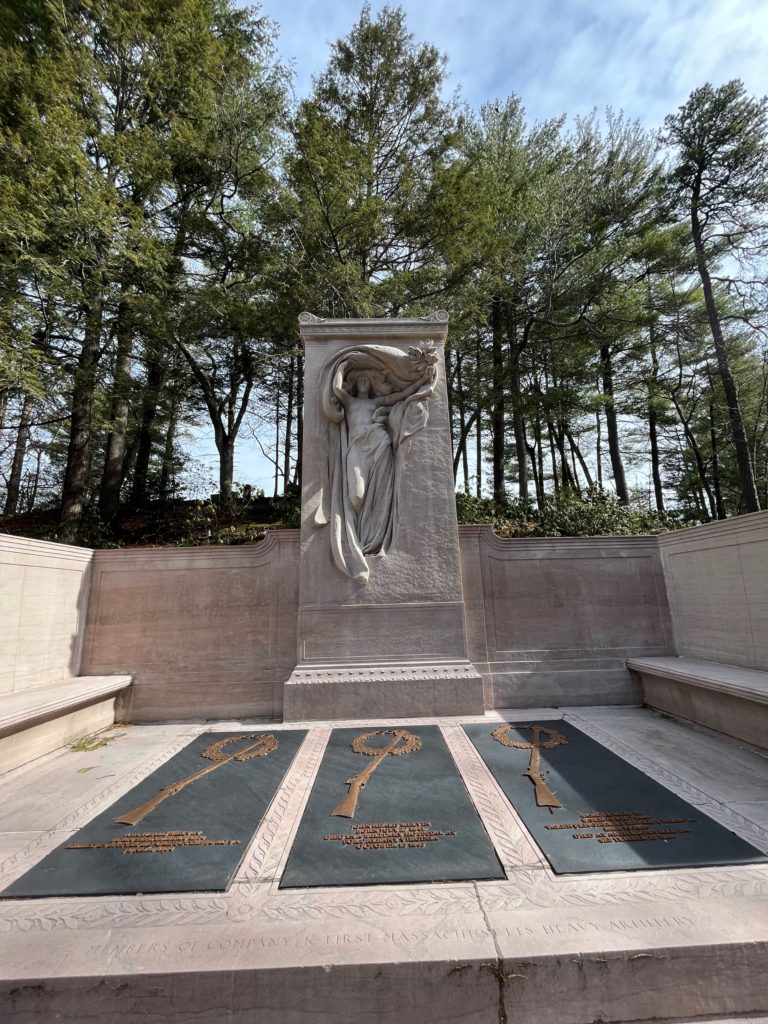
[Photo credit: Hmaag, CC BY-SA 3.0 <https://creativecommons.org/licenses/by-sa/3.0>, via Wikimedia Commons]
Lincoln: The Fire of Genius: How Abraham Lincoln’s Commitment to Science and Technology Helped Modernize America is available at booksellers nationwide.
Limited signed copies are available via this website. The book also listed on Goodreads, the database where I keep track of my reading. Click on the “Want to Read” button to put it on your reading list. Please leave a review on Goodreads and Amazon if you like the book.
You also follow my author page on Facebook.
David J. Kent is President of the Lincoln Group of DC and the author of Lincoln: The Fire of Genius: How Abraham Lincoln’s Commitment to Science and Technology Helped Modernize America and Lincoln: The Man Who Saved America.
His previous books include Tesla: The Wizard of Electricity and Edison: The Inventor of the Modern World and two specialty e-books: Nikola Tesla: Renewable Energy Ahead of Its Time and Abraham Lincoln and Nikola Tesla: Connected by Fate.
 Robert Lincoln got his initial interest in astronomy from his father. Abraham Lincoln was fascinated by astronomy, as I discuss in my book,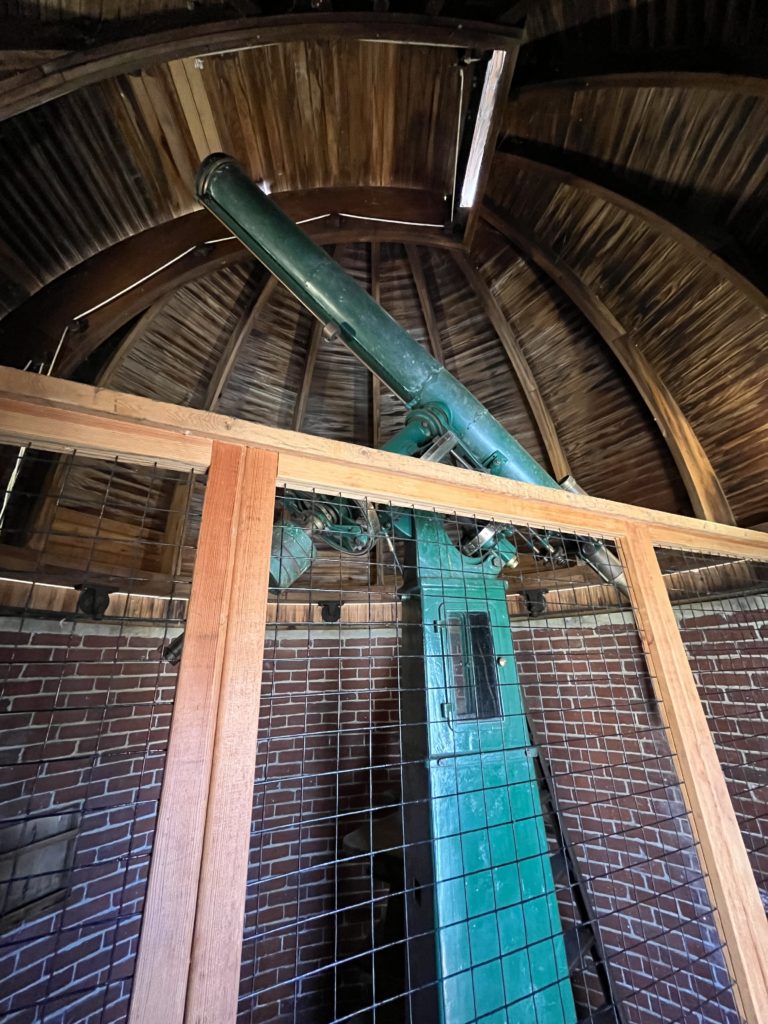
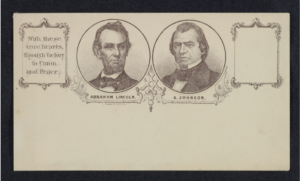 Today, July 26, marks the 75th anniversary of the opening of the Lincoln Papers at the Library of Congress.
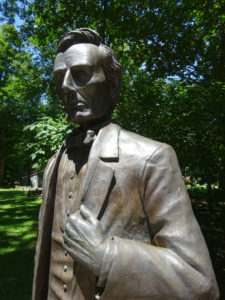
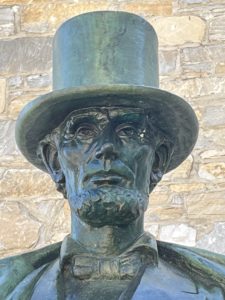 Abraham Lincoln is the most memorialized president in American history, in terms of the number of monuments and statues in all fifty states and the U.S. territories. According to the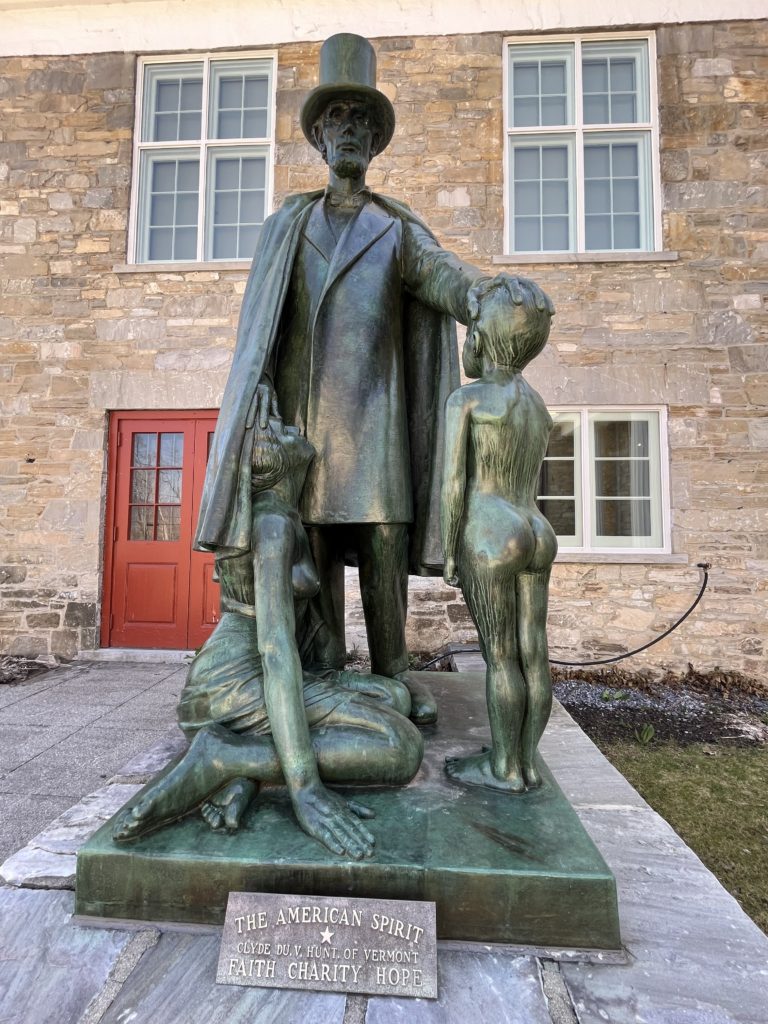
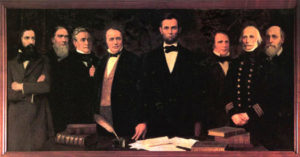 In Abraham Lincoln’s lecture on Discoveries and Inventions, he discussed how the ingenuity of man had made life easier for the growing millions of Americans. Early in the lecture he used biblical language to relate how the need for clothing led to technological advances, as was also true for communication. At one point he turned to transportation. As with clothing, he stressed the advantages of inventive, productive labor that improves the human condition. Here the goal was to advance beyond human motive power to get from place to place. Inventive thought led to development of the wheel, then wagons on land and boats on water. These were powered by animals such as horses, mules, and oxen on land, or wind and paddles on the water.
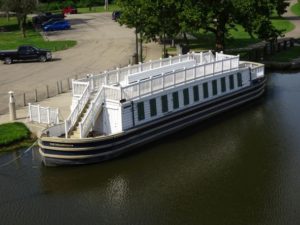 On June 20, 1848, Congressman Abraham Lincoln so strongly believed in the long-term economic benefit of improvements that he used some of the limited time allotted to freshmen congressmen to argue for internal improvements on the floor of the House. He began by rebutting the recent Democratic platform written for the 1848 nomination of Lewis Cass, which concluded the Constitution did not confer upon the federal government the power to carry on a system of internal improvements. Lincoln disagreed and systematically dismantled each of the positions offered to support that conclusion.