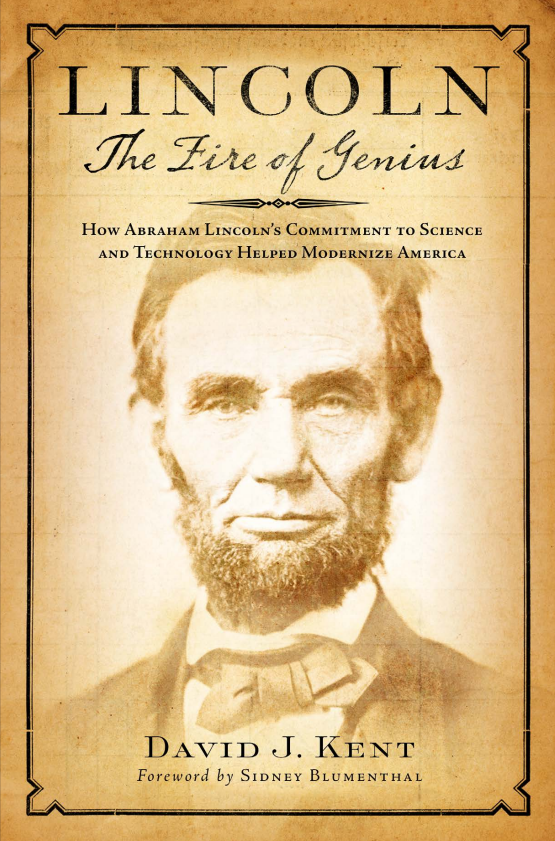
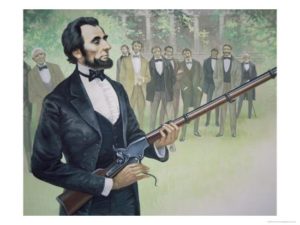
 Abraham Lincoln had an interest in technology, and on June 10, 1861 he sees a new weapon he likes. I write about this and other incidents in my forthcoming book:
A few weeks into the war, he pressed Captain James Dahlgren on a new gun presented by Orison Blunt. After encouraging Dahlgren to “please see Mr. Blunt,” Lincoln wrote “What do you think of it? Would the government do well to purchase some of them?” When Dahlgren replied positively the same day, Lincoln endorsed the envelope with another prod for action: “I saw the gun myself, and witnessed some experiments with it,” Lincoln wrote, adding “I really think it worthy the attention of the government.” Presumably these were the Enfield-patterned rifles Blunt made for the Army a year later.
Pursuing another promising new rifle, Lincoln wrote to Ripley “to introduce you to Mr. Strong who has what appears to be an ingenious and useful Carbine” and asked Ripley to give it a service test. Strong was an unlikable man with dubious ethics, but his breechloading carbine provided the advantage of faster loading at the base of the shorter barrel compared to the longer barreled, muzzle loading muskets most commonly in use. Ripley was unimpressed. While admitting that the new system was “novel and ingenious,” he told Lincoln that it was no better than any of the other breechloading rifles available, which Ripley found to be too complicated to employ in service. Keep it simple was Ripley’s motto, and he preferred old muskets to simplify supply of guns and ammunition to thousands of green troops.
The above is just a teeny snippet from the new book. I’m doing the final editing for submission to the publisher within the next few weeks. Over the next several months I’ll have more information to release about the book, including a stellar Foreword by a well-known author, a cover reveal, and much more.
David J. Kent is the author of Lincoln: The Man Who Saved America. His newest Lincoln book is scheduled for release in February 2022. His previous books include Tesla: The Wizard of Electricity and Edison: The Inventor of the Modern World and two specialty e-books: Nikola Tesla: Renewable Energy Ahead of Its Time and Abraham Lincoln and Nikola Tesla: Connected by Fate.
Follow me for updates on my Facebook author page and Goodreads.
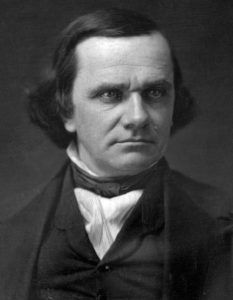 At 9:10 am on Monday, June 3, 1861, Stephen A. Douglas died in Chicago at the age of forty-eight. Thus ended a remarkable life, both as a leader in the antebellum Democratic party and as a foil to Abraham Lincoln’s rise. Douglas had fallen ill weeks before while headed back to Illinois to lobby for Democratic support of the newly elected President Lincoln once the Civil War started. Lincoln immediately directs that government offices be close on the day of the funeral and that the Executive Mansion (aka, the White House) and departments be draped on mourning for thirty days. On June 4th, Secretary of War Simon Cameron issues a circular to Union armies, announcing “the death of a great statesman…a man who nobly discarded party for this country.”
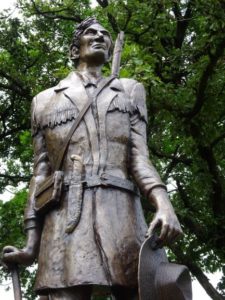 On May 27, 1832, Captain Abraham Lincoln’s company is mustered out of U.S. service by Nathaniel Buckmaster, Brigade major. Lincoln writes the muster roll of his company, certifying that remarks on activities of several members are accurate and just. He then enrolls in company of Capt. Elijah Iles for service in 20-day regiment.
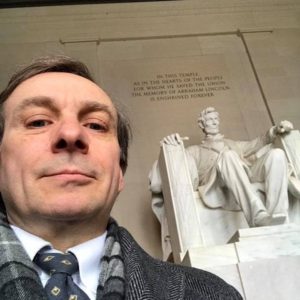 This week I officially became President! So much has been going on that I figured a quick professional update was in order.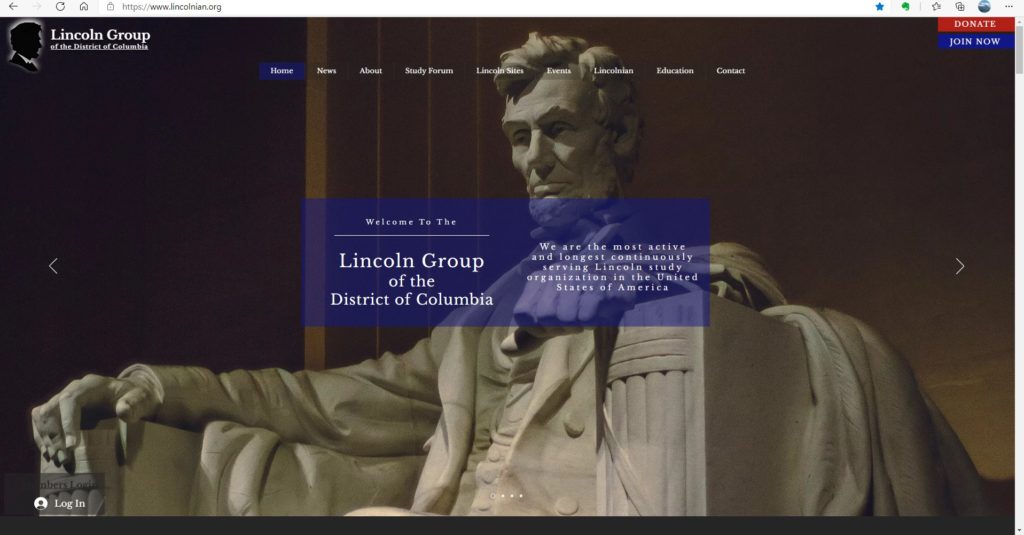
 Periodically I check a website called
 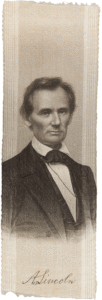 When he returned from the Black Hawk War, Lincoln was without any means of employment or income. He briefly considered learning blacksmithing, but he also wanted to further his education, which he acknowledged was sorely lacking. Around this time New Salem resident James Herndon sold his interest in the general store he owned with his brother Rowan to William F. Berry, who had served with Lincoln in the militia. Dissatisfied with Berry, a few weeks later Rowan sold his own share to Lincoln. Berry was the son of a Presbyterian minister from an influential family, so may have paid for his share, but Lincoln’s share was obtained on credit. In 1832, Berry and 22-year-old Lincoln were suddenly partners, store owners, and in debt.
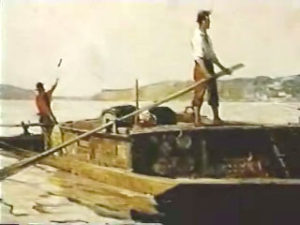 Soon after moving to Illinois, Lincoln made his second flatboat trip to New Orleans. A local entrepreneur and schemer named Denton Offutt approached Lincoln’s relative John Hanks about manning such a journey. Hanks then recruited Lincoln and brother-in-law John Johnston, all of whom now lived in a wooded area west of Decatur near the banks of the Sangamon River. Because of the previous “winter of deep snow,” melting snowpack made the roads impassable by the first of March 1831, forcing the three men to purchase a canoe and paddle down the Sangamon River as far as Springfield, where they expected to find a fully loaded flatboat. Offutt, however, had somehow forgotten to arrange for it.
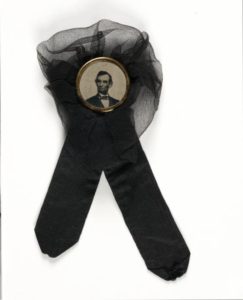 The mood in Washington was euphoric. After four long years the war was nearly over. Lincoln had anticipated this ending in his second inaugural address, reminding northerners that they should welcome southerners back into the Union:
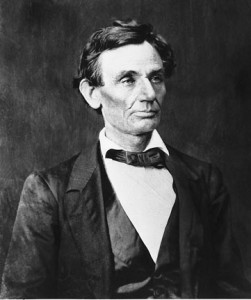 On April 6, 1858, in Bloomington, Illinois, Abraham Lincoln gave his first science lecture on what has become known as “Discoveries and Inventions.” Or maybe he wrote two lectures by that name; the issue is a bit murky.