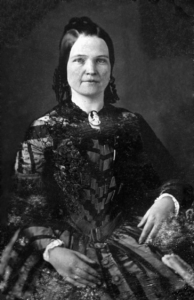
 On this auspicious date in 1844, Mrs. Lincoln bought material to make corsets. Six yards of “gimp,” which was a strong twisted silk, wool, or cotton (not to be confused with the plastic form of gimp I used in Boy Scouts), along with ample amounts of lace. Presumably she already had whalebone or simply used over-starched fabric for stiffness. As critical as this was for containing the spreading remnants of Robert’s birth the previous year, this was only one of many important events happening on this day in Lincoln’s life.
August 26th seemed to be a good day for speeches. In 1844, a 35-year-old first term Congressman Abraham Lincoln spoke at the Rough and Ready Club in Rockville, Maryland. In 1852, Lincoln rebutted Stephen A. Douglas’s speech at the Scott Club in Springfield, Illinois. In 1854, Lincoln gives his first speech on the Kansas-Nebraska Act at the Whig Party Convention in Winchester, Illinois. The local paper reports “His . . . masterly effort . . . was replete with unanswerable arguments, which must and will effectually tell at the coming election.” In 1858, Lincoln gets an ambrotype photograph taken in Macomb, IL, before heading out to Amboy, where he makes a short speech that night.
President Lincoln turns to writing in 1863. He declines an invitation to speak in Springfield, IL, noting that such a trip was impossible in the midst of the Civil War. Writing was has become a famous letter to James C. Conkling, he lays out his rationales for his actions to save the Union:
There are those who are dissatisfied with me. To such I would say: You desire peace; and you blame me that we do not have it. But how can we attain it? There are but three conceivable ways. First, to suppress the rebellion by force of arms. This, I am trying to do. Are you for it? If you are, so far we are agreed. If you are not for it, a second way is, to give up the Union. I am against this.
He also called out those white men who disdain his emancipation measures, noting:
Peace does not appear so distant as it did. I hope it will come soon, and come to stay; and so come as to be worth the keeping in all future time. It will then have been proved that, among free men, there can be no successful appeal from the ballot to the bullet; and that they who take such appeal are sure to lose their case, and pay the cost. And then, there will be some black men who can remember that, with silent tongue, and clenched teeth, and steady eye, and well-poised bayonet, they have helped mankind on to this great consummation; while, I fear, there will be some white ones, unable to forget that, with malignant heart, and deceitful speech, they have strove to hinder it.
This day also brings some personal news related to my forthcoming book and my role as president of the Lincoln Group of DC.
Regarding my book, I’ve been waiting for the publisher to get back to me with edits, expecting that the book would be released around February of 2022. I’m now told that the release date has been scheduled for September 2022. This changes my planning considerably. In the interim, I’ve decided to move forward with another book I’ve been working on related to a dialogue I had last year on Confederate monuments. I’ll have more information on that one soon, but I hope to publish it on the Amazon framework by the end of this year.
The Lincoln Group of DC has also been active. In October, I’ll be joined by immediate past-president John O’Brien and distant past-president Ed Steers in teaching a course on Abraham Lincoln via Encore Learning. We’ll be tackling Lincoln’s Youth (Ed), Lincoln as Politician (Me), Lincoln as Commander-in-Chief (Me), and Emancipation and Legacy (John). Here is more detailed information about the course. More info about Encore Learning.
The Lincoln Group is also planning for the Centennial of the Lincoln Memorial. Dedicated in 1922, the 100th anniversary will be celebrated with an entire month of programs in May 2022. The Lincoln Group will have a ceremony with music, speakers, and much more on the steps of the Lincoln Memorial. We’ll also be sponsoring Lincoln-associated events with the American Film Institute in Silver Spring, MD, a possible discussion on the Memorial and the Civil Rights movement with the National Archives, and a possible luncheon with speakers at the Willard Hotel. Keep up on the plans via our new Lincolnian.org website.
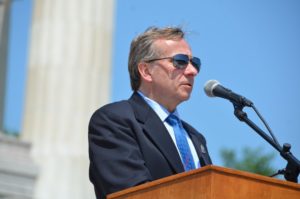
[Photo from Wikimedia Commons, https://commons.wikimedia.org/w/index.php?curid=9702761]
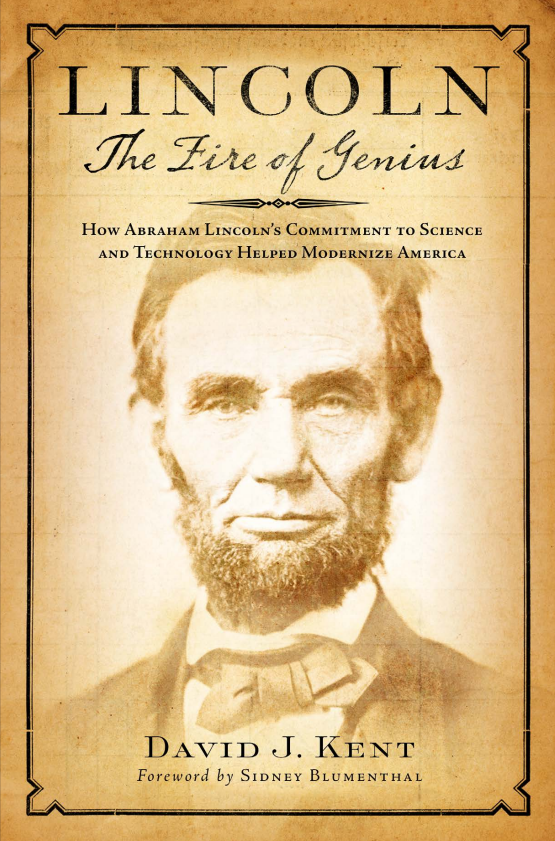
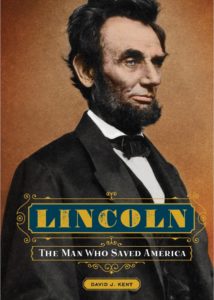
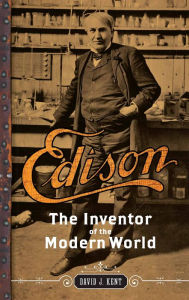
David J. Kent is an avid science traveler and the author of Lincoln: The Man Who Saved America, in Barnes and Noble stores now. His previous books include Tesla: The Wizard of Electricity and Edison: The Inventor of the Modern World and two specialty e-books: Nikola Tesla: Renewable Energy Ahead of Its Time and Abraham Lincoln and Nikola Tesla: Connected by Fate.
Check out my Goodreads author page. While you’re at it, “Like” my Facebook author page for more updates!
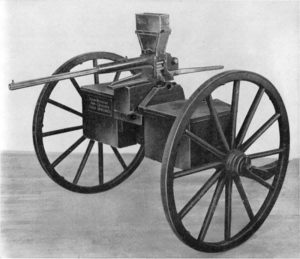 On August 17, 1861, Abraham Lincoln witnessed an exhibition of what Lincoln dubbed the “coffee mill gun.” Lincoln was always pushing for modernized weaponry beyond the standard muskets, which were inaccurate and slow to reload. He pushed Ordinance Chief James Ripley to put into service various breechloaders, rifles, carbines, and repeaters.
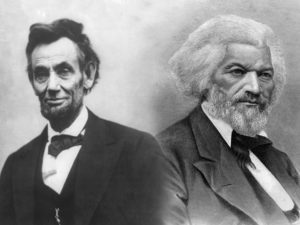 On August 10, 1863, Abraham Lincoln met with Frederick Douglass in the White House. Douglass had arrived unannounced, accompanied by Kansas Senator Samuel Pomeroy. They found the waiting room filled with people seeking an audience with the president, so Douglass, dressed in a dark suit on this sweltering August morning, assumed he would have a long wait. Instead, Lincoln’s secretary John Hay came quickly out to greet him and usher him into the inner sanctum.
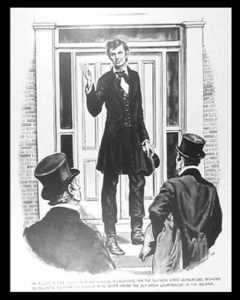 On August 4, 1834, at the age of 25, Abraham Lincoln was elected to the Illinois State Legislature. This was two years after he ran the first time – and lost.
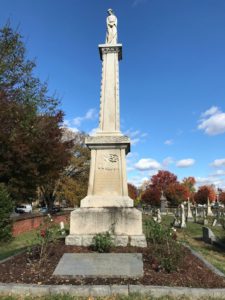 On July 27, 1864, Abraham Lincoln called on Edwin Stanton to increase the pay of women working in the cause of the Civil War. He wrote:
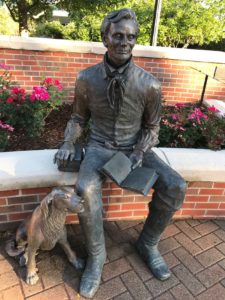 Famously, Abraham Lincoln wrote that he the “aggregate of all his schooling did not amount to one year.” He added that he “was never in a college or Academy as a student; and never inside of a college or academy building til since he had a law-license.” And yet, Lincoln is a college guy, of sorts.
 I often check
 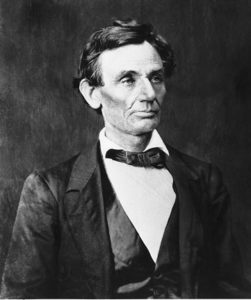 On June 23, 1857, Abraham Lincoln sued the Illinois Central Railroad. The Railroad had hired him on many occasions to defend their interests, but on this occasion they balked at the unusually high fee Lincoln charged – $5000. Lincoln had served the railroad well over many years, often taking limited fees, for example he had drawn only $150 for a year’s worth of work encompassing “at least fifteen cases (I believe one or two more) and I have concluded to lump them off at ten dollars a case.” This time, the McLean County Tax Case, he wanted to get paid the value of the work.
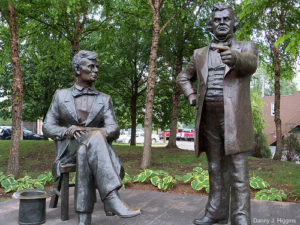 Abraham Lincoln lost his 1856 Senate campaign, but in 1858 he had another opportunity to run for Senate, this time against his old rival Stephen A. Douglas. In June Lincoln gave what is perhaps one of his most cited oratories, the “House Divided” speech. Once again he warned that the Kansas-Nebraska Act had opened the country to expansion of slavery—not just in the territories, but throughout the nation. Beginning with a paraphrased line from the Bible (Mark 3:25), Lincoln notes: