It is the final stretch before the fall elections. Abraham Lincoln and Stephen A. Douglas have had joint debates in Ottawa, Freeport, Jonesboro, and Charleston, and Galesburg, plus each have given many dozens of individual speeches across Illinois. The final two joint debates occurred in quick succession in Quincy and Alton, two towns on the banks of the Mississippi River.
Quincy
On October 13, the two men took the stage in Quincy in what was then called John’s Square but today is Washington Park. Approximately 10,000 to 15,000 people crowded into the square, many of whom claimed to be “Old Whigs” like Lincoln, who considered Henry Clay – a long-time leader of the Whig party – his “beau ideal of a statesman.” Because they were alternating who spoke first in a format that gave each of them plenty of time to present their views (as opposed to today’s “debates” in which each is given a scripted 2-minutes to answer a moderated question), it was Lincoln’s turn to begin. He reiterated what he had said in previous debates, reminding everyone that Douglas kept lying about Lincoln’s views and the party platform. Lincoln also reiterated his belief, and the belief of the Republican party at the time, that slavery was a moral wrong that should not be spread.
“We [the Republican Party] also oppose it as an evil so far as it seeks to spread itself. We insist on the policy that shall restrict it to its present limits.”
Republicans would focus on blocking the expansion of slavery into the western territories but abide by constitutional constraints that did not authorize federal abolition of slavery in the states where it already existed.
When Douglas’s turn came to speak, he said that:
“I will not argue the question whether slavery is right or wrong. I tell you why I will not do it. I hold that under the Constitution of the United States, each State of this Union has a right to do as it pleases on the subject of slavery.”
Douglas also denied Lincoln’s insinuation that Douglas has conspired with others to make slavery permanent. This denial stemmed from the first debate in Ottawa, where Lincoln implied that “Stephen, Franklin, Roger and James” (i.e., Douglas, Pierce, Taney, and Buchanan) had secretly worked together to nationalize slavery. Having said it in Ottawa, Lincoln dropped the line from future debates because it was too conspiratorial and without evidentiary support (although clearly Buchanan and Taney had so conspired). That didn’t stop Douglas from denying it at every debate thereafter.
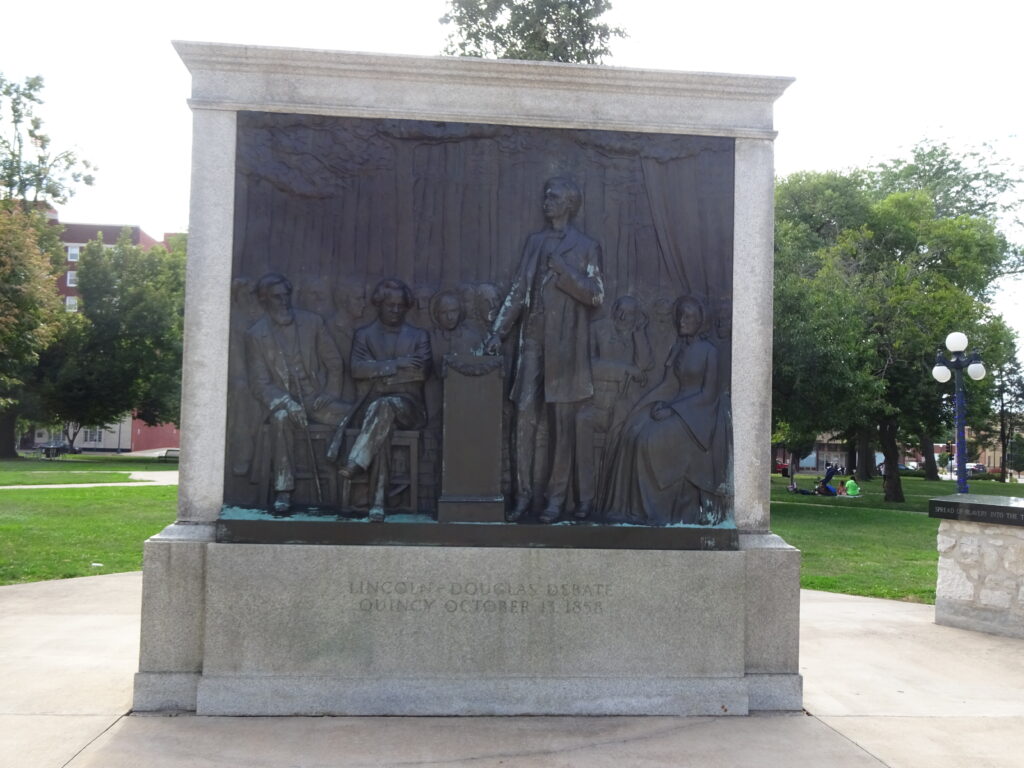
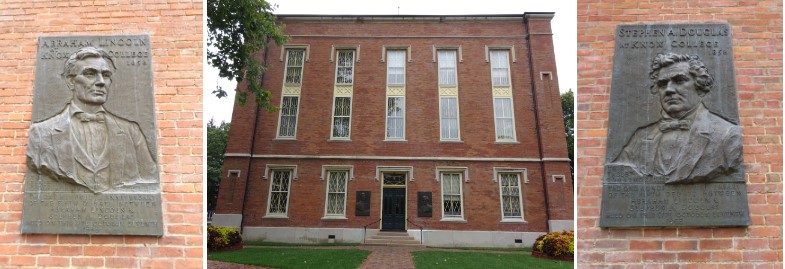
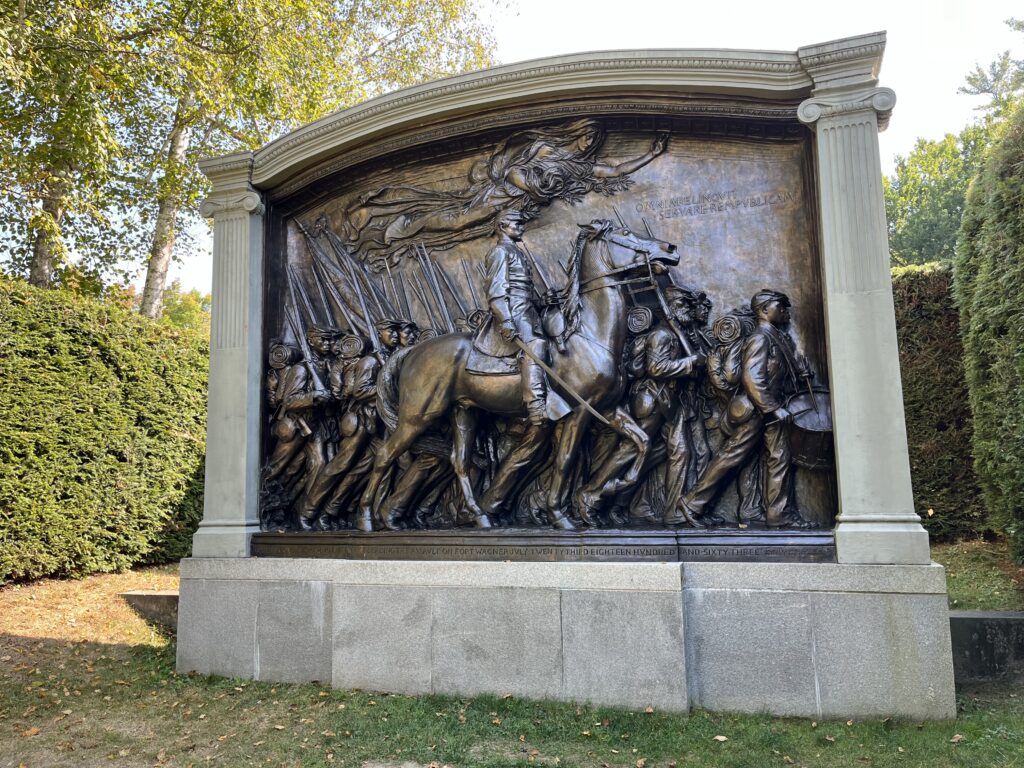
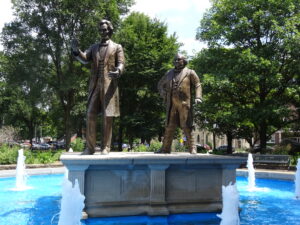
Today, a bas-relief frieze sculpture depicts the event, while a low wall on either side of the sculpture features six pairs of “Point/Counterpoint” quotes take from the debate.
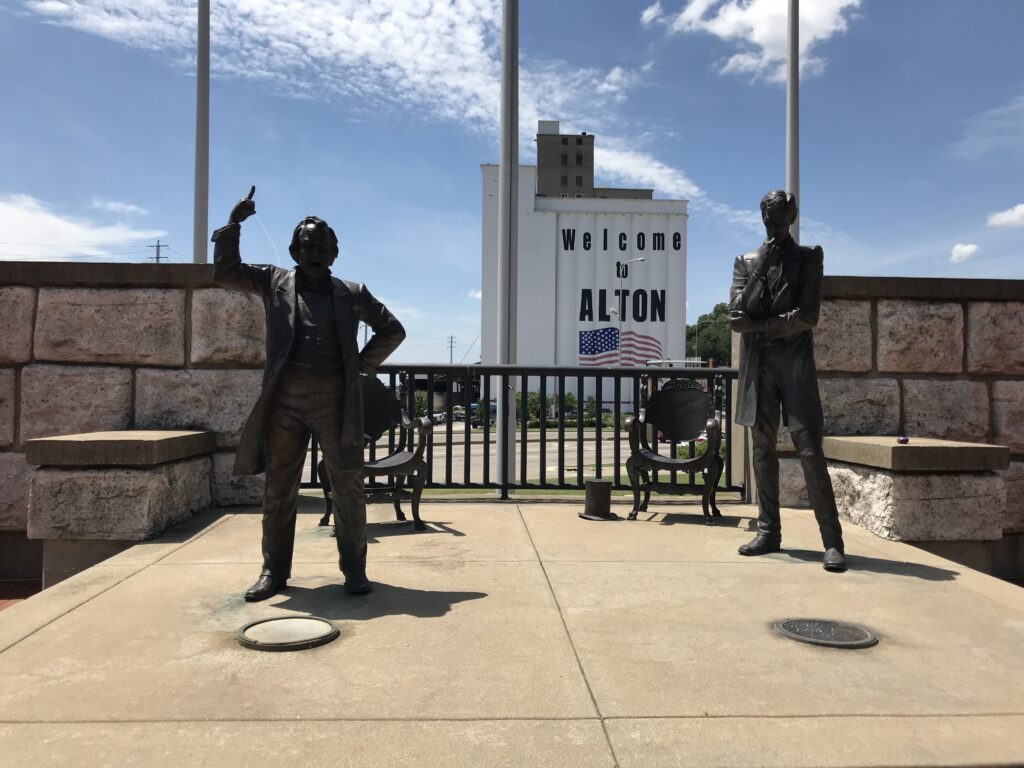
Alton
After Quincy, the two candidates hopped onto the same steamboat to travel to the next debate site in Alton. About 5,000 people gathered in front of the new city hall to hear the two men battle it out for one last joint debate. Many came from St. Louis, across the river from Alton, paying one dollar for each round-trip ticket. The Chicago and Alton Railroad offered half price fare from Springfield and elsewhere for those who wanted to attend the debate. Still, by this time most people had read about the debates in the newspapers, who had shorthand stenographers recording (more or less) verbatim what the two men were saying. The day was cloudy and fall weather was starting to settle in, which contributed to the lower turnout.
Douglas declared that the founders knew that the country had sectional differences and that they had deliberately left open the question of slavery for the states to decide.
“If they want slavery let them have it; if they do not want it, allow them to refuse to encourage it.”
Lincoln reiterated his “wish is that the further spread of it may be arrested, and that it may be placed where the public mind shall rest in the belief that it is in the course of ultimate extinction.”
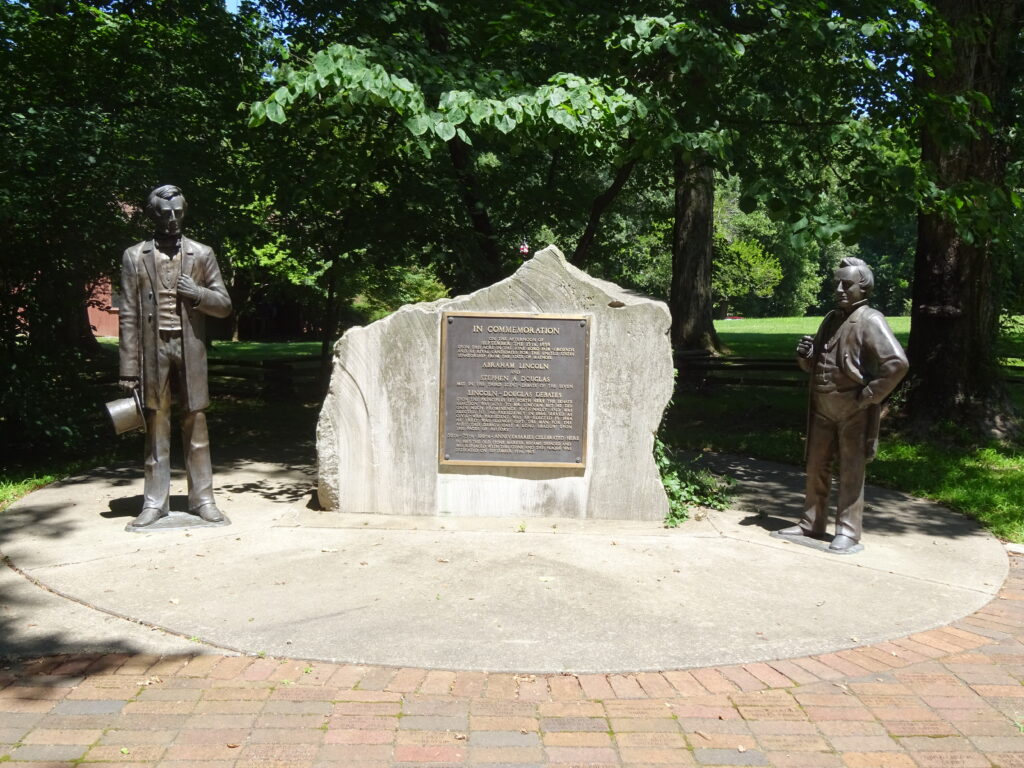
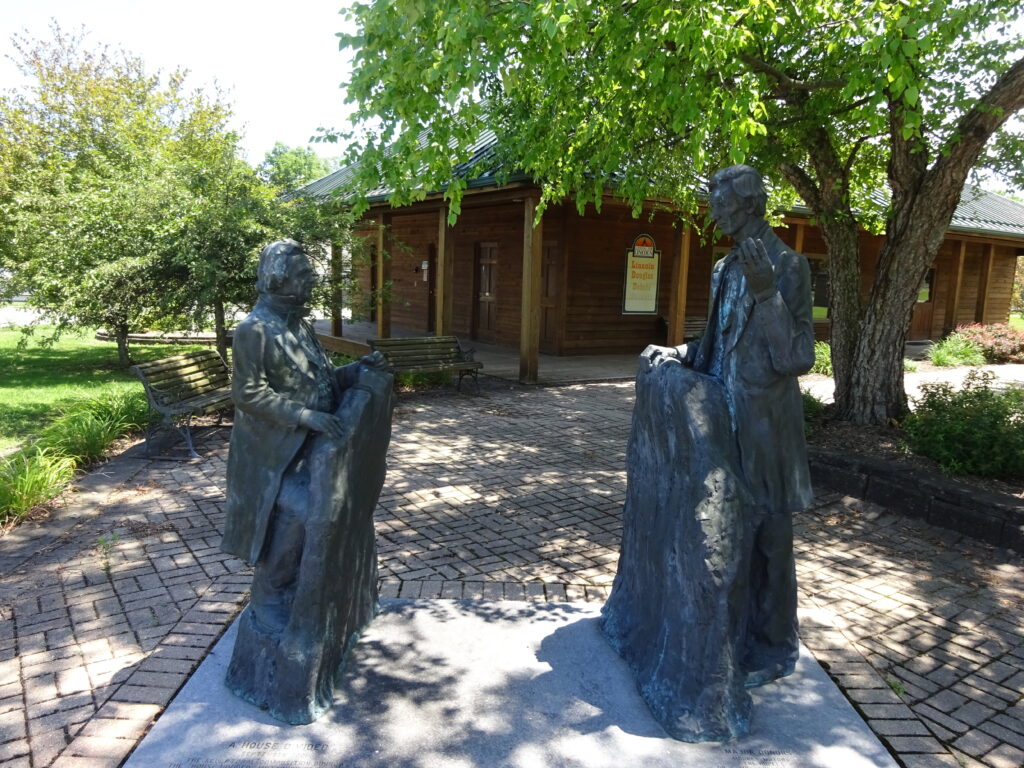
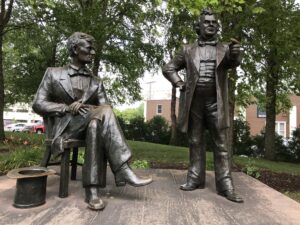
The Alton city hall burned down in 1923, but life-size statues of Lincoln and Douglas stand on a platform of the site in commemoration.
Aftermath
The seven joint debates were critically important, although they didn’t change the almost certain outcome of the senate election. At the time, state legislatures chose senators [the 17th Amendment giving direct vote to the people wasn’t until 1913], and although Lincoln’s Republican party gained more votes, Democrats still dominated the Illinois legislature and thus selected the incumbent Douglas for another senate term. Unquestionably, Lincoln the vote counter knew his chances of winning the election under such a system was unlikely, but the debates made him a national figure. Lincoln made sure to collect the newspaper transcripts of all seven debates, which he had published in book form in the spring of 1860, thus reminding everyone of his and Douglas’s views on slavery. Because of the Freeport Doctrine – Douglas saying that any territory becoming a state could block slavery if it so wanted – the slave powers of the South would never support Douglas as the Democratic presidential nominee. That led to a split Democratic party in 1860, allowing Lincoln as the Republican nominee to win the election and become president.
And the war came.
[Photos of Quincy (top) and Alton (bottom) by David J. Kent]
Lincoln: The Fire of Genius: How Abraham Lincoln’s Commitment to Science and Technology Helped Modernize America is available at booksellers nationwide.
Limited signed copies are available via this website. The book also listed on Goodreads, the database where I keep track of my reading. Click on the “Want to Read” button to put it on your reading list. Please leave a review on Goodreads and Amazon if you like the book.
You also follow my author page on Facebook.
David J. Kent is Immediate Past President of the Lincoln Group of DC and the author of Lincoln: The Fire of Genius: How Abraham Lincoln’s Commitment to Science and Technology Helped Modernize America and Lincoln: The Man Who Saved America.
His previous books include Tesla: The Wizard of Electricity andEdison: The Inventor of the Modern World and two specialty e-books: Nikola Tesla: Renewable Energy Ahead of Its Time and Abraham Lincoln and Nikola Tesla: Connected by Fate.
 With the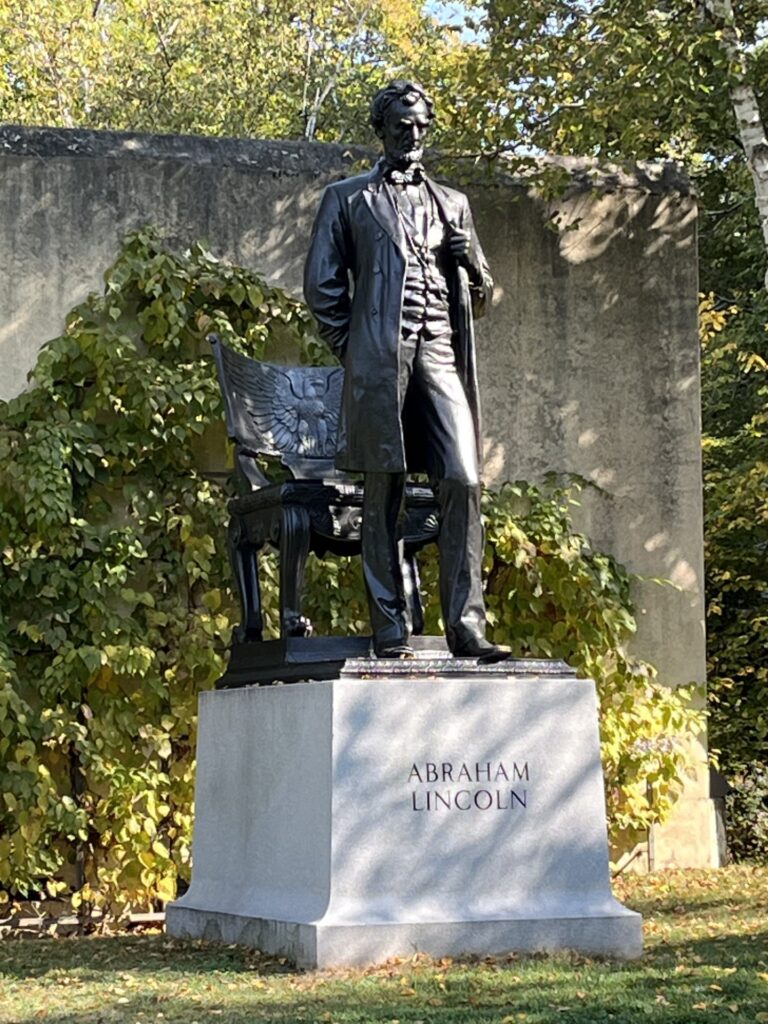
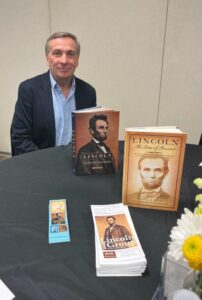 I was invited to speak about Lincoln: The Fire of Genius by the local chapter of the Daughters of the American Revolution, which usually we all refer to as the DAR. I spoke at their first meeting of the fall in northern Virginia and actually was able to bring them some DAR history they didn’t already know.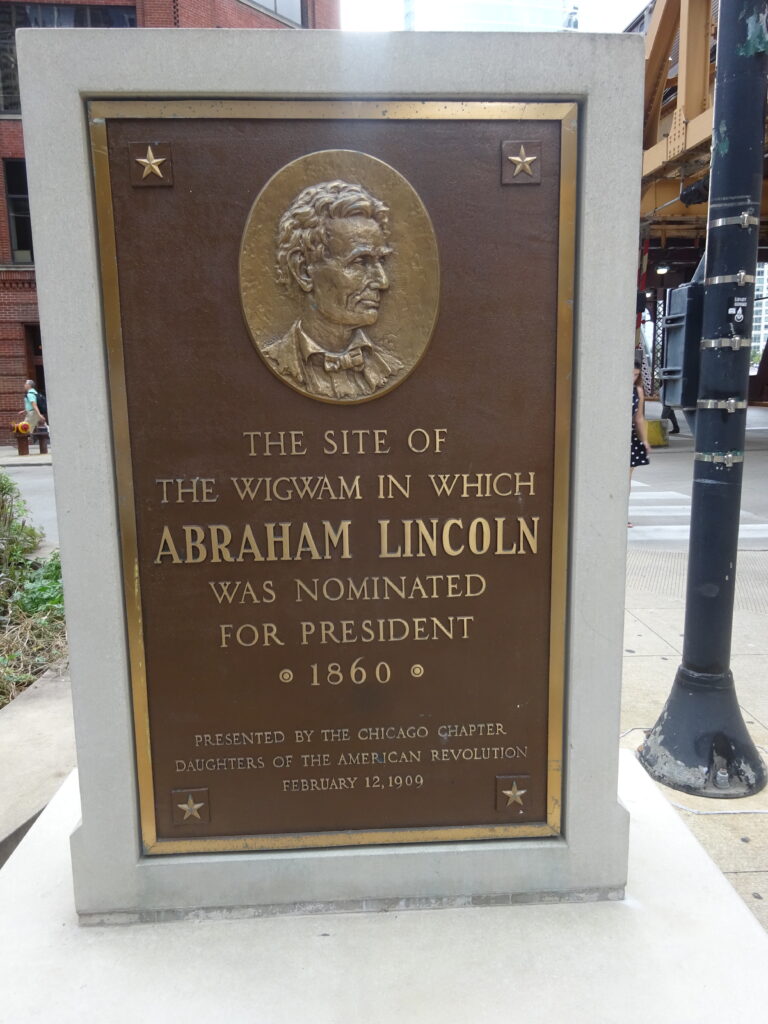
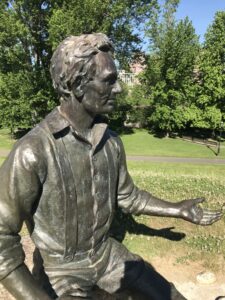 On March 5, 1860, Lincoln gave a speech in Hartford, Connecticut during his tour of New England after his Cooper Union address. One of the issues that Lincoln tackled was the role of labor and the ongoing Lynn shoemakers’ strike. Lincoln pointed used the strike to point out the difference between the free labor of the North (i.e., the paid labor in which laborers are free to find better paying employers) versus the slave labor of the South (i.e., chattel slavery for the life of the person, their children, their children’s children, ad infinitum). The conservative party at the time complained that the Lynn strike was the result of antislavery agitation and sectional controversy. Lincoln noted:
 Less than a week after their first debate in Ottawa, Abraham Lincoln and Stephen A. Douglas ventured into Freeport, Illinois, for the second of their seven joint debates during the senate election of 1858. By all standards, Freeport turned out to be the most consequential. From it came the Freeport Doctrine.
 Abraham Lincoln and Stephen A. Douglas engaged in perhaps the most important series of debates on American history,