Lincoln in Hingham, New England (and Hingham, old England)

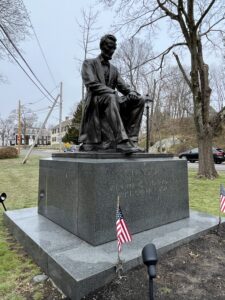
Lincoln in Hingham, Massachusetts, New EnglandThere stands a statue of Abraham Lincoln in Hingham, Massachusetts, New England. It’s immediately across the street from the Samuel Lincoln house. In Hingham, England, United Kingdom there is also a statue of Lincoln. But why? And who was Samuel Lincoln?

The original Samuel was an Englishman who left his home near Hingham, England (100+ miles northeast of London) and moved to the Massachusetts Bay Colony in 1637. He settled in, where else, the new town of Hingham, Massachusetts. The New England Hingham is a coastal town southeast of Boston. Think of it this way – if you look out the window of the tallest building in Boston (the John Hancock Tower) and look southeast toward Provincetown on the very tip of Cape Cod, you’re probably looking over Hingham. In any case, Samuel made his way to the New England Hingham from the old England Hingham as a teenager and started a long line of Lincoln descendants, including the one that begat the Abraham Lincoln lineage.

Abraham Lincoln never visited Hingham, Massachusetts (and obviously, not Hingham, England). He did come close once. In 1848, while a sitting congressman, Lincoln did a tour of Massachusetts campaigning for the Whig nominee for president, Zachary Taylor. The Mexican War hero (which the Whigs “very generally opposed” as unnecessary and unconstitutional) and southern slaveholder didn’t sit well with New England’s Conscience Whigs, who spun off into a Free Soil Party. Lincoln was there to try to keep them in the Whig fold. Taylor won the election, but it was closer than it should have been. He then inconveniently died sixteen months into his presidency, thus opening the door for the Compromise of 1850 and the nightmare that turned into. But that’s for another post.

The statue in Hingham, Massachusetts is a full size President Lincoln sculpted by Charles Keck. He is depicted sitting on a large stone staring downward in deep contemplation. The statue sits on a large pedestal. Standing in front of it, he seems to be staring at the viewer (or at his own feet, depending on your perspective).
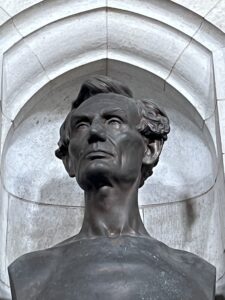
Lincoln in Hingham, England, old EnglandThe statue in Hingham, England is actually a bust, not a full statue. It was created based on the life mask of Leonard Volk made in 1860 just after Lincoln’s nomination. It depicts a much younger, beardless (and shirtless) Lincoln. It sits in an alcove on the side of St. Andrew’s Church. The bust was installed in 1919 to commemorate the Lincoln ancestry that had for many generations worshiped at the St. Andrew parish.

I’ve had the privilege of seeing both of these Lincoln memorials recently. I visited the statue in Hingham, Massachusetts during my tours of New England tracing Lincoln’s own two tours, one in 1848 and the other in 1860. I visited the bust in St. Andrew’s Church just a few weeks ago as I toured the UK seeing Lincoln statues from Edinburgh to Durham to Manchester to (near) Wales to Bath to Hingham. All of these visits gave me more insights into the Lincoln family tree, which I discuss in my new book, Lincoln in New England: In Search of His Forgotten Tours, which comes out March 3, 2026.


[Photos by David J. Kent, 2023, 2025]
Fire of Genius

Coming in March 2026: Lincoln in New England: In Search of His Forgotten Tours

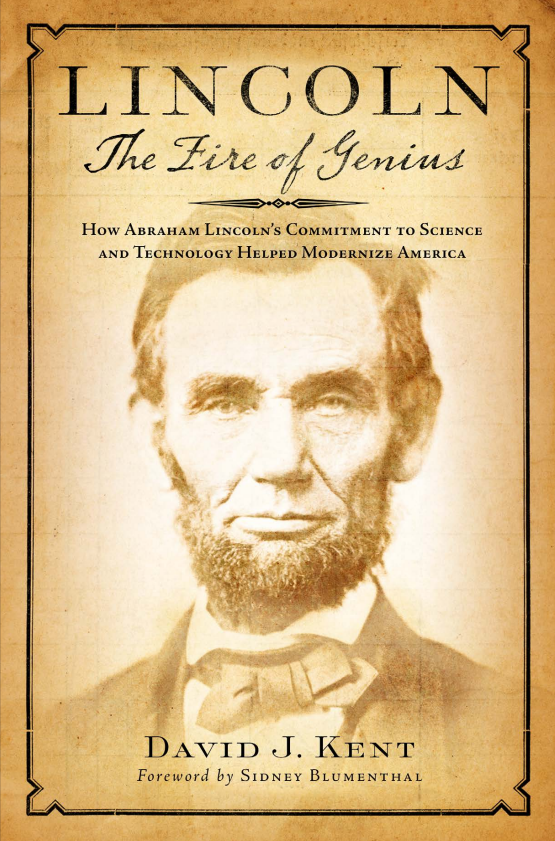
Also see – Lincoln: The Fire of Genius: How Abraham Lincoln’s Commitment to Science and Technology Helped Modernize America.

Join me on Goodreads, the database where I keep track of my reading. Please leave a review on Goodreads and Amazon if you like the book.

You also follow my author page on Facebook. Also follow me on Instagram.

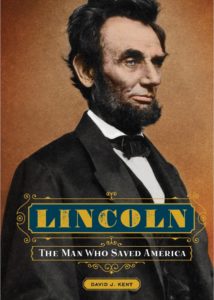
David J. Kent is Immediate Past President of the Lincoln Group of DC and the author of Lincoln: The Fire of Genius: How Abraham Lincoln’s Commitment to Science and Technology Helped Modernize America and Lincoln: The Man Who Saved America.

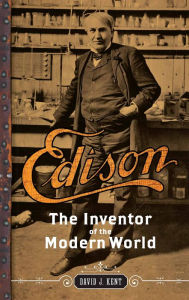
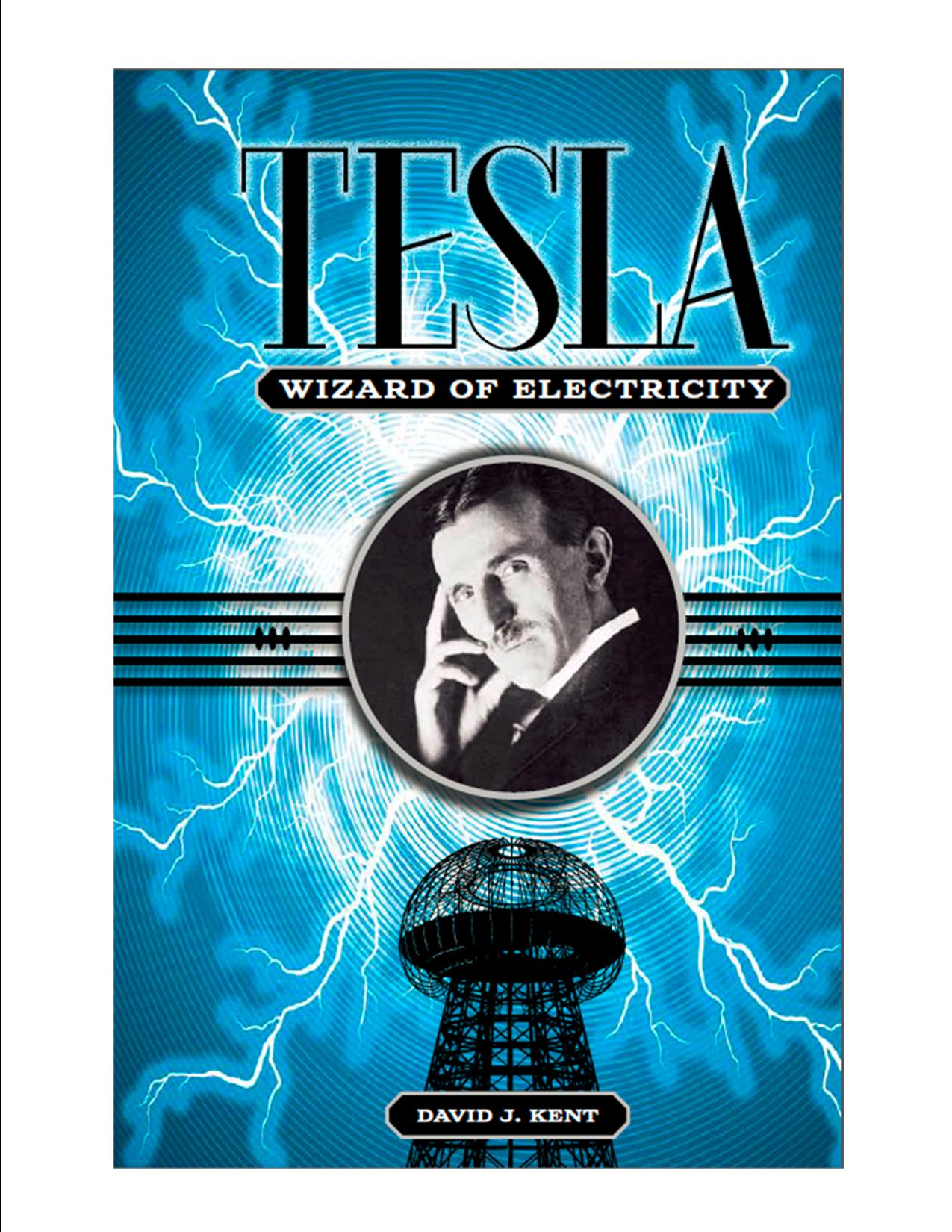
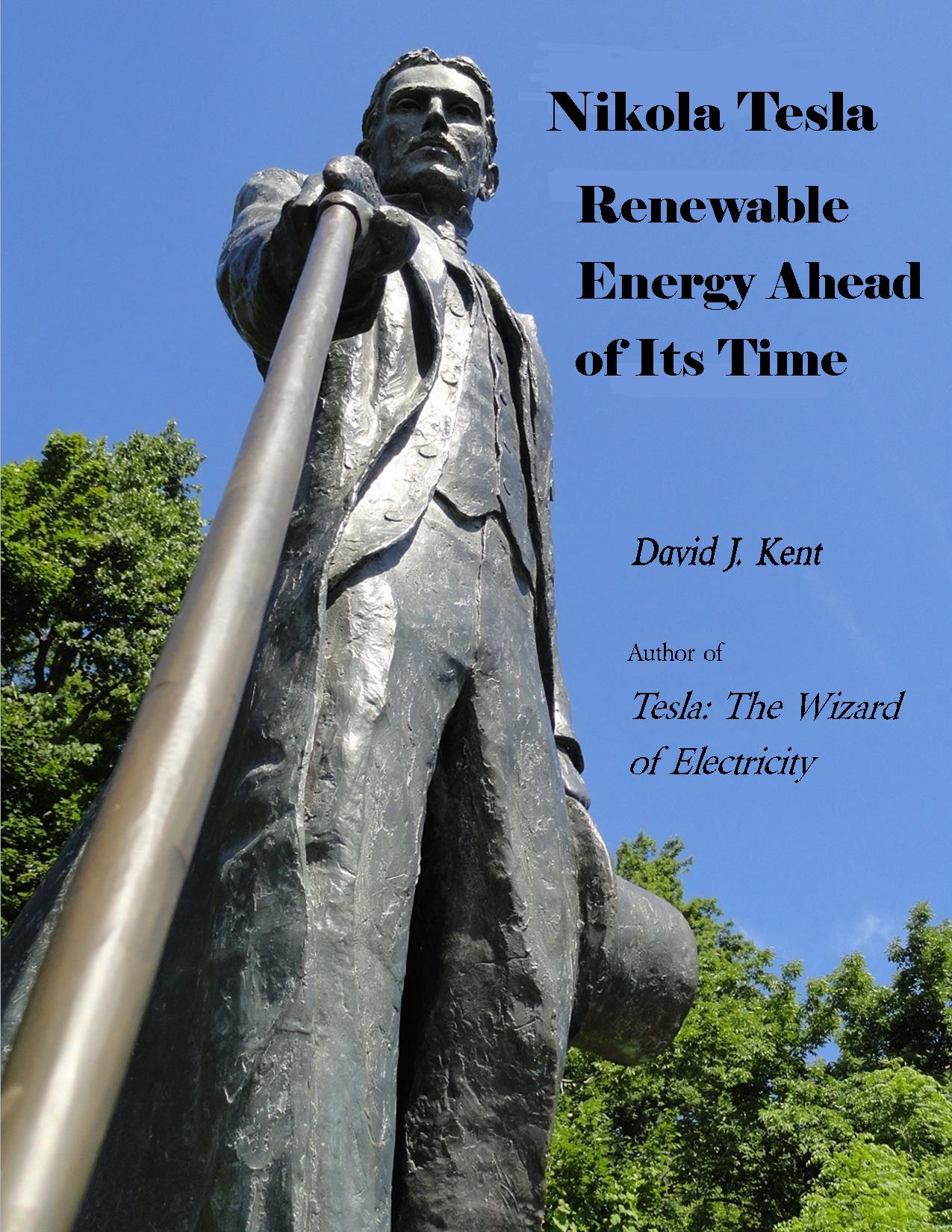
His previous books include Tesla: The Wizard of Electricity and Edison: The Inventor of the Modern World and two specialty e-books: Nikola Tesla: Renewable Energy Ahead of Its Time and Abraham Lincoln and Nikola Tesla: Connected by Fate.
Abraham Lincoln’s Connections to Edinburgh, Scotland

Abraham Lincoln never traveled outside the United States other than a few hours on the Canadian side of Niagara Falls. While he had planned to after his presidency, he never traveled overseas. He definitely never went to Edinburgh or anywhere else in Scotland. And yet, Edinburgh has not only a statue of Lincoln but also other connections to our sixteenth president. I became aware of these connections during my recent Lincoln-themed road trip around the United Kingdom.

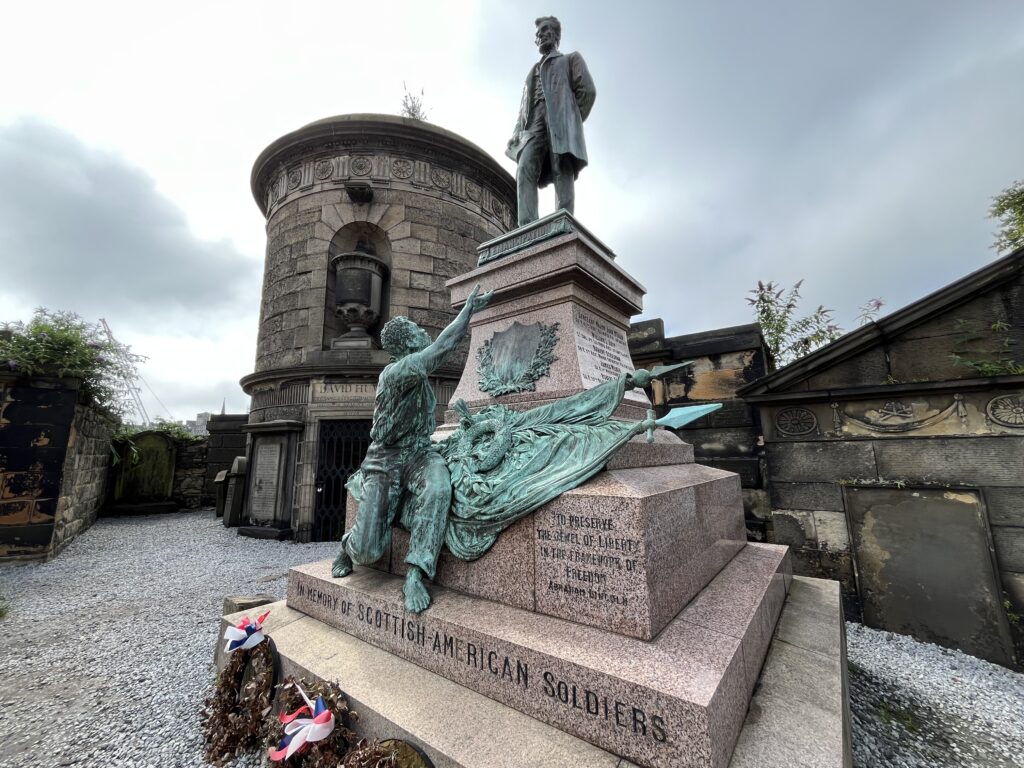
Lincoln statue, Edinburgh, Scotland

The most obvious is a grand full-length statue of Lincoln that tops the Emancipation Monument in Edinburgh’s Old Calton Burial Ground. Created by the well-known American sculptor George E. Bissell (whose bust of Lincoln sits two feet from me as I type these words), the monument also includes a second figure, a crouching, freed formerly enslaved man extending his arms in gratitude to the imposing Lincoln above him. In a sense, the juxtaposition is reminiscent of the more controversial Thomas Ball Emancipation (Freedman’s) Memorial in Washington, DC. Unlike the Ball statue, however, this figure is fully clothed and resting on furled flags, symbols of victory. This remains the only American Civil War Memorial outside the United States and is a tribute not just to Lincoln but to the memory of Scottish American soldiers who fought in the war. Unveiled in 1893, the Lincoln statue was the first life-sized statue of an American President unveiled in Europe. Philosopher David Hume’s stone tower serves as an impressive backdrop to the Lincoln monument.

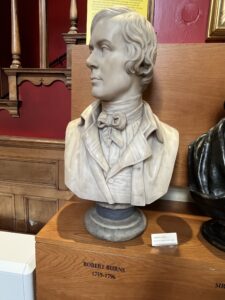
Robert Burns, Writers' Museum, Edinburgh, ScotlandAnother connection is to Robert Burns, the Scottish poet whom Lincoln had a particular fascination. Lincoln had supposedly discovered Burns from Jack Kelso, an enigmatic friend from Lincoln’s New Salem days. Kelso had emigrated to the United States from Scotland, where he had previously been a Glasgow schoolteacher. He apparently owned many volumes of Burns that Lincoln read over and over (ditto for Shakespeare). Lincoln was hooked and recited Burns from memory on many occasions through his life. Robert Burns is eminently present in Edinburgh, including a large monument at the foot of Calton Hill (not far from the aforementioned Lincoln statue). Burns is also one of the three Scottish writers featured in the Writers’ Museum tucked into Lady Stair’s Close a few steps off the Royal Mile that leads to the Edinburgh Castle. He is joined there by Robert Louis Stevenson and Sir Walter Scott.

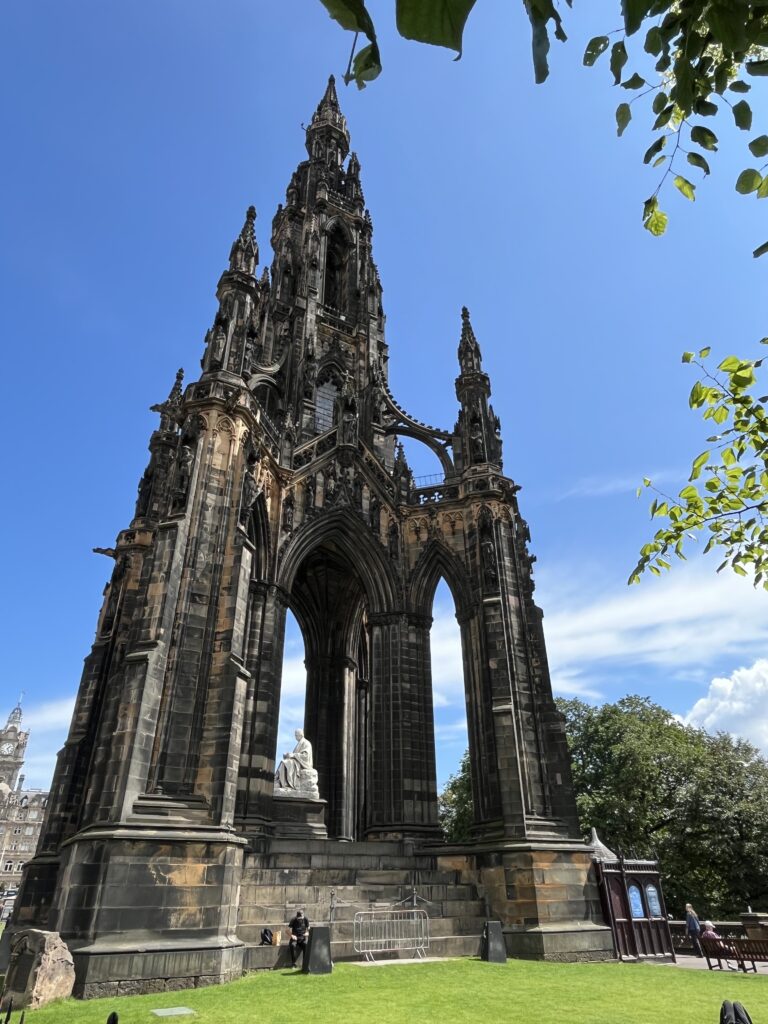
Sir Walter Scott provides yet another, albeit somewhat indirect, connection to Lincoln. The Scott Monument is a Victorian Gothic multi-towered structure that is the second-largest monument in the world to a writer. It dominates the skyline from most of Edinburgh along Princes Street near the Waverly Railway Station (named after Scott’s Waverly novels). Here’s where the Lincoln connection comes in. Way back in 1838 a man named Frederick Bailey escaped from slavery, moved briefly to New York and married Anna Murray, changing their last name to Johnson. They quickly moved on to New Bedford, Massachusetts, where they stayed with Nathan and Mary Johnson. It turns out Johnson was a common name and seeking something more distinctive, Frederick asked Nathan to help pick a new last name. Nathan was a fan of, you guessed it, Sir Walter Scott, and suggested Frederick take on the name Douglas, the name of two principal characters in Scott’s poem “The Lady of the Lake.” Frederick decided to give it a little flair and added the extra “s,” giving us the man we all know today as Frederick Douglass.

Sir Walter Scott Monument, Edinburgh, Scotland

There is another, more obscure, connection to Lincoln in Scotland. During my travels I also stayed one night in an old mansion overlooking the cliffs in Dunbar on the far eastern Scottish coast. Dunbar is the birthplace of John Muir, who as I discussed in a previous post, was instrumental in making Yosemite a National Park. Lincoln, of course, had designated Yosemite as the first federal land to be set aside for protection.

I’ll have more on my Lincoln road trip through the UK in future posts, so stay tuned.

[Photos by David J. Kent, 2025]

Fire of Genius

Coming in March 2026: Lincoln in New England: In Search of His Forgotten Tours

Also see – Lincoln: The Fire of Genius: How Abraham Lincoln’s Commitment to Science and Technology Helped Modernize America.

Join me on Goodreads, the database where I keep track of my reading. Please leave a review on Goodreads and Amazon if you like the book.

You also follow my author page on Facebook. Also follow me on Instagram.

David J. Kent is Immediate Past President of the Lincoln Group of DC and the author of Lincoln: The Fire of Genius: How Abraham Lincoln’s Commitment to Science and Technology Helped Modernize America and Lincoln: The Man Who Saved America.

His previous books include Tesla: The Wizard of Electricity and Edison: The Inventor of the Modern World and two specialty e-books: Nikola Tesla: Renewable Energy Ahead of Its Time and Abraham Lincoln and Nikola Tesla: Connected by Fate.
Update – Lincoln in New England Book Gets a New Title

Lincoln in New England cover coming soonBack in May I announced that I submitted the final manuscript for my new book about Lincoln’s two tours of New England. As the production process proceeds, I’ve been working with the editors to fine-tune the book. Most of that sausage-making is behind the scenes and won’t be noticeable to the public, but one change is rather obvious. I have a new title!

The title of the book in print will be…(imagine a drum roll here)…Lincoln in New England: In Search of His Forgotten Tours.

My original working title, Unable to Escape This Toil, came from a letter Abraham Lincoln had written to his wife Mary. He was in Exeter, New Hampshire at the time visiting his son Robert, who was at Phillips Exeter Academy studying to retake the Harvard entrance exams he had failed the previous summer. Lincoln had given a big (really big) speech at Cooper Union in New York, then planned a relaxing few days visiting his son. By the time he got there he had already given one additional speech and committed to at least five more. Another four were waiting for him when he arrived at the Exeter train station. In his letter home, Lincoln wrote: “I am unable to escape this toil,” he said, adding “If I had foreseen it, I think I would not have come East at all.” He was being a bit whiny and disingenuous, which I discuss in a paper that I just submitted to the Lincoln Forum Bulletin for publication this fall. In any case, the title seemed a big opaque to the general public, so we changed it to a much more descriptive Lincoln in New England. The subtitle is tweaked slightly to go with the new title.

As of this writing, Lincoln in New England: In Search of His Forgotten Tours is scheduled for release on Tuesday, March 3, 2026. You can even pre-order the book via the publisher website and other booksellers:

Globe Pequot (with links to Amazon, Barnes and Noble, Books-a-Million, and Bookshop)

Amazon

[The other links weren’t updated yet, so I’ll add them when they work]

Meanwhile, formatting of the book continues. It will include fifty black-and-white photos from my travels and of historical places, plus two maps to show Lincoln’s speaking tour routes.

Stay tuned for the cover reveal to come soon!

[Photos by David J. Kent, 2025]

Fire of Genius

Coming in March 2026: Lincoln in New England: In Search of His Forgotten Tours

Also see – Lincoln: The Fire of Genius: How Abraham Lincoln’s Commitment to Science and Technology Helped Modernize America.

Join me on Goodreads, the database where I keep track of my reading. Please leave a review on Goodreads and Amazon if you like the book.

You also follow my author page on Facebook. Also follow me on Instagram.

David J. Kent is Immediate Past President of the Lincoln Group of DC and the author of Lincoln: The Fire of Genius: How Abraham Lincoln’s Commitment to Science and Technology Helped Modernize America and Lincoln: The Man Who Saved America.

His previous books include Tesla: The Wizard of Electricity and Edison: The Inventor of the Modern World and two specialty e-books: Nikola Tesla: Renewable Energy Ahead of Its Time and Abraham Lincoln and Nikola Tesla: Connected by Fate.

In Search of Lincoln and Tad in Richmond (and Jeff Davis too)

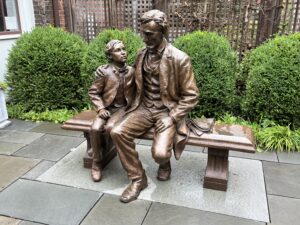
Lincoln and Tad, Richmond VAThe American Civil War Museum in Richmond, Virginia once had a statue depicting Abraham Lincoln and his son Tad sitting on a park bench. As of this writing it is no longer there, and hasn’t been since 2023. So, where is it?
I discussed Lincoln’s trip into Richmond in a previous post, which you can read here. In a nutshell, Lincoln had been visiting Ulysses S. Grant and the troops at City Point, a bluff overlooking the confluence of the Appomattox and James Rivers. When Richmond fell and Jefferson Davis’s government fled south, Lincoln decided to take Tad and visit the city. There he walked from the river to what had been the White House of the Confederacy. Shortly after his visit, Lincoln made his way back to Washington, and Lee surrendered to Grant by the time he got there.

The White House of the Confederacy, along with Tredegar Iron Works and the Appomattox Courthouse building where Lee surrendered, is now the American Civil War Museum (next door to the main location is the Tredegar Pattern Building, still run by the National Park Service as part of its Richmond National Battlefield). The statue of Lincoln and Tad commemorating Lincoln’s visit was installed at the Tredegar site in 2003. Not everyone was happy. In a post on the Lincoln Group of DC’s website, Lincolnian.org, Wendy Swanson noted that:

However, despite this peaceful theme the atmosphere at the statue’s actual dedication, almost twenty years ago on April 5, 2003, was anything but serene. Protestors with pro-Confederate leanings did their best to disrupt the dedication ceremony. Garbed in clothing from the era as well as modern t-shirts containing themes derogatory to the Sixteenth President, the protestors’ presence at the dedication was quite evident. They greeted ceremony attendees with chants and anti-Lincoln signs and slogans. During the ceremony a small plane flew over the crowd, displaying a banner containing words made infamous by John Wilkes Booth at Ford’s Theatre on April 14, 1865, “Sic semper tyrannis.” There also was a second event held that day to counter the tribute to Lincoln. At Hollywood Cemetery there was a protest vigil at the grave of Jefferson Davis.

While many people were in Gettysburg this week commemorating the Battle of Gettysburg, which occurred July 1-3, 1863, I was in Richmond visiting Tredegar and the Confederate White House. Two and a half years ago the statue of Lincoln and Tad was moved “temporarily” to The Valentine, a Richmond-themed Museum two blocks away. At Tredegar the statue had its own stone exedra bearing the words from Lincoln’s second inaugural address: To Bind Up the Nation’s Wounds. At the Valentine, the statue sits in a small corner outside the building, where it is expected to sit for several years while the National Park Service builds an amphitheater at the Tredegar site. The amphitheater is apparently still under construction, although it looked largely finished and quite impressive during my visit this week.

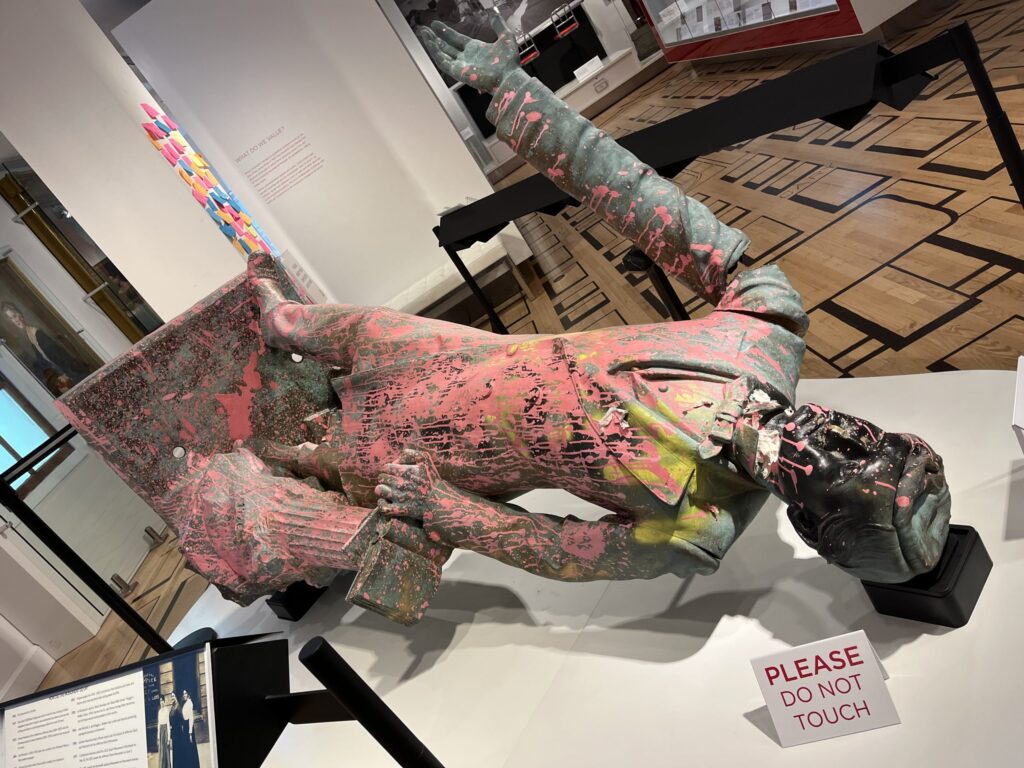
Jefferson Davis at the Valentine, Richmond VAWhile at the Valentine I also got to see another “Civil War President.” A statue of Jefferson Davis had stood for many decades along Monument Avenue in Richmond. During the 2020 protests over the murder of George Floyd in Minnesota, the Davis statue was vandalized with paint, then pulled down. That statue now sits – or more accurately, lays – in the Valentine’s main gallery. Pink and yellow paint splatters the bronze, Davis’s head is bashed in from the fall off his pedestal, and his right arm is nearly severed. The display symbolizes the city’s change in attitude over its prior adulation of Confederate figures. All of its many dozens of Confederate statues have now been removed, with the exception of a few remaining on the grounds of the Viriginia State Capitol (you walk past them as you proceed from the equestrian statue of George Washington to the Governor’s Mansion). They are now joined by two large group statues, one featuring the many women who fought for voting rights and the other of Barbara Johns and others who fought the battle that would become Brown v. Board of Education. Johns is scheduled to replace Robert E. Lee in the U.S. Capitol’s Statuary Hall. Interestingly, it was Edward Virginius Valentine who had sculpted both the Lee statue (now removed from the hall and currently at Richmond’s Museum of History and Culture) and the one of Davis now at the Valentine Museum. Hopefully, Johns will make it into Statuary Hall soon, perhaps after the new governor takes off after this fall’s election.
There was much more to my trip to Richmond, so expect future posts on the area.

[Photos by David J. Kent, 2025]

Fire of Genius

Coming in February 2026: Lincoln in New England: In Search of His Forgotten Tours

Also see – Lincoln: The Fire of Genius: How Abraham Lincoln’s Commitment to Science and Technology Helped Modernize America.

Join me on Goodreads, the database where I keep track of my reading. Please leave a review on Goodreads and Amazon if you like the book.

You also follow my author page on Facebook. Also follow me on Instagram.

David J. Kent is Immediate Past President of the Lincoln Group of DC and the author of Lincoln: The Fire of Genius: How Abraham Lincoln’s Commitment to Science and Technology Helped Modernize America and Lincoln: The Man Who Saved America.

His previous books include Tesla: The Wizard of Electricity and Edison: The Inventor of the Modern World and two specialty e-books: Nikola Tesla: Renewable Energy Ahead of Its Time and Abraham Lincoln and Nikola Tesla: Connected by Fate.

Lincoln is Nominated for Vice President. Wait, What?

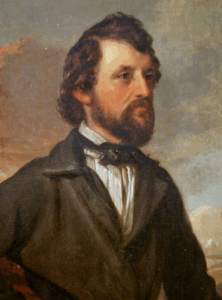
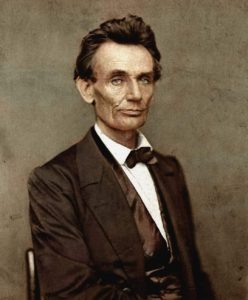
John C. FremontAbraham Lincoln is best known as the sixteenth President of the United States, long before the POTUS acronym was invented. He was elected in November 1860 and by the time he was inaugurated in March 1861, seven southern states had seceded, with four more joining them just over a month later after the new Confederacy attacked Fort Sumter. But this wasn’t the first time Lincoln had been put forward for executive office. In 1856 he was nominated by his fellow new Republican Party members for Vice President after the party had nominated John C. Fremont for President.
Lincoln didn’t win the final vote at the Republican convention. That went to the William L. Dayton of New Jersey. Lincoln and Dayton were joined by several other prominent figures of the time, such as Charles Sumner, Nathaniel Banks, Henry Wilson (all three from Massachusetts). When the first informal ballot was taken, Dayton led with 253 votes from the delegates to 110 votes for Lincoln. The next closest was Banks with 43. When the first official formal ballots were cast, Dayton had jumped up to 523 and Lincoln was down to 20. That’s not surprising as Dayton was considered the presumptive pick anyway. More surprising is that the one-term congressman who had been out of political office for over seven years was even being considered, no less placing a reasonable second.

Among those surprised to hear the news was Abraham Lincoln himself. When the Chicago newspaper containing the proceedings from the Republican convention held in Philadelphia reached Lincoln on June 20th, Lincoln joked that there must be some mistake. “I reckon that ain’t me; there’s another great man in Massachusetts named Lincoln, and I reckon it’s him.”

Presumably Lincoln was referring to Levi Lincoln, Jr., whom he had met in Worcester, Massachusetts during his visit to campaign for Zachary Taylor in 1848. Levi had been governor of Massachusetts and was Mayor of Worcester when the Whig’s held their state convention that year. Lincoln had gone there not just to promote Taylor, but to convince wayward Whigs who had formed a splinter party called the Free Soilers from accidentally handing the election to the Democrats. How successful he was in that attempt is part of my forthcoming book, Unable to Escape This Toil, but he joined several other prominent men at a dinner party at the Levi Lincoln mansion in the city and subsequently discovered that he and Levi were related through a common ancestor in Hingham.

In any case, Fremont lost that 1856 election so Lincoln wouldn’t have become vice president anyway, which is probably for the best. Four years later he would become the first Republican POTUS.

I’ll have more on Lincoln’s time in New England in future posts. Stay tuned for Lincoln in New England scheduled for release March 3, 2026.

[Photo of John C. Fremont in Public Domain, Wikimedia Commons]

Fire of Genius

Coming in March 2026: Lincoln in New England: In Search of His Forgotten Tours

Also see – Lincoln: The Fire of Genius: How Abraham Lincoln’s Commitment to Science and Technology Helped Modernize America.

Join me on Goodreads, the database where I keep track of my reading. Please leave a review on Goodreads and Amazon if you like the book.

You also follow my author page on Facebook. Also follow me on Instagram.

David J. Kent is Immediate Past President of the Lincoln Group of DC and the author of Lincoln: The Fire of Genius: How Abraham Lincoln’s Commitment to Science and Technology Helped Modernize America and Lincoln: The Man Who Saved America.

His previous books include Tesla: The Wizard of Electricity and Edison: The Inventor of the Modern World and two specialty e-books: Nikola Tesla: Renewable Energy Ahead of Its Time and Abraham Lincoln and Nikola Tesla: Connected by Fate.

Lincoln Nominates Zachary Taylor, Responds to His Wife, Goes to Massachusetts

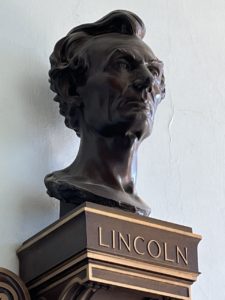
Massachusetts State HouseOn June 11, 1848, congressman Abraham Lincoln arrived back in Washington, D.C. after having traveled all night from Philadelphia, where he attended the Whig National Convention that nominated Zachary Taylor for president. Upon his return he finds a letter from his wife Mary, who has been visiting her family in Kentucky for several months. These two events begin a campaign and a mystery.
Zachary Taylor was an odd choice to be the Whig nominee. Had had been fairly apolitical up to this point, having spent most of his life in the military. In fact, it was his military service in the Mexican War that ingratiated him to the American public, who clamored for him to be the next president of the United States. He was so popular that both the Whig and Democratic parties vied to make him their nominee. Taylor at first said he would only agree if he could do so “untrammeled with party obligations or interests of any kind,” the sort of divine elevation that George Washington had enjoyed after the Revolutionary War. Both the Whigs and Democrats quickly disavowed him of that politically naïve delusion. He agreed to sign on with the Whigs, finding them slightly less objectionable than the conservative Democrats of the South.

For his part, while Lincoln was in Philadelphia at the Whig Convention, he spurned his old beau ideal of a statesman, Henry Clay, and spoke out in favor of Taylor. Clay had been a nominee three times before, losing every time. Ever the vote counter, Lincoln wrote a friend that “Mr. Clay’s chance for an election, is just no chance at all,” going on to enumerate which states Clay could not carry. Based on his read of public sentiment, Lincoln noted, “in my judgment, we can elect nobody but Gen. Taylor.” And so Taylor became the Whig nominee. Lincoln was assigned to go to Massachusetts to make the case for Taylor, which as a I will discuss in future posts and in my forthcoming book, Unable to Escape This Toil: In Search of Abraham Lincoln’s Forgotten New England Tours, was not an easy task.

Which gets to the letter from Mrs. Lincoln. Mary and their two sons (Robert and Eddie) had been visiting her family in Lexington, Kentucky for months. They had been in a small boarding house room with Lincoln since he arrived in Washington to serve as Whig representative from Illinois, but boredom and conflicts with other tenants sent her south. Now she was planning to return to Washington. Lincoln, who had been happy to see her go, now seemed happy to have her come back. In his letter back to her the next day he wrote:

The leading matter in your letter, is your wish to return to this side of the Mountains. Will you be a good girl in all things, if I consent? Then come along, and that as soon as possible. Having got the idea in my head, I shall be impatient till I see you.

After noting that the congressional session was expected to end by July 17th, he added:

Come on just as soon as you can. I want to see you, and our dear—dear boys very much. Every body here wants to see our dear Bobby.

Here is where the mystery arises. When did Mary arrive in Washington, and did she accompany Lincoln on his tour of Massachusetts, which started on September 9th? On July 2nd he again wrote to Mary, who he presumed to have just started back, but then the record goes silent. The Lincoln Log mentions on July 23rd that “Mrs. Lincoln and boys probably arrive from Lexington about this time,” but this is merely conjecture based on Lincoln’s letter from three weeks before. No mention of Mary and the boys is recorded in the press or in the letters of Lincoln or any of his political escorts during Lincoln’s Massachusetts trip. The only indication that Mary was there comes from a letter she wrote in December 1867 (2.5 years after Lincoln’s assassination) rebutting statements by painter Francis Carpenter and claiming that “Mr. L. accompanied by my two little boys & myself, visited B[oston] & remained there 3 weeks, detained by the illness of our youngest son….” That would seem to confirm her presence, but there are several glaring errors in the letter that make suspect her memory of events that happened 20 years previously, especially given the extent of trauma she had experienced in that time. I dig more into this in a paper I’m writing for the Journal of the Abraham Lincoln Association.

Notwithstanding whether he was accompanied by his family or not, Lincoln definitely went to Massachusetts where he found more internal Whig conflicts than he could have imagined and learned valuable lessons that would position him for greatness.

[Photo by David J. Kent, bust of Lincoln in the Massachusetts State House, Boston, MA]

Fire of Genius

Coming in February 2026: Lincoln in New England: In Search of His Forgotten Tours

Also see – Lincoln: The Fire of Genius: How Abraham Lincoln’s Commitment to Science and Technology Helped Modernize America.

Join me on Goodreads, the database where I keep track of my reading. Please leave a review on Goodreads and Amazon if you like the book.

You also follow my author page on Facebook. Also follow me on Instagram.

David J. Kent is Immediate Past President of the Lincoln Group of DC and the author of Lincoln: The Fire of Genius: How Abraham Lincoln’s Commitment to Science and Technology Helped Modernize America and Lincoln: The Man Who Saved America.

His previous books include Tesla: The Wizard of Electricity and Edison: The Inventor of the Modern World and two specialty e-books: Nikola Tesla: Renewable Energy Ahead of Its Time and Abraham Lincoln and Nikola Tesla: Connected by Fate.

Coming Soon: Unable to Escape This Toil – New Book from David J. Kent

It’s been submitted!

UPDATE: The book has been retitled: Lincoln in New England: In Search of His Forgotten Tours

I’m happy to say that I just submitted the manuscript for my newest book: Unable to Escape This Toil: In Search of Abraham Lincoln’s Forgotten New England Tours. The book is being published by Globe Pequot, the trade arm of Rowman & Littlefield Publishing Group. Unable to Escape This Toil is scheduled for release in February 2026.


Here is the Publisher’s Marketplace Announcement for the book:

Unable to Escape This Toil Publishers Marketplace Announcement

As the announcement notes, the book is written in a “ride-along” style narrative, which means it blends coverage of my modern road trips of all the sites where Lincoln gave speeches during his two tours with the history of Lincoln’s times and issues. Readers get to visit the locations, check out what memorials remain of the sites, hear from local and regional experts, and get a sense of what the travel was like for Lincoln. Interwoven within the ride-along is the history of his time. Why was Lincoln there, and what did he accomplish?

In 1848, Lincoln’s first trip took him to Massachusetts between sessions of his single term as U.S. congressman. Zachary Taylor had been chosen as the Whig nominee for president, and the Whigs were finding he was not an ideal candidate. Lincoln spoke in Worcester to fend off a wayward Whig faction known as the Free Soilers, who were fielding their own nominee. In New Bedford he was expose to the growing abolitionist movement. He found himself dealing with another split in the Whig ranks between the Conscience and Cotton Whigs. The renowned writers of Concord were stirring up the transcendentalist pot against slavery. And Lincoln was discovering his Massachusetts ancestors. Lincoln went to Massachusetts “with hayseed in his hair” and came away vastly educated in the realities of the world

In 1860, Lincoln was back in New England, this time in Rhode Island, New Hampshire, and Connecticut. The twelve years since his last visit was one of life-altering chaos for him and for the nation. As tensions between North and South rose, Lincoln found himself taking his influential Cooper Union speech on the road trying to keep the new Republican Party from imploding while at the same time working hard to split the Democratic Party, now torn between its northern pro-slavery but pro-Union contingent led by Stephen A. Douglas and its southern pro-slavey but pro-secession faction looking for an alternative.

Lincoln’s first trip changed him. His second trip changed the country and sent us into the Civil War.


Now that the manuscript is in the hands of my editor, I’ll be giving more information on the forthcoming book as the cover and bookseller links become available. I hope you’ll bookmark this website and join my Facebook and Instagram pages. Keep on the lookout for free giveaways and other incentives as the release date gets closer. And as always, thanks for all your support.

If you haven’t already, check out my previous book, Lincoln: The Fire of Genius, and leave a review on Goodreads and Amazon to help get the word out.

Fire of Genius

Coming in February 2026: Lincoln in New England: In Search of His Forgotten Tours

Also see – Lincoln: The Fire of Genius: How Abraham Lincoln’s Commitment to Science and Technology Helped Modernize America.

Join me on Goodreads, the database where I keep track of my reading. Please leave a review on Goodreads and Amazon if you like the book.

You also follow my author page on Facebook. Also follow me on Instagram.

David J. Kent is Immediate Past President of the Lincoln Group of DC and the author of Lincoln: The Fire of Genius: How Abraham Lincoln’s Commitment to Science and Technology Helped Modernize America and Lincoln: The Man Who Saved America.

His previous books include Tesla: The Wizard of Electricity and Edison: The Inventor of the Modern World and two specialty e-books: Nikola Tesla: Renewable Energy Ahead of Its Time and Abraham Lincoln and Nikola Tesla: Connected by Fate.

Taper Collection of Lincoln Artifacts Raises Nearly $8 Million at Auction

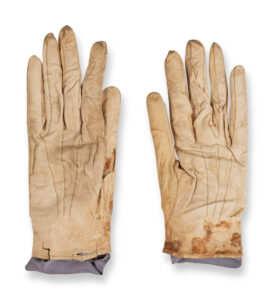
Lincoln's bloody gloves from night of assassinationA major auction of Abraham Lincoln artifacts held May 21, 2025, brought in nearly $8 million dollars. The largest amount for any single item was over $1.5 million (including auction fees) for a pair of blood-stained gloves that Lincoln wore the night of the assassination.
Hindman ran the auction for the Lincoln Presidential Foundation, whose predecessor organization had purchased the Taper Collection of Lincolniana. Approximately 10 percent of that collection was included in the auction designed to raise money to pay off the ongoing debt from the initial purchase many years ago.

In addition to the gloves, other items from the night of the assassination also exceeded their estimated pre-auction value. Lincoln’s handkerchief sold for $826,000, more than double its initial estimate. A monogrammed cuff button that had been on one of Lincoln’s sleeves when he was assassinated went for $445,000, while a ticket stub from that night’s performance of Our American Cousin garnered $381,200.

Other items included a partial sheet from Lincoln’s “sum book” with mathematical calculations and a poem, which sold for $521,200, and the first printing of Lincoln’s second inaugural address – estimated to be worth between $40,000 and $60,000 – sold for $165,000.

One intrigue in the sale was that an anonymous bidder known as “Paddle 1231” was by far the largest buyer, purchasing about $4 million worth of the $8 million total, including the gloves, handkerchief, and other high-ticket items. Some have speculated about whether that buyer could be Illinois Governor and First Lady JB and MK Pritzker, who have a history of purchasing Lincoln artifacts at auction and have donated them to the Abraham Lincoln Presidential Library and Museum in the past. Neither the governor’s office nor the Lincoln Presidential Foundation would comment on the matter, which is pure speculation at this point.

Controversy surrounded some of the items in the collection, most notably the provenance of the stovepipe hat that had been on display in the Museum. Considerable upheaval in the Museum and Library staff has occurred in recent years and the Museum severed ties with the predecessor foundation, leading to its reorganization into the current Lincoln Presidential Foundation.

The remaining 90 percent of the Taper Collection continues to be held by the Foundation while the old debt is retired and new locations for display are investigated. While no one seems to be happy that some items were auctioned off, there are hopes that many of them will be donated or loaned to an appropriate museum for public display. Perhaps the mysterious “Paddle 1231” will ensure that happens?

You can see all the items and their sale prices at the Freeman/Hindman’s site here.

[Photo credit: From Freeman/Hindman’s auction site]

Fire of Genius

Coming in February 2026: Unable to Escape This Toil

Available now – Lincoln: The Fire of Genius: How Abraham Lincoln’s Commitment to Science and Technology Helped Modernize America is available at booksellers nationwide.

Limited signed copies are available via this website. The book also listed on Goodreads, the database where I keep track of my reading. Click on the “Want to Read” button to put it on your reading list. Please leave a review on Goodreads and Amazon if you like the book.

You also follow my author page on Facebook.

David J. Kent is Immediate Past President of the Lincoln Group of DC and the author of Lincoln: The Fire of Genius: How Abraham Lincoln’s Commitment to Science and Technology Helped Modernize America and Lincoln: The Man Who Saved America.

His previous books include Tesla: The Wizard of Electricity and Edison: The Inventor of the Modern World and two specialty e-books: Nikola Tesla: Renewable Energy Ahead of Its Time and Abraham Lincoln and Nikola Tesla: Connected by Fate.

Abraham Lincoln, Zachary Taylor, and the Land Office Job He Didn’t Get

Abraham LincolnAbraham Lincoln was not happy. He had worked hard to get Zachary Taylor elected as president as a Whig, and yet he was being passed over for the lucrative General Land Office job. Worse, he was being ignored, something the man who had been Whig leader in the Illinois legislature and recent representative to Congress. On May 16, 1849, he made his dissatisfaction with Taylor’s appointment of Justin Butterfield to the Land Office in Illinois.
Always a Whig in politics (to that point), Lincoln had used his time between sessions of his single term in the U.S. House of Representatives to stump for Zachary Taylor in Massachusetts. Taylor was a strange choice for the Whigs, who had generally disapproved of the Mexican War as a transparent attempt to enlarge the territory in which to expand slavery. But the Whigs felt he was the only candidate who could win (both major parties courted him) and that he would be pliable (he professed no firm political views), so they chose him over perennial candidate, Lincoln’s beau ideal of a statesman, Henry Clay. That wasn’t the only problem. As a Southern slaveowner, Taylor rankled the antislavery sensibilities of the liberal wing of the Whig party in Massachusetts, although the more conservative Whigs (e.g., textile mill owners who depended on the availability of Southern cotton) were less concerned. Disaffected Whigs had built a Free Soil movement to promote an antislavery candidate and Lincoln was sent to smooth over ruffled feathers in an attempt to keep party leaders in the Whig camp. Lincoln was well received and did seem to convince many Whigs, and although the central part of Massachusetts with its more stringent Free Soil passions voted for former president Martin Van Buren as the Free Soiler candidate, the full contingent of Massachusetts’s electoral votes went to Taylor. Taylor became president.

Lincoln continued to stump for Taylor once he returned home to Illinois. Which is why he was so rankled. After first suggesting others for the Land Office job, he switched to seeking the office for himself to ensure that a strong supporter of Taylor would get the prime position. He was ignored. Taylor (or more accurately, those in the administration making the appointment recommendations) had gotten it into their heads to appoint Justin Butterfield of Chicago. Lincoln was incensed. Writing to the Secretary of the Navy William B. Preston on this date, Lincoln argued that Butterfield had done nothing to get Taylor elected:

“[W]hen you and I were almost sweating blood to have Genl. Taylor nominated, this same man was ridiculing the idea . . . and when Gen: T. was nominated, if [Butterfield] went out of the city of Chicago to aid in his election, it is more than I ever heard, or believe. . . . If there is one man in this state who desires B’s appointment to any thing, I declare I have not heard of him.”

His pleading fell on deaf ears. Butterfield got the job, and Lincoln was out of political office for the next twelve years. He would build a steady legal practice, get aroused back into politics by the Kansas-Nebraska Act, fail in two senate races, and then – after another tour of New England in 1860 – get elected as the 16th President of the United States.

Those two tours of New England bracketed the most contentious and critical decades in our nation’s history. Lincoln was vastly different men from one tour to the next, as was the country.

Stay tuned!

[Photo credits: Public Domain]

Fire of Genius

Coming in February 2026: Unable to Escape This Toil

Available now – Lincoln: The Fire of Genius: How Abraham Lincoln’s Commitment to Science and Technology Helped Modernize America is available at booksellers nationwide.

Limited signed copies are available via this website. The book also listed on Goodreads, the database where I keep track of my reading. Click on the “Want to Read” button to put it on your reading list. Please leave a review on Goodreads and Amazon if you like the book.

You also follow my author page on Facebook.

David J. Kent is Immediate Past President of the Lincoln Group of DC and the author of Lincoln: The Fire of Genius: How Abraham Lincoln’s Commitment to Science and Technology Helped Modernize America and Lincoln: The Man Who Saved America.

His previous books include Tesla: The Wizard of Electricity and Edison: The Inventor of the Modern World and two specialty e-books: Nikola Tesla: Renewable Energy Ahead of Its Time and Abraham Lincoln and Nikola Tesla: Connected by Fate.

Chasing Lincoln Across Upstate New York

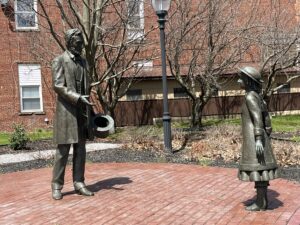
Grace and Abe statue, Westfield, NYAbraham Lincoln traveled through upstate New York in early 1861 on his way to Washington, DC for his inauguration, stopping in Westfield, Buffalo, Albany, Peekskill, and New York City. Twelve years before, in 1848, he stopped in Buffalo and saw Niagara Falls on his way home between sessions of congress after he toured around eastern Massachusetts giving speeches in support of Zachary Taylor as the Whig nominee for president [Spoiler: Taylor won] In late April of this year, traveled much the same route in northern New York on my way to the Lincoln Forum spring conference at Hildene in Manchester, Vermont.

My first stop was Westfield, where Lincoln first met Grace Bedell, the young girl who had earlier written to tell him he would get more votes if he grew a beard. Granted, he didn’t start growing it until after the election, but he had it when he stopped in Westfield on his inaugural train journey. When he arrived in Westfield for a brief refueling stop, he called out to see if she was present. She was, and they shared a big hug to a crowd of cheers. Today, a small park features life-sized bronze sculptures of Lincoln and Bedell along with tributes to soldiers who fought in the Civil War. Right beside the park is Grace & Abes, a brewpub where you can choose from a selection of “Abe’s Ales” or all seven deadly sins from “7 Sins Brewery” (and no, there is no beer named after Grace Bedell since she had not yet turned 12 years old at the time).

From there I was on to Buffalo, where among other attractions (and a side trip to the Canadian side of Niagara Falls), I checked out two statues of Lincoln. “The Boy Lincoln” by sculptor Bryant Baker depicts a young Lincoln seated on a log and holding a book. The other, simply titled “Lincoln,” was sculpted by Charles Henry Neihaus and depicts a sitting President Lincoln. It is located in front of the South side of the Buffalo History Museum. One trivia note – Niehaus at one time had eight statues of famous men in Statuary Hall of the United States Capitol, a record. Four have them have since been replaced, but the four that remain are still more than any other sculptor in the Hall.

In Rochester, I checked in on several sites related to Frederick Douglass and Susan B. Anthony. There are fourteen statues of Douglass in and around Rochester, including one of he and Anthony having tea. I visited the cemetery where both of them are buried. One of the Douglass statues has him and Lincoln standing full height grasping hands in a firm handshake between equals.

After checking out the Finger Lakes and Seneca Falls (where women began their struggle to get the vote), it was on to Auburn, the home of Lincoln’s Secretary of State, William H. Seward. Touring the home was fascinating, as was the grand bust of Lincoln in the library, joined by a similar one of Seward. Auburn is also the adopted home of Harriet Tubman, so I checked out yet another cemetery for the tombs of Seward and Tubman.


After a quick stop in Syracuse to see two more Lincoln statues, it was on to Manchester, Vermont, where I attended a weekend Lincoln Forum conference at Hildene, Robert Lincoln’s summer home. I had been there before, but this was a great opportunity to do some fact checking for the book I’m writing on Lincoln’s two New England tours, plus see about 150 other Lincoln researchers.

I’m currently in the final stages of writing the book that will be released in February 2026, so stay tuned for more information on that in the coming months.

[Photo credits: All taken by David J. Kent, April 2025]

Fire of Genius

Coming in February 2026: Unable to Escape This Toil

Available now – Lincoln: The Fire of Genius: How Abraham Lincoln’s Commitment to Science and Technology Helped Modernize America is available at booksellers nationwide.

Limited signed copies are available via this website. The book also listed on Goodreads, the database where I keep track of my reading. Click on the “Want to Read” button to put it on your reading list. Please leave a review on Goodreads and Amazon if you like the book.

You also follow my author page on Facebook.

David J. Kent is Immediate Past President of the Lincoln Group of DC and the author of Lincoln: The Fire of Genius: How Abraham Lincoln’s Commitment to Science and Technology Helped Modernize America and Lincoln: The Man Who Saved America.

His previous books include Tesla: The Wizard of Electricity and Edison: The Inventor of the Modern World and two specialty e-books: Nikola Tesla: Renewable Energy Ahead of Its Time and Abraham Lincoln and Nikola Tesla: Connected by Fate.