Abraham Lincoln was born in Kentucky in 1809. But in 1861, as the Civil War was threatening to split the country in two, Lincoln may have actually gained dual citizenship. Not only was he an American citizen, the Republic of San Marino granted him citizenship there as well.
For those who have never heard of San Marino, or thought it was merely a quaint Italian city, it actually is an independent country. An enclave nestled into Italy’s northeast, the tiny 24 square mile country claims to be the “oldest surviving sovereign state and constitutional republic in the world” (according to Wikipedia).
Tiny as it is, San Marino apparently had a good marketing department when they decided to send a letter to the new President of the United States in 1861. Two recently discovered documents have now been provided to The Papers of Abraham Lincoln, a project “dedicated to identifying, imaging, transcribing, annotating, and publishing all documents written by or to Abraham Lincoln during his entire lifetime (1809-1865).” According to the project:
The first of the two letters was sent to Lincoln by San Marino’s Regent Captains, the nation’s joint heads of state. In English and Italian, they said that as a “mark of high consideration and sincere fraternity” for the United States, citizenship in the Republic of San Marino had been conferred on Lincoln. They also acknowledged America’s “political griefs” and prayed that God would “grant you a peaceful solution.”
Well, how about that. The Most Serene Republic of San Marino conferred citizenship upon Abraham Lincoln. Lincoln even replied, again, as noted by the Papers project:
In his response dated May 7, 1861, Lincoln thanked the Council of San Marino “for the honor of citizenship” and assured them that “although your dominion is small, your State is nevertheless one of the most honored in all history.” He explained that the Civil War “involves the question whether a Representative republic, extended and aggrandized so much as to be safe against foreign enemies, can save itself from the dangers of domestic faction.”
“I have faith in a good result,” Lincoln assured them.
All of this goes to show that, despite thousands of books in print, there are still things to learn about Abraham Lincoln. I’ve discovered this myself as I’ve reviewed hundreds of letters and documents from the Library of Congress in preparation for a forthcoming book. I’ve even found quite a few interesting “connections” between Lincoln and my other favorite topic – Nikola Tesla. I’ll have more on those connections in a future post.
David J. Kent is an avid science traveler and the author of Lincoln: The Man Who Saved America, in Barnes and Noble stores now. His previous books include Tesla: The Wizard of Electricity (2013) and Edison: The Inventor of the Modern World (2016) and two e-books: Nikola Tesla: Renewable Energy Ahead of Its Time and Abraham Lincoln and Nikola Tesla: Connected by Fate.
Check out my Goodreads author page. While you’re at it, “Like” my Facebook author page for more updates!
 So 2013 was an incredible year, and 2014 is already looking like it will be even more incredible. Later this month I’ll take a look back on all that has happened this past year. Meanwhile, my event schedule for 2014 is starting to take shape. Here are just a few of the events already on the calendar for the first six to eight months:
 ? – What is this…nothing on my calendar yet for June? I’ll need to do something about that soon.
 Abraham Lincoln once gave a speech that was so awe-inspiring that all the reporters there forgot to write it down. Sounds implausible, right? Ah, but it’s actually true. Elwell Crissey takes us back to May 29, 1856 with “Lincoln’s Lost Speech: The Pivot of His Career.” And despite the little problem of not having a record of the actual speech, Crissey does a great job enlivening the whole event surrounding its presentation.
 One would think the book’s subtitle “The speech that made Abraham Lincoln President,” would set up an unattainable expectation of greatness. After all, how could a book hold a candle to a great speech? Or perhaps the speech wasn’t so great after all and the author merely wanted to sell more books. And yet, I was wonderfully surprised to see that this really was an exceptional book about an exceptional speech.
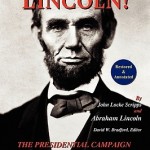 Vote Lincoln! The Presidential Campaign Biography of Abraham Lincoln is a 2010 annotated version of the first full biography of Abraham Lincoln published in 1860. Ostensibly written by John Locke Scripps, publisher of what would become the Chicago Tribune, much of the text was actually ghost written by Abraham Lincoln himself. Intended as a campaign biography, the book provides a revealing look at how Lincoln viewed his own life to that point.
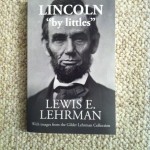 Periodically on this site I provide reviews of books about Abraham Lincoln. This is a review of Lincoln “by littles” by Lewis E. Lehrman, published by The Lehrman Institute in 2013.
 Barack Obama has said that the two people he admires most are Martin Luther King and Abraham Lincoln. Perhaps this shouldn’t be much of a surprise. In Dreams From My Father, Obama recounts his trials growing up as a young black man with mixed race heritage. While clearly a different upbringing than that of most black men living in America, he did experience the prejudices that were openly prevalent then, and more subtle and covert today.