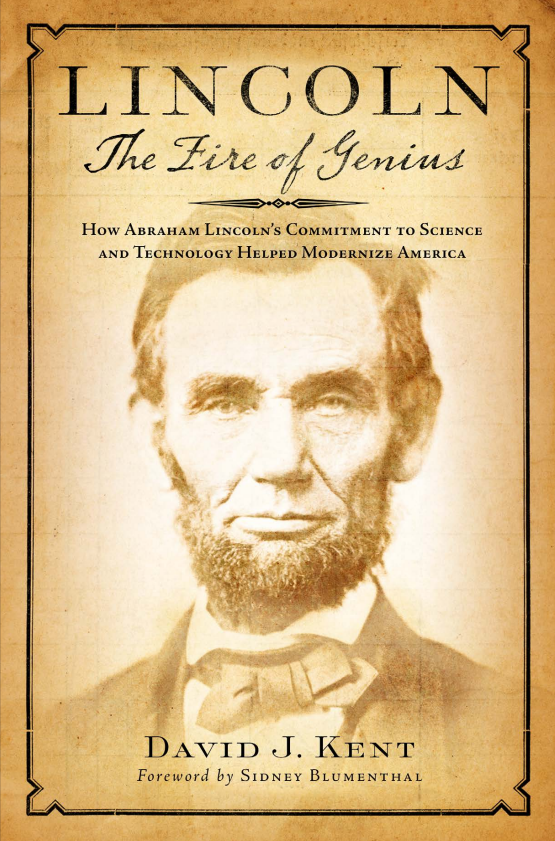
Abraham Lincoln is the only president to ever get a patent, an ingenious, though impractical, method for lifting boats over shoals. This interest in technology served him well during the Civil War as battles increasingly relied on mechanization for transportation, communication, and weaponry.
I’ve hinted at some of these things in previous posts and will be enlarging on this as my new book develops. As I do that, here are some relevant posts you may have missed:
Abraham Lincoln’s Air Force – Balloons in the Civil War: A discussion with James L. Green, a Director of Planetary Science with NASA and a worldwide expert on Thaddeus Lowe and the use of gas-filled balloons during the early part of the war. Green is working on a new book on the topic and was gracious enough to host me for a lunch discussion.
Abraham Lincoln and the Technology of War: A recent exhibit held in the Ford’s Theatre Center for Education and Leadership displayed telegraphs, weapons, and other artifacts reflecting various forms of technology that helped the North win the war.
While you’re at it, check out these two reviews of books comparing Abraham Lincoln and Charles Darwin, two men born on the same day who each left a lasting legacy that changed the world.
Check back soon for more about Abraham Lincoln’s interest in science and technology. BTW, did you know that Nikola Tesla and Abraham Lincoln have a World’s Fair connection? Find out more here.
One year ago today I left behind the first half of my life. After more than 30 years as a working scientist I had decided to give up a comfortable salary for a life of (essentially) no income. I would become a poor starving writer.
It was the best decision I ever made.
I loved my previous life. Well, most of it. But the parts I didn’t like had grown in proportion to the parts that excited me. Using my skills, my knowledge, and my personal connections with colleagues and clients, I made a large amount of money – for others. Sure, my salary was nice enough, but increasingly the benefits of my labor went to others, and those others seemed decreasingly appreciative of that fact. Abraham Lincoln’s line from his Second Inaugural Address about “wringing their bread from the sweat of other men’s faces” kept popping into mind. Not a perfect analogy, but close enough.
I learned a lot during all those years – about science, about business, about people. I also learned that science is often trumped by business concerns and people’s perceptions. I felt there was a growing need to communicate science to the public, and that scientists weren’t always very good at meeting that need. I decided to do something about that.
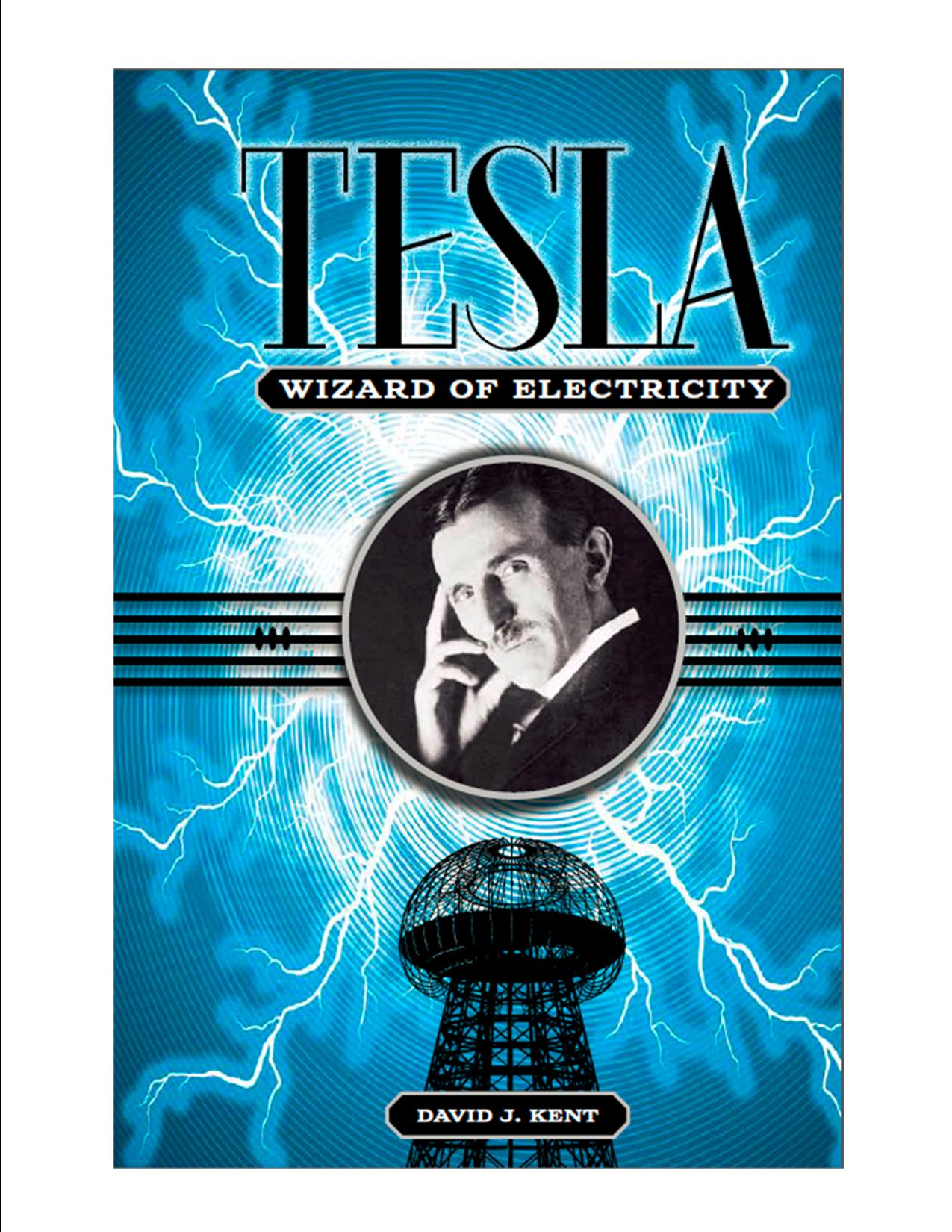
Coincident with this desire was some serendipity that led to publication of my first professional book, Tesla: The Wizard of Electricity. As the old saw grinds, “the stars aligned, angels’ voices rang down from the heavens” and all that not-so-scientifically-accurate metaphorical interlude. In real terms, stuff fell into place and it became clear this was the time to take the risk. So I did.
So where am I this one year later? I’ve traveled a bit, though not as much as I would have liked. One highlight of 2014 is an amazing trip to Argentina, with several smaller and more local trips throughout the year. I’ll squeeze in a few more jaunts before New Year’s and am busy planning for 2015 (Peru? China? Rushmore?). Science Traveling will play an increasingly important role in my future.
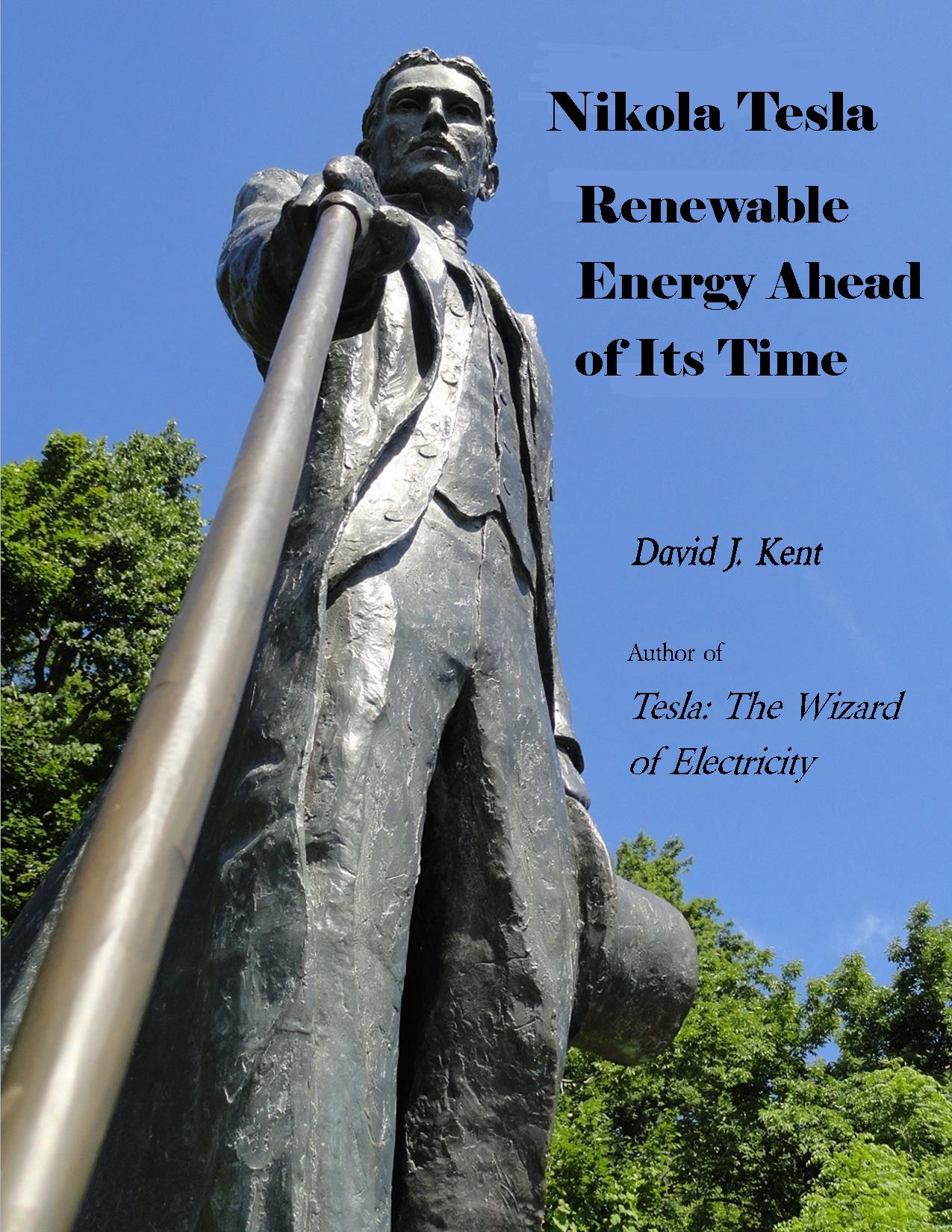
I’m also writing. Tesla: The Wizard of Electricity was back in Barnes and Noble stores mid-summer and was selling faster than it did last year (in fact, sales in the first 6 weeks already nearly matched all last year). To this I added a second book, an e-book exclusive to Amazon called Nikola Tesla: Renewable Energy Ahead of Its Time. More books are in the works, including my opus on Abraham Lincoln’s interest in science. Add in some manuscript editing, magazine articles, newsletter writing, and even some grant requests (plus my blogs, which I’ll reveal more about later), and yes, I’ve been keeping incredibly busy. All in an effort to bring science to the public – to make science fun again.
Finally, as I wind down my final year of the presidential cycle for the regional SETAC Chapter, I begin my first year in a leadership role with the Lincoln Group of the District of Columbia. As the director of outreach and education for LGDC I’m working with an engaged group of Lincoln scholars and aficionados to celebrate the life of Abraham Lincoln and ignite a new generation of interest. His “science geekiness” bridges my lifelong interest in Lincoln with my lifelong career in science. A perfect prelude to my forthcoming book. 🙂
I can confidently acknowledge that it’s a very happy anniversary indeed. The first of many.
Follow me by subscribing by email on the home page. And feel free to “Like” my Facebook author’s page and connect on LinkedIn. Share with your friends using the buttons below.
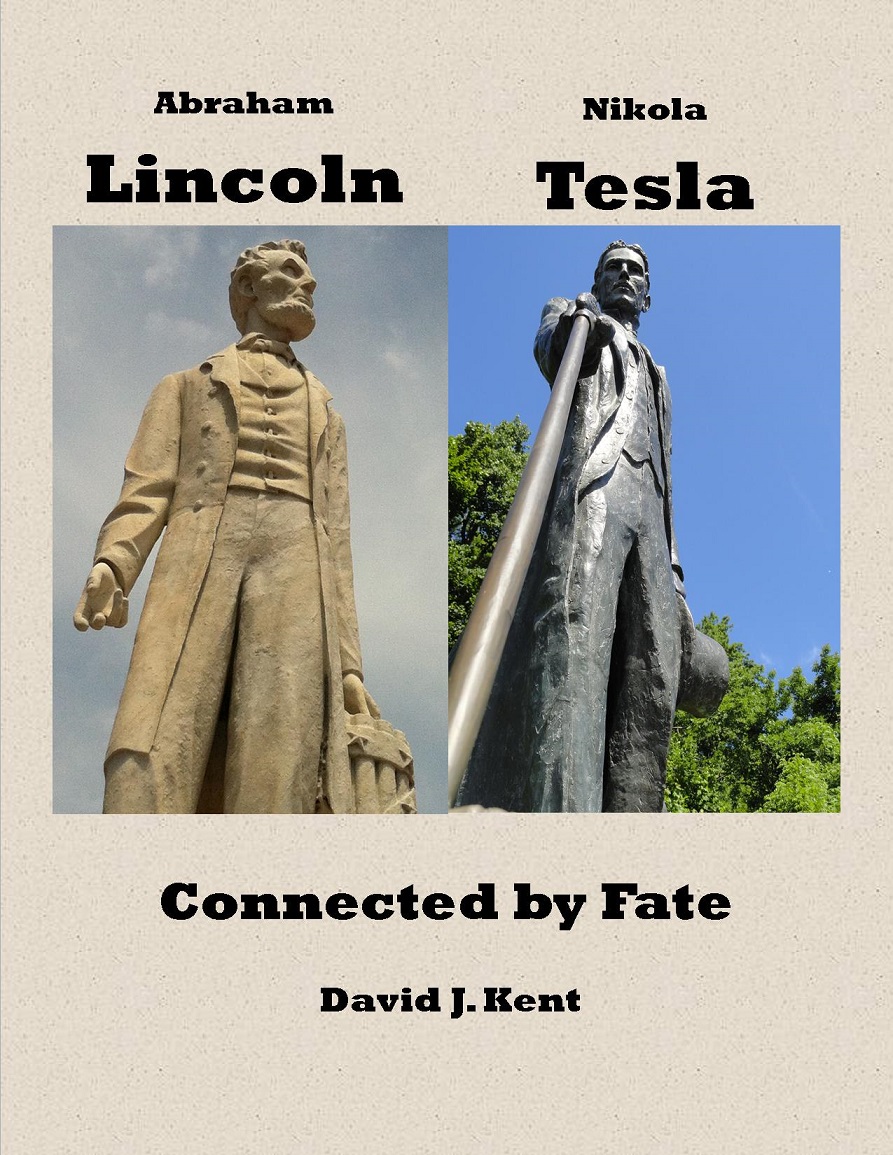
Though Nikola Tesla was born only nine years before the assassination of Abraham Lincoln, and half a world apart, there nevertheless are an uncanny number of connections between the two great men. One of them involves a World’s Fair (two, actually).
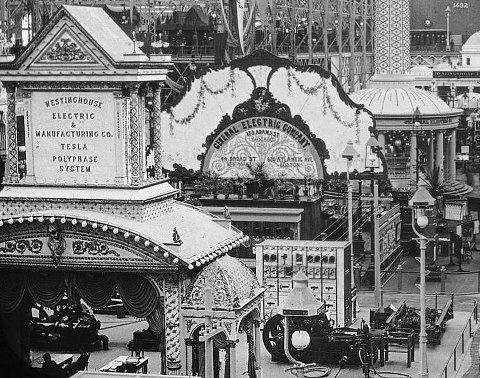
Nikola Tesla’s first big break in the war of the currents with Thomas Edison was at the World’s Columbian Exposition, also known as the Chicago World’s Fair of 1893. Up to this time Edison dominated the growing electricity business with his direct current (DC) systems. But DC had some severe limitations and Tesla favored his own alternating current (AC) system. Edison brutally protected his DC turf with a campaign to discredit AC, even supporting the development of the first electric chair to show how dangerous AC could be.
But Tesla had teamed up with George Westinghouse and the combination of Tesla’s AC system and Westinghouse’s business acumen allowed them to win the bidding to light up the Chicago World’s Fair – the first attempt to electrify at this scale. It was a huge success.
The World’s Fair grounds were designed by some of the greatest architects of the time, including Daniel Burnham and Frederick Law Olmstead. The canals, pools, and massive buildings – the White City – were tremendous, but the centerpiece was a 65-foot tall sculpture called the Statue of the Republic (nicknamed “Big Mary”). With its stone base it stood 111-feet high over the Grand Basin.
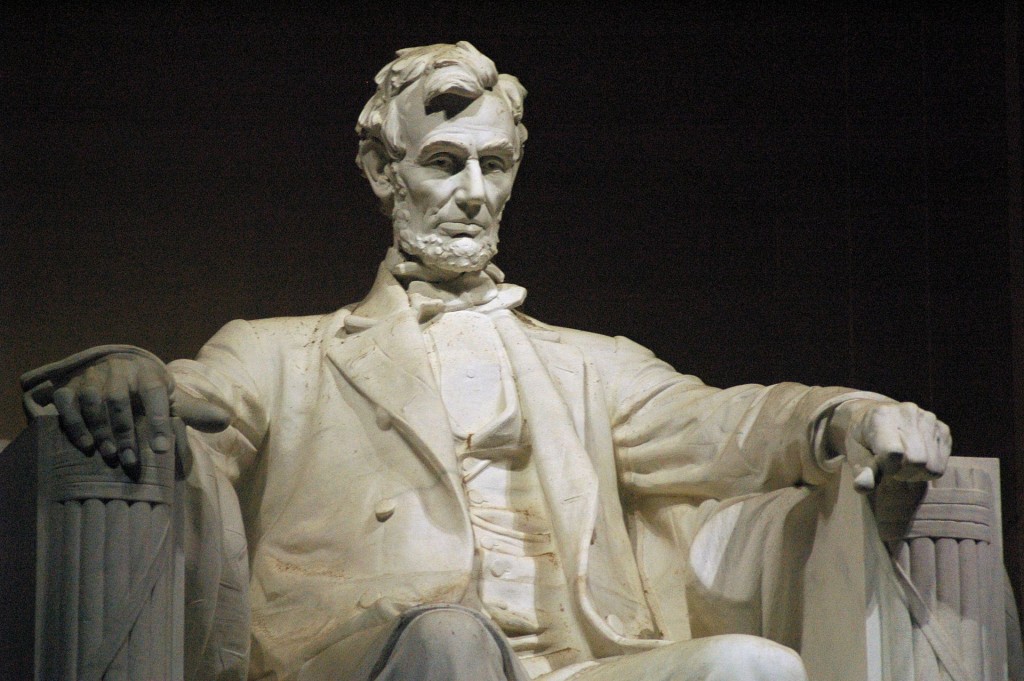
The connection to Abraham Lincoln? Well, “Big Mary” was designed by none other than Daniel Chester French. French, of course, went on to design the seated statue of Abraham Lincoln that dominates the Lincoln Memorial in Washington, D.C. Interestingly, Daniel Burnham, the architect who supervised the design and building of the Chicago World’s Fair and who selected French to design “Big Mary,” was also on the Lincoln Commission tasked with designing a fitting memorial to our 16th President. Burnham strongly lobbied for another architect, Henry Bacon, to build the Lincoln Memorial. In fact, Bacon did design and build the Greek Doric temple that houses French’s famous statue and serves as one of the world’s most visited monuments.
Meanwhile, French’s original Statue of the Republic was destroyed by fire only two years after the fair ended. French was later commissioned to create a smaller version – only 24-feet high and gilded in bronze – for the 25th anniversary of the fair. Appropriately, it now stands on the site of the original World’s Fair Electricity Building, the place where Nikola Tesla first brought alternating current into the modern world.
Oh, there’s another World’s Fair connection between Nikola Tesla and Abraham Lincoln. I’ll talk about that in a later post. 🙂
The world woke up this morning to the news of the untimely death of actor, comedian, and humanitarian Robin Williams. Having been a fan of his since his first appearance as Mork on the sitcom Happy Days, before he spun the character off into his own show Mork and Mindy, his demise comes as a shock. The world mourns.
One of the ways many people are honoring his life’s work is by posting a clip of Williams from the movie Dead Poet’s Society. It features a passage from Walt Whitman’s extended metaphor poem, “O Captain! My Captain!”
It’s a poignant moment in the movie. It’s also a poem Whitman wrote about the death of Abraham Lincoln.
Walt Whitman lived in Washington during the Civil War and often watched President Lincoln ride by horseback, later by carriage, to and from his summer living quarters in the Soldier’s Home (now called the Lincoln Cottage). He admired Lincoln, and after the assassination Whitman composed “O Captain! My Captain!” to mourn the loss of such a great man. According to the Wiki article:
The captain in the poem refers to Abraham Lincoln who is the captain of the ship, representing the United States of America. The first line establishes a happy mood as it addresses the captain. The phrase “our fearful trip is done” is talking about the end of the Civil War. The next line references the ship, America, and how it has “weathered every rack”, meaning America has braved the tough storm of the Civil War, and “the prize we sought”, the end of slavery, “is won”. The following line expresses a mood of jubilation of the Union winning the war as it says “the people all exulting”; however, the next line swiftly shifts the mood when it talks of the grimness of the ship, and the darker side of the war. Many lost their lives in the American Civil War, and although the prize that was sought was won, the hearts still ache amidst the exultation of the people. The repetition of heart in line five calls attention to the poet’s vast grief and heartache because the Captain has bled and lies still, cold, and dead (lines six through eight). This is no doubt referencing the assassination of Abraham Lincoln and Whitman’s sorrow for the death of his idol.
Such a sad, yet exalting, eulogy for the fallen President. And somehow, a fitting elegy for the tormented Robin Williams. Such a trial was his internal life; such a treasure was his gift to all of us.
As Williams’ character in Dead Poet Society puts it, the poem encourages us to think:
That you are here—that life exists, and identity;
That the powerful play goes on, and you will contribute a verse.
This begs the question: “What will your verse be?”
Robin Williams’ verse was cut short. For us the living, our verse is still to be written.
Abraham Lincoln and Charles Darwin were born on the same day, February 12, 1809. Both became icons of change and are will be remembered throughout history for their contributions. The book is subtitled: Shared Visions of Race, Science and Religion. While their views were not so much shared as contrasted, author James Lander deftly flips back and forth between Darwin’s and Lincoln’s lives as they experience their separate travels, coming of age, development of ideas, and eventual breakthroughs into the public eye as they dramatically change history.
While the same age, the two men have very different lives. Lincoln is born poor in the frontier with few resources and little formal education, then takes charge just as the country is rendering itself apart. His travel is entirely domestic, flatboating down the Mississippi River as a young man, traveling the circuit in Illinois as a lawyer, and the northern part of the United States as a legislator and political speaker. Darwin was born into a wealthy family, married into an even wealthier family, received the highest educational opportunities, and after spending five years traveling the world on his famous studies, became sickly and largely reclusive the rest of his life.
Still, Landers points out that while Lincoln is remembered for his fight against slavery, he also had a significant interest in science. Likewise, while Darwin is known for his Origin of Species and contributions to science, he also was an adamant abolitionist and carried on fervid correspondence with American botanist Asa Gray, in which he debated the slavery issue in depth. In fact, Landers brings us into how the academic debate raging over the singularity of man’s creation (vs multiple creation of man) influenced the ongoing discussion of equality of white and black men. “Scientific racism” becomes a common theme as it was espoused both by Lincoln’s main foil, Stephen A. Douglas, and Darwin’s scientific nemesis, Louis Agassiz.
The 26 chapters unevenly look at Lincoln and Darwin as these three main issues – race, science, and religion – pervade each of their lives. Landers does a good job of balancing the discussions of these two men for each of the issues, comparing and contrasting where applicable. Overall, this scholarly work published by the Southern Illinois University Press is well done and deserves more attention than it seems to have received.
El Capitan, Yosemite Falls, Half Dome, Glacier Point. We’ve all heard of the wonders of Yosemite National Park in California, but how many knew that the park was started by Abraham Lincoln? June 30th, 2014 marks the sesquicentennial of Lincoln’s signing of the Yosemite Grant, the law that created what we now affectionately know as Yosemite.
“Not just a great valley, but a shrine to human foresight, the strength of granite, the power of glaciers, the persistence of life, and the tranquility of the High Sierra.” Leave it to the National Park Service to so succinctly capture the beauty of Yosemite. For this privilege we owe our gratitude to the unfortunately forgotten Galen Clark and John Conness, to John Muir, and to Abraham Lincoln for having the foresight to protect natural lands even as the Civil War interminably dragged on for its third year.
Canadian-born Galen Clark had moved to California for the Gold Rush. Unsuccessful in that endeavor and fighting for his life against tuberculosis, Clark spent much of his time roaming in the mountain air. Inspired by, and concerned for, the beauty of the Mariposa Grove of Giant Sequoia trees, he wrote to friends and Congress pleading for their protection. Getting the support of Irish-born Senator John Conness, Clark managed to motivate a Congress interested in strengthening Union connections with the relatively new state of California. President Lincoln, who had by this time already signed laws allowing land grants, homesteads, and the transcontinental railroad, was eager to support westward expansion. On June 30,1864 he signed the Yosemite Grant providing federal protection for Yosemite Valley and the Mariposa Grove, which was quickly ceded over to California and became the first California State Park. Galen Clark became the first “Guardian of the Grant.”
The importance of this act cannot be overstated. For it to have happened at all while the country was in the midst of tearing itself apart is a testament to Lincoln’s and Congress’s foresight. Lincoln’s signature set precedent for establishing Yellowstone as the first National Park in 1872, to be followed by protection for other pristine – and irreplaceable – vistas.
And then there is John Muir. Muir is probably best known for his advocacy of Yosemite and the nearby Hetch Hetchy Valley. Muir’s efforts to save Hetch Hetchy were ultimately unsuccessful, but Muir teamed up with influential Century Magazine editor Robert Underwood Johnson to recapture Yosemite from state park status to federal. On October 1, 1890 Yosemite National Park was created. Johnson also urged Muir to set up a new conservation group to advocate for the preservation of all of the Sierra Nevada mountain region, and in 1892 the Sierra Club was born. [More below the video]
Those who have read my book on Nikola Tesla may recognize the names of Robert Underwood Johnson and John Muir for another reason. Johnson was a big publisher of Tesla’s articles in Century Magazine. Coincidentally, he also published the serialization of John Nicolay and John Hay’s Abraham Lincoln: A History prior to its release in book form. Muir was one of many famous guests that attended Johnson’s gala parties in his New York mansion, and became friends with another frequent guest – Nikola Tesla.
Small world, isn’t it?
Other articles connecting Abraham Lincoln and Nikola Tesla:
Everyone knows Abraham Lincoln, in part because of the diligent work done by his two secretaries – John G. Nicolay and John Hay. But little has been done to illuminate the two men themselves. Zeitz has done us all a favor by accomplishing just that.
Subtitled “John Hay, John Nicolay, and the War for Lincoln’s Image,” Lincoln’s Boys is a history of Lincoln, a history of the times, and a history of Lincoln’s two private secretaries. One quickly comes to realize that “secretary” is a misnomer, as Nicolay and Hay’s responsibilities not only included managing and responding to correspondence, but also trusted diplomats who went on sensitive missions to confer with key generals and politicians across the country. They also controlled access to the President, such as a chief of staff would do today.
The first of five sections looks at Nicolay and Hay’s separate upbringings and how they came to become part of Lincoln’s inner circle after his election in 1860. We get a sense of their differing demeanors as well as Lincoln’s own attitudes toward life and the major issues of the day – slavery and the secession of southern states. Part II largely takes place during the White House years. In Part III we follow the two young men following Lincoln’s assassination as they embark on diplomatic lives in Europe and back home, start families, and come into their own.
In Part IV, Zeitz brings us into the long process of writing the 10-volume history of Lincoln that largely defines these two men. It also defines Lincoln. This is perhaps the most critical part of the book as the author explains how the early biographies of the stricken President either were self-aggrandizing fanciful reinterpretations by those seeking to enhance their own place in history, or were creative reinvention by the South to makes slavery disappear as the cause of war. The long gap between the end of Lincoln’s life and when Nicolay and Hay (and also Herndon) finally produced their biographies left a vacuum that was filled with erroneous “history.” The two secretaries, with Robert Lincoln supporting them, sought to write the definitive history that corrects the record and firmly established the idea of “Our Ideal Hero.” They were uniquely positioned to do that.
While Nicolay largely devoted his later life to Lincoln’s memory, Hay went on to an active political career capped by over seven years as Secretary of State to two presidents (one of whom, William McKinley, was also struck down by an assassin’s bullet). In a superbly written and easily readable book, Zeitz has brought these two under-appreciated men into view and shined the light on them. Lincoln would be happy for them.
On June 28, 2014, the Lincoln Group of the District of Columbia celebrated the 150th anniversary of the saving of Washington during the Civil War. Like Abraham Lincoln, we stood tall at Fort Stevens, though unlike Lincoln, no one shot at us. But first, the Monocacy National Battlefield.
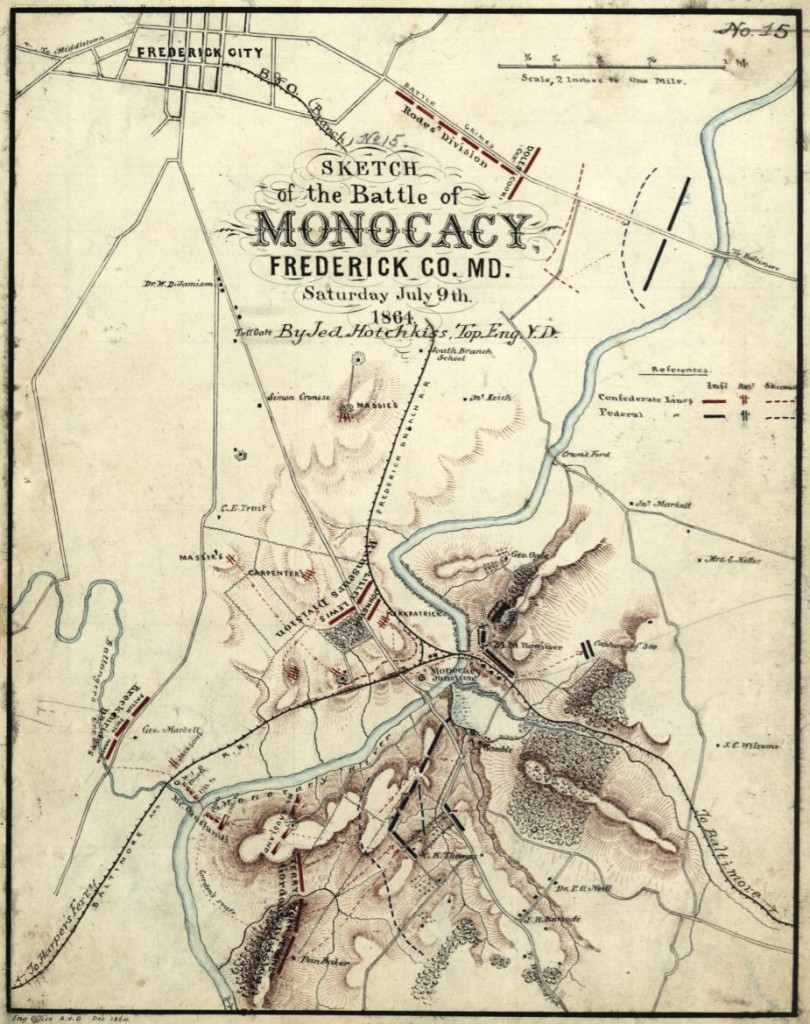
About 30 members of the Lincoln Group left the Grosvenor-Strathmore Metro Station by motor coach and headed for our first stop at the Monocacy battlefield grounds. The battle, which occurred in the summer of 1864, was a strategic gamble by Confederate General Jubal Early to take Washington. On Robert E. Lee’s orders, Early secretly marched his men at a record clip northward in the Shenendoah Valley, across the Potomac into Maryland, and headed for the Union’s capital city. The goal was to cause enough concern in the North to disrupt the upcoming presidential elections, Lee envisioning that the defeat of Abraham Lincoln would help the war end on the South’s terms. All the better if Early could capture the Union capital city and force Lincoln into exile.
First catching on to Early’s ploy was Union General Lew Wallace (later the author of Ben Hur), with some inside intelligence from B&O Railroad President John Garrett. Despite already being chastised by Ulysses S. Grant for his perceived failures of command at Shiloh, Wallace took the initiative to move a cobbled-together group of inexperienced soldiers to meet Early head-on at Monocacy. By the end of the day Wallace’s troops were retreating in defeat, but that day of delay allowed other troops to arrive at Fort Stevens for a final victory, pushing the much larger Confederate army back into Virginia and saving the city.
Craig Howell, the Lincoln Group’s outgoing 1st Vice-President and DC-certified Civil War tour guide, led us across the fields at Monocacy to view the main railroad trunk lines that bracketed the early battle. From there we reboarded the bus to visit two other battlefield locations at the Worthington House and Thomas farm. Craig’s knowledge of the troop movements during the battle, sprinkled with stories of personality conflicts and unending background information, made the tour both entertaining and incredibly informative. After a delightful open-air lunch at the Urbana Park, we were on to Fort Stevens. Located inside the District line from Silver Spring, Maryland (and not far from the modern day horror of the “DC sniper”), Fort Stevens is a series of low dirt mounds lined with Union cannon. Here was not only the repelling of Early’s forces but the site of one of Abraham Lincoln’s most famous incidents.Living not far away at the Soldier’s Home, Lincoln had decided to see the action first hand. Ignoring the risk, Lincoln stood his 6-foot, 4-inch frame (plus tall top hat) on top of the mound to get a view. A medical officer standing beside him was hit with a bullet, after which the infamous (and possibly apocryphal) line was blurted out: “Get down you fool.” Whether it was this or a more respectful imploring for the President to get out of the line of fire we will likely never know, but thankfully he did get down and was unharmed.Our last stop was at Fort DeRussy, another of the small forts that served as a perimeter around Washington DC during the war. Earthenwork like Fort Stevens, DeRussy also boasted a “100-pounder,” a rifled Parrott cannon that could fire accurately for up to 4 miles.Many thanks to Craig Howell for being such a fantastic and knowledgeable tour guide, to Beltway Transportation for the comfortable bus and daring driver, and to Karen Needles, Susan Dennis, and everyone else in the Lincoln Group who arranged the tour. As the saying goes, a great time was had by all.
But wait, there’s more. Check out all the upcoming events of the Lincoln Group of DC as we continue our celebration of Abraham Lincoln in these sesquicentennial years of the Civil War.
It’s been a busy weekend/week/month/year. On this site I write about Nikola Tesla, Abraham Lincoln, Travel, and Aquariums, but I also write on other sites and I’ll be adding more sites shortly. At the same time I’ll be consolidating. Make sense? Keep watching this space for more information.
I’ll be writing more in-depth about these in future posts, but to give you a flavor of what is coming, check out these highlights:
Nikola Tesla: A new book, the reissue of the previous book, and some talks. I mentioned these in a previous post here. I’ll be holding a vote for the final title shortly, and another for the final cover. Sign up for my Facebook author’s page for details on how to get the ebook for free when it comes out.
Abraham Lincoln: This weekend was the first face-to-face meeting of the new officers for the Lincoln Group of DC (LGDC). As part of my new outreach and education duties we’ve set up LGDC pages on Facebook, LinkedIn, and Twitter. I’ll have a post on these shortly. We also have a gazillion (more or less) events scheduled for the near future. Check out the LGDC website for more information.
Travel: I’m way behind on planning the trip to Scandinavia, but the goal is to go to Norway, Sweden, and Denmark. Trips to Mt. Rushmore and Chicago/Springfield are also in the works (and also way behind schedule in planning). Before that I’ll be up in New England to visit the family and give a talk about Tesla at the Ipswich Museum.
Aquariums: So many more aquariums to write about. I have two more on my list to visit while in the Scandinavian countries noted above.
Writing: I’ve recently started free writing, that is, writing in response to prompts, contests, and for future use in memoir/fiction books. I recently submitted short pieces to two contests – one a science fiction article and the other a short memoir. To accommodate the free writing, as well as the diverse writing on Lincoln, Tesla, science, and other topics, I’ll be setting up separate blogs that will then be cross-posted back here.
There is much more going on as well. I’m being considered for a major award related to my work with the regional chapter of SETAC. A possible on-air segment on the History Channel is in discussions, as is a profile in a book about Tesla’s People (people building a curriculum about Nikola Tesla). Works in progress include the Abraham Lincoln book I’ve discussed previously plus a travel photo book and, of course, the soon to be released Tesla and Renewable energy ebook.
Add in a few major life events, some introspection, and the vagaries of nature, and there will be tons to talk about. One thing I have planned is a revamping of this website to highlight my multiple books and other writing; more informational articles on Tesla, Lincoln, science, and travel; and a new newsletter for my updated mailing list.
I have a lot of Abraham Lincoln books. Too many for my shelves, it seems. While I read a dozen (or two) books about our 16th President every year, the fact remains that my collection outpaces my available time. Still, it remains a joy.
I’ve previously listed the Lincoln books I acquired in 2013. In this post I’ll list the books I’ve acquired in the first half of this year. And yes, I know that June still has a couple of weeks to go, but I’ve put myself on a moratorium (of sorts), at least until the end of the month. Check out the list below.


 Abraham Lincoln is the only president to ever get a patent, an ingenious, though impractical, method for lifting boats over shoals. This interest in technology served him well during the Civil War as battles increasingly relied on mechanization for transportation, communication, and weaponry.
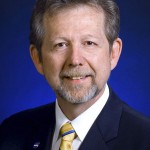 Abraham Lincoln’s Air Force – Balloons in the Civil War: A discussion with James L. Green, a Director of Planetary Science with NASA and a worldwide expert on Thaddeus Lowe and the use of gas-filled balloons during the early part of the war. Green is working on a new book on the topic and was gracious enough to host me for a lunch discussion.
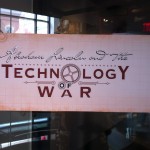 Abraham Lincoln and the Technology of War: A recent exhibit held in the Ford’s Theatre Center for Education and Leadership displayed telegraphs, weapons, and other artifacts reflecting various forms of technology that helped the North win the war.
 One year ago today I left behind the first half of my life. After more than 30 years as a working scientist I had decided to give up a comfortable salary for a life of (essentially) no income. I would become a poor starving writer.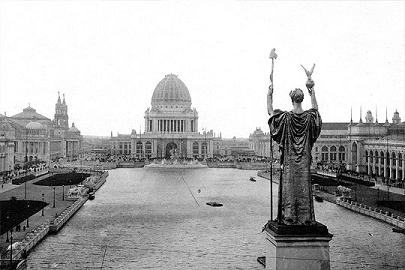
 The world woke up this morning to the news of the untimely death of actor, comedian, and humanitarian Robin Williams. Having been a fan of his since his first appearance as Mork on the sitcom Happy Days, before he spun the character off into his own show Mork and Mindy, his demise comes as a shock. The world mourns.
 Abraham Lincoln and Charles Darwin were born on the same day, February 12, 1809. Both became icons of change and are will be remembered throughout history for their contributions. The book is subtitled: Shared Visions of Race, Science and Religion. While their views were not so much shared as contrasted, author James Lander deftly flips back and forth between Darwin’s and Lincoln’s lives as they experience their separate travels, coming of age, development of ideas, and eventual breakthroughs into the public eye as they dramatically change history.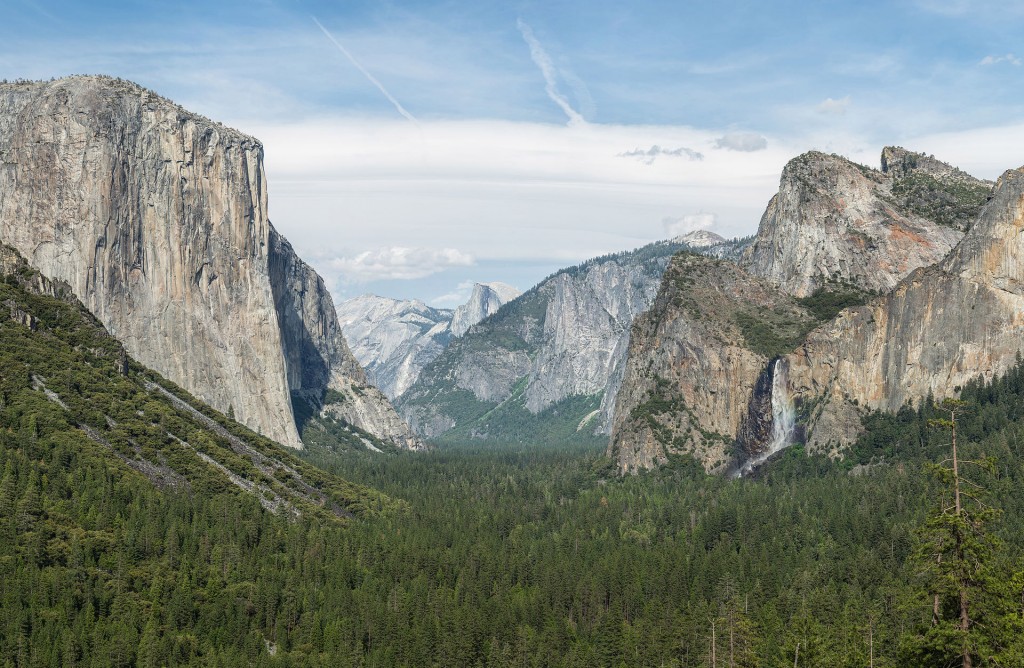
 Everyone knows Abraham Lincoln, in part because of the diligent work done by his two secretaries – John G. Nicolay and John Hay. But little has been done to illuminate the two men themselves. Zeitz has done us all a favor by accomplishing just that.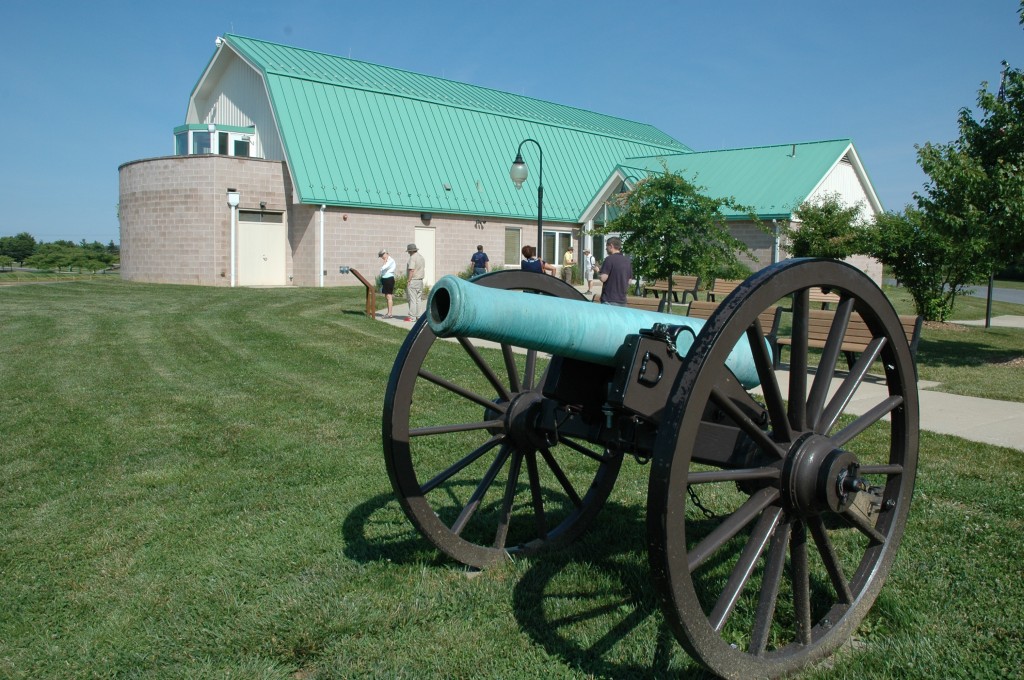

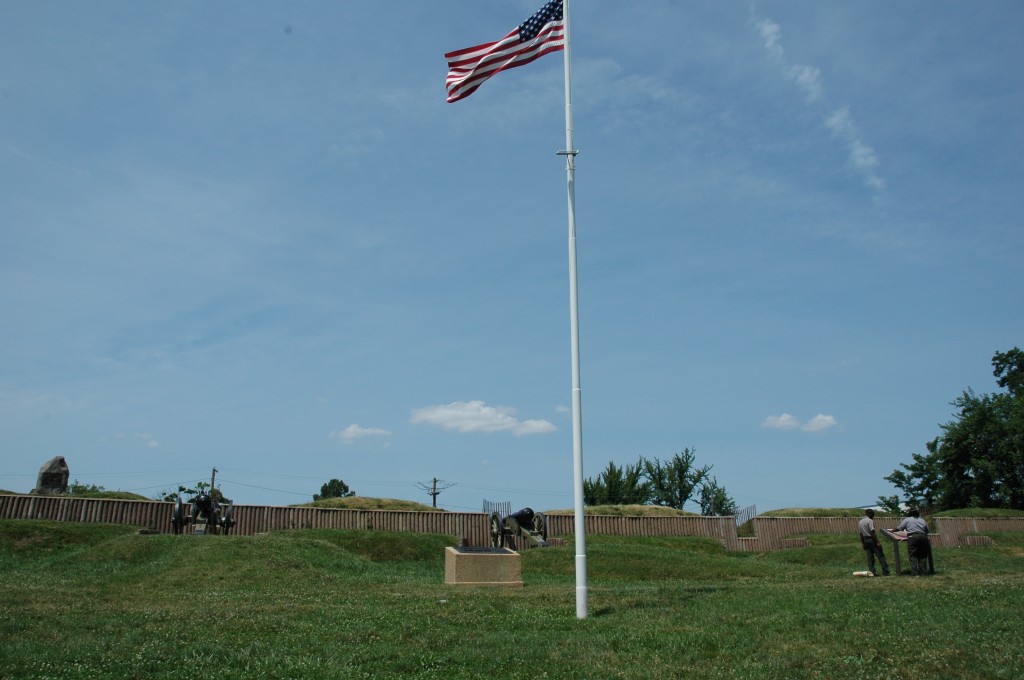 After a delightful open-air lunch at the Urbana Park, we were on to Fort Stevens. Located inside the District line from Silver Spring, Maryland (and not far from the modern day horror of the “DC sniper”), Fort Stevens is a series of low dirt mounds lined with Union cannon. Here was not only the repelling of Early’s forces but the site of one of Abraham Lincoln’s most famous incidents.
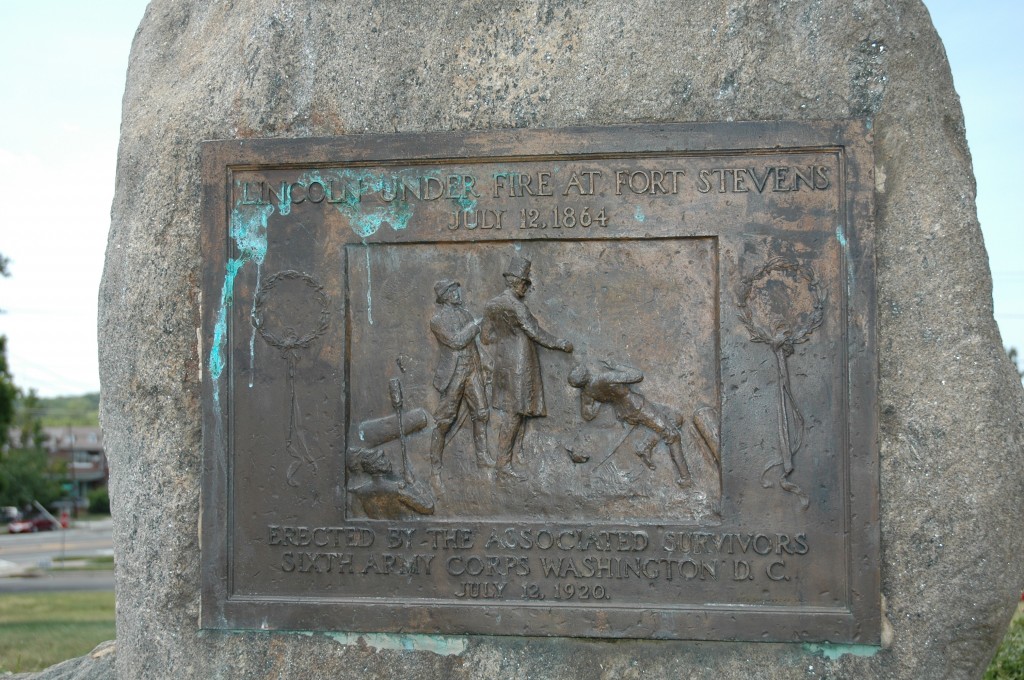 Living not far away at the Soldier’s Home, Lincoln had decided to see the action first hand. Ignoring the risk, Lincoln stood his 6-foot, 4-inch frame (plus tall top hat) on top of the mound to get a view. A medical officer standing beside him was hit with a bullet, after which the infamous (and possibly apocryphal) line was blurted out: “Get down you fool.” Whether it was this or a more respectful imploring for the President to get out of the line of fire we will likely never know, but thankfully he did get down and was unharmed.
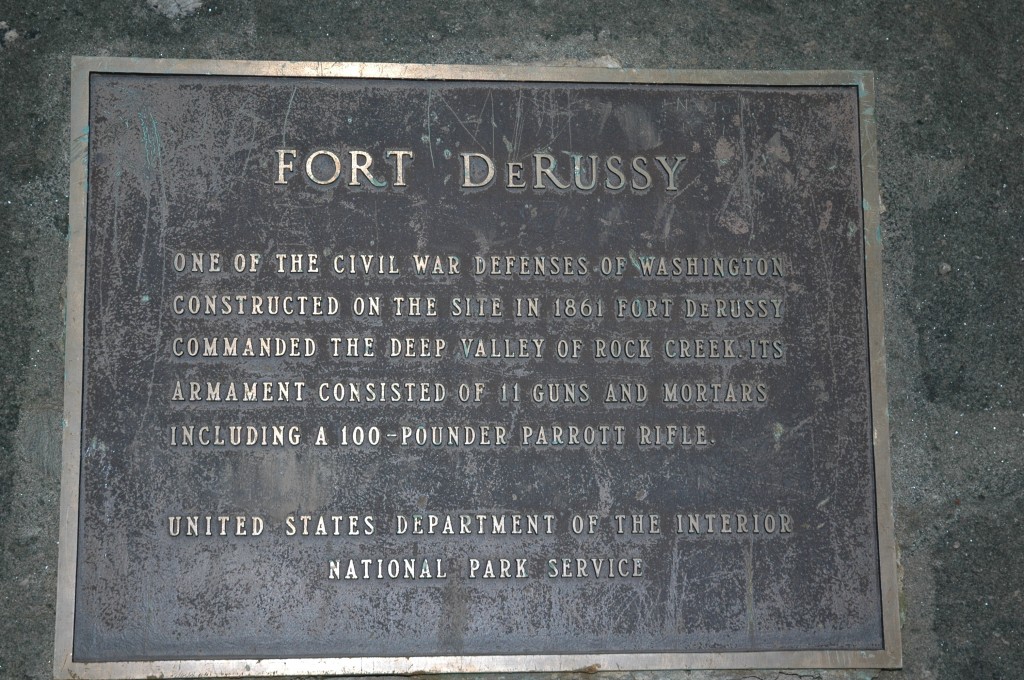 Our last stop was at Fort DeRussy, another of the small forts that served as a perimeter around Washington DC during the war. Earthenwork like Fort Stevens, DeRussy also boasted a “100-pounder,” a rifled Parrott cannon that could fire accurately for up to 4 miles.Many thanks to Craig Howell for being such a fantastic and knowledgeable tour guide, to Beltway Transportation for the comfortable bus and daring driver, and to Karen Needles, Susan Dennis, and everyone else in the Lincoln Group who arranged the tour. As the saying goes, a great time was had by all.
 It’s been a busy weekend/week/month/year. On this site I write about Nikola Tesla, Abraham Lincoln, Travel, and Aquariums, but I also write on other sites and I’ll be adding more sites shortly. At the same time I’ll be consolidating. Make sense? Keep watching this space for more information.
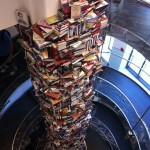 I have a lot of